Saturday, July 26, 2008

Go Chic At Formoz Festival

Anyone heard of Go Chic?

I saw this 5-girl, Taiwanese disco-punk group at the Formoz Festival in Taipei, and was quite blown away.

They're like Japan's Perfume, but in another life, gone bad—kicked out of talent training school after getting caught smoking, or staying over at the boy friend's house, or sniffing thinner, they decide to form a punk band instead. In Taiwan. And they recruit two more girls.

All the heat and sweating might be what caused this murky fantasy to pop into my head, but they WERE all dressed in different-colored plastic cocktail dresses, outfits that Perfume might conceivably be seen in, and from far away from the stage where I stood, Go Chic's vocalist looked vaguely like Nocchi and the synth player like A-chan.

Except this Nocchi lowered her pink dress to reveal the black bra underneath, and danced that way for the rest of the show... OK, they have more in common with wild-girl vocalist Japanese punk groups like Limited Express or Midori, and I was a bit surprised to see something like that in Taiwan; while I know almost nothing about the music scene here, the groups I have seen up to now have mostly seemed earnest and understated, and not at all in-your-face like Midori. I also read here that another Taiwanese group, White Eyes, is the same sort of deal, and I was sad to find out that I missed them when they played earlier in the day...

Go Chic call themselves an electronica/hyphy/psychedic group, but there were also early punk, new wave, slow hard rock, funk and synth/disco sounds at the Formoz show. During the faster numbers the crowd in the front pogo-ed and slam-danced, while the Go Chic girls splashed beer on them and the black-bra vocalist kicked stage divers back into the pit... What would have the planners of Formoz's venue, a park with exhibits aimed at teaching kids Chinese and Confucian values, have thought if they'd seen this debaucherous spectacle on the premises??

***

P.S., I love how Go Chic say in their MySpace page: “BTW: it's go "sheeeeekkkkk" not chick, duh!”

Tuesday, July 22, 2008

Japan Live TOKYO LIVE HOUSE GUIDE

You're going to a music show in Tokyo. You wonder what the venue is like. You've come to the right place.

This post is about Tokyo's music clubs, which are called live houses. There's an incredible number of them—everything from huge venues that house thousands of people, to two speaker holes-in-the-wall. They are mainly located in the big shopping districts—Shibuya, Shinjuku and Shimokitazawa—but some are in quieter areas too. This post lists the main live houses, and the interesting smaller clubs and cafes. It's not a complete listing; some places I've neglected to mention because I forgot to, or didn't know the place, or didn't like it. Let me know if you think I should add any clubs.

NOTE: Directions to these clubs can be found in Tokyo Gig Guide. Tokyo Damage Report also has a list of punk clubs and other weird venues. I also wrote in the past about how to go to these clubs.

SHIBUYA

O-Nest: The O-Nest is probably Tokyo's most exciting live house now. It's a small venue that attracts artists that are innovative and accessible but haven't hit the big time yet (Spangle call Lilli line would be one example). O-Nest is also well designed: it has separate stage and bar floors connected by a stairwell overlooking Shibuya's love hotels, and it's one of the few live houses that lets you leave the club and re-enter it later. But though it's a good club I've found one strange thing about the O-Nest, which is it seems to have a high incidence of shows that look good on paper that end up being duds. I've probably left in the middle of more gigs here than anywhere else. Maybe that's a result of their hosting many new bands whose skills haven't caught up to their novelty and the hype surrounding them.

Quattro: I dislike the Quattro. But I have to go there once in a while because some musicians only play there. It's a Soulless Corporate Live House (SCLH). The sound and light systems are outstanding. But everything else is mediocre: the venue has no atmosphere; the staff are apathetic or worse; and the 'one drink' that you have to pay 500 yen for is about the size of free booze samples they hand out in department stores.

La Mama: I've only been here once or twice, but it's a decent live house with an easy-to-see, wide stage.

Eggman: Similar to La Mama. It's one of Shibuya's older live houses, and I think it's seen better days.

O-East & O-West: Sister live houses of the O-Nest, these two are for bigger acts, and they're both Soulless Corporate Live Houses (SCLH's), like the Quattro.

O-Crest: Size-wise it's between O-Nest and the two big O's, it's also basically a mini-SCLH.

Ax Shibuya: One of Tokyo's biggest live houses, it's a SCLH. But you gotta go there to see acts like Perfume.

Deseo: Next to the Yamanote train tracks, this is a live house for bands that are starting out. It's a Dive House—a live house that's a dive.

Yaneura Shibuya: This place has been around for ages, and it's the definition of a Dive House: witness within its walls the unending struggle between unruly, inebriated youth and surly staff.

Cyclone: Sister live house of Yaneura, it's also a true Dive House. My friend Dr. I once said this is a club for juvenile delinquents.

Chelsea Hotel: A relatively new live house, it looks like a lobby of a cheap hotel(in line with its name?), and attracts decent bands.

Aoiheya (blue room): This is a fun live house run by a chanson singer, and is designed according to her tastes (vines handing from the live stage ceiling, etc.).

Lush: A very hard to find live house, Lush hosts decent bands.

Tube: In a small alley near Tower Records, this a small but pleasant and well-designed space.


SHIMOKITAZAWA

Que: Sometimes called one of the three great live houses of Shimokitazawa, along with the Shelter and Club 251, the Que is THE club for guitar pop, power pop and all manners of melodic, not-so-hard rock. It's the home turf of groups like advantage Lucy. The Que is also one of the few smaller live houses that don't force ticket sale quotas upon performers, and its events are generally of high quality. In spite of its prestige, though, the club is small, with only one main room, and can get very cramped at sold-out shows.

Shelter: Just down the street from the Que, the Shelter is the place for hard rock and smarter punk. It's a Dive Bar, but in a good way—they host rockin' bands, and the fans are into the shows.

Club 251: About midway in musical taste between the Que and Shelter. It's probably also fair to say that of the top-3 Shimokitazawa live houses, it's number three.

440: Right above 251, and run by the same people, this is a cafe club with chairs for the audience. The acts are generally mellow, with a lot of acoustic sets, and post-Shibuya-kei groups often play here. If watching a show here, make sure you aren't late, because then you will have to stand and there isn't that much space...

Basement Bar: This club is nearly impossible to find, hidden behind the beer cartons of a liquor store off of the main Shimokitazawa drag. It's a small live house that hosts decent events.

Mosaic: A fairly new live house, Mosaic is good because it has a bar on one floor and the live stage under it, letting you escape for a drink if an act is bad.

Mona Records: Like 440, this is a cafe club, but one with more character: the space is designed to look like a living room, and the area where musicians play is a raised floor where audience members take off their shoes and sit on the floor like in a traditional Japanese home (even the musicians play shoeless!). The bands featured at this club are pop, jazz, acoustic and mellow, mellow, mellow. Mona Records also sells CDs, has its own small label, and hosts small art exhibits—it's one of the more interesting clubs in Tokyo.

Garage: On the other side of the tracks from the Shimokitazawa Big-3, the Garage seems to mainly feature genki, straightforward youth rock groups. It's a small venue, and being right in the middle of a true residential area, the staff will, with fervor, chase you away from the premises as soon as shows end.

SHINJUKU

Loft: The Loft isn't Tokyo's biggest live house, but it is certainly its most legend-filled: having opened in 1976, the club has over the years featured some of Japan's most popular acts such as Southern All Stars, Boowy and Judy and Mary. The events held here are still of generally high quality. The Loft moved to Kabukicho from Nishi-Shinjuku in 1999—the live house now is a comfortable space with separate stage and bar floors, but be sure you don't get lost in the building that houses the Loft, because most of the other establishments in the building look pretty questionable...

Marz/Motion/Marble: All on the same block near the Loft, these three live houses are run by the same people, and sometimes events are held at a number of these clubs at once, letting you go from one to the other (and allowing you to get food and cheaper drinks at convenience stores en route, if you desire). Marz is a sparkling new club with a fancy light system. Motion is a small live house suited for minor indie bands. Marble, I haven't been to.

Jam: Shinjuku Jam is another of the older Shinjuku live houses, but, while its rival, the Loft, has turned into a Big Deal, the Jam remains a Dive House, a live house that is also a dive. Still, some people like the Jam for that, and it certainly has character. I've heard that the Jam is haunted.

Red Cloth: A fairly new live house, the Red Cloth is an attractive, small venue that's decorated in a vaguely Chinese fashion. From my experience the staff is generally friendly, and the indie events held here are often good.

ACB Hall: A total dive house, for punk kids.

YOYOGI

Zher The Zoo: Run by the same people as the Que in Shimokitazawa, Zher The Zoo features bands that are very similar to those at the Que (Luminous Orange played here, for example). And no, I don't know what the name means.

KOENJI

Club Liner: Managed by a member of the comic punk group Telstar, Club Liner is a small club that brings in a lot of decent indie groups, many of them probably the Telstar guy's pals. Club Liner is also one of the first live houses, as far as I know, that divided its space into smoking and non-smoking sections (cigarette-smelling clothes and stinging eyes are constant occupational hazards for Tokyo club-goers).

Club Roots: This is a tiny club in an interesting building with an Okinawan theme, including an Okinawan restaurant and a culture center. Roots also serves awamori and a limited number of Okinawan fast food.

20000V: This is a Dive House (a live house that's also a dive), but one of those that's hard to dislike if you have a taste for dives.

Los Angeles Club: Went here a long time ago, don't remember what it's like, but am pretty sure it was a Dive House.

Enban: This is supposed to be a record store/cafe, but it's not clear whether it actually exists. I once passed by the place it's supposed to be, but didn't see anything except a window, from which some sketchy looking characters stared down at me. It could be that the Koenji guys are just putting me on, and this club is fictional—you have to watch out for Koenji people...they are sometimes of somewhat suspicious character...

SANGENJYAYA

Heaven's Door: In the middle of a peaceful local shopping district with little stores and eateries is this home of tattooed, body-pierced head-bangers and punkers of all stripes. Heaven's Door is the epitome of a Dive House (a live house that's also a dive), but one that you are sort of glad exists, in the same way that you appreciate there being brutal carnivores in the great outdoors, in addition to gentle creatures such as sheep, deer, zebras, etc.

Grapefruit Moon: If you're headed to this lovely cafe and are starting to worry whether the directions are wrong—could a music club really be in a little street like this with vegetable and fruit shops and fish sellers?—don't fret, and keep on going, because you're almost there. Right next to a bathhouse, Grapefruit Moon often features laid-back indie pop bands.

AKIHABARA

Goodman: Goodman is the place to go for prog, post-punk, smart indie-type bands. There seems to be a lot of affinity between the Goodman crowd and Koenji folks—maybe because it's connected by the Sobu line?

KICHIJOJI

Star Pine's Cafe: Not much to say about Star Pine's Cafe except that it's a nice-looking, two-storied club.

Mandala 2: A cafe bar that's pretty characterless. Good indie bands sometimes play here, however.

DAIKANYAMA

Unit: I've never been here, and hope I don't ever have to, because the place exudes bad vibes: unsmiling staff who appear authoritarian in the way they make show-goers line up before shows, and so on. It's too bad because this club attracts a lot of fashionable, post-Shibuya-kei-type groups that look interesting. I imagine that the Unit is basically a SCLH (Soulless Corporate Live House).

HARAJUKU

Astro Hall: Not a big fan of this place...not sure what the management here wants to accomplish except to squeeze money out of young people there to see trendy bands. It's a mini-SCLH (Soulless Corporate Live House).

EBISU

Liquid Room: This big club used to be in Shinjuku in a scary building whose floor would bounce up and down with the crowd as they bopped to the music...The Liquid Room is now in a bright and shiny new building near the station, but it's a true SCLH (Soulless Corporate Live House)—I once saw a security guard stop someone from passing out live show fliers TWO BLOCKS from the club, after a show. What sort of authoritarianism IS that?? Still, a visit to the Liquid Room is inevitable once in a while, because they host a lot of great Japanese and foreign artists...

Guilty: I went here ages ago to see Fugazi, and don't remember a thing about it. A big regret in my life is that I saw Joe Lally at the Freshness Burger near the Guilty but didn't say hi to him.

Saturday, July 12, 2008

GREAT SONGS: Chara's "Time Machine"


Will Chara ever again write a song as good as “Time Machine”?

Having casually followed her career in the years since the song came out, I have to say I'm not hopeful. But, then again, “Time Machine” is one of the best Japanese pop tunes of the late-90's, so wishing for a repeat performance may be asking too much of her.

At the start I should note that Chara is not by any stretch of the imagination an 'indie' musician, the focus of these pages: she has recorded with Sony since the start of her career, and the album containing “Time Machine”, Junior Sweet, was a million seller. But she's so influential, even among independent musicians—along with Shiina Ringo and Yuki, she must be one of the J-pop trinity of inspirational female singers—that it doesn't feel strange to write about her in an indie context.

The reason for Chara's influence is her unique, unmistakable, strange yet beautiful singing style. In “Time Machine”, we get a full serving of it. I remember when I first listened to her, I was skeptical but fascinated. Chara sounds like no other, a grown-up singing in a whispery, whining voice that resembles a young girl's, but with the maturity always apparent in the background. It seems like a highly intuitive singing style, sounding that way because she thinks it's good that way, and not because she's following any rules.

Listen to the way she starts “Time Machine”, alternating between hopeful high notes and quieter, low notes, like a sigh: to me, she seems to be painting a musical portrait in white and black. It's a broken heart song: she's talking about feeling betrayed by false promises of unchanging love, and that a time machine to return to the former good days isn't showing up. Except, it's ambiguous as to whether the lover has really disappeared from the singer's life; she sings about holding a needle and thread that could tie them back together, and ends the tune with a line that what's needed is for 'you' to feel love again.

I don't like the video of this song much, though it's good it's on YouTube so people can listen to the tune. Like most videos of songs you listened to a lot before seeing the video, the image just seems wrong. Its premise is that Chara is looking back in sadness to the happy days she spent together with actor Tadanobu Asano, her husband in real life. The problem is that the scenes showing Chara and Asano flirting around leave a much stronger impression than the scenes of her sad introspection, so the video ends up seeming to be a celebration of their relationship. And, of course, most Chara fans know she's happily married to Asano, so the sad parts aren't believable.

My image of this song is less star-studded—it's about an average girl in some random Japanese town, thinking back in her room on better days. Well, OK, that probably wouldn't provide much material for a video...but to me, that's the right image. I almost wish that a person listening to “Time Machine” for the first time on YouTube just listen to the words and not watch the images...

One last thing: the other day I was watching NHK and an old video of Chara playing “Time Machine” in an acoustic set came on. I was pleased, but the (non-Japanese) guys around me groaned, saying here's another example of terrible J-pop, etc. Which is totally erroneous, but it did remind me that Chara and others like her might be an acquired taste.

Saturday, June 28, 2008

Texas Pandaa At Basement Bar

I went to the Basement Bar see Texas Pandaa, whose latest album was one of my top-ten favorites of 2007. The members of this band have a way of swaying their upper bodies with their feet in place that gave me visions of seaweed drifting underwater. Combined with the stage lights in blue and green, and the faraway, murky feel of the music, the image was of hanging out in the marine kingdom. People call Texas Pandaa a shoegazer band, but I felt a more accurate description would be sun-gazer, that is, from the bottom of the ocean. This band features two female singers, who stand on the left and right and sing seductively like a couple of Sirens...Anyway, enough with all the marine metaphors, what I'm trying to say is this is a marvelous live group whose shows have their own distinct feel (and I believe that one of the members is a reader—hi!).

Also performing was another band I like, 4 Bonjour's Parties, who are headed to Taipei in late-July to play at the Formoz festival.

Saturday, June 21, 2008

In Asakusa

I'm writing an essay for a band (more on that some other day), and have been doing research on the town of Asakusa as part of that effort. A book I found by the actor and essayist Shoichi Ozawa has been very useful. The thing about Asakusa is that there are lots of interesting things away from the main tourist strip, but you have to know what you're looking for, and this book highlights them.

For example, I found out reading Ozawa's book about a bodhisattva statue called Ichiyou Kannon, standing lonesome in an empty lot behind Sensouji temple. A woman working in nearby Yoshiwara had sent her young son off to work (a common thing in the Edo era), but one day she hears her son's voice say “I've come home”, and soon after she receives the sad news that the son has drowned. In her sorrow she has a kannon sculpted to look like her son—and it still stands, alone, behind the big temple.

Right next to the Ichiyou Kannon is the Asakusa Shrine, which gets less notice than Sensouji because it's smaller and less imposing, but the shrine building is an Important Cultural Property and is quite beautiful—on the facade are pictures of dragons, including one that looks like like a cross between a fly and a dragon, and the interior of the shrine is guarded by two samurai dolls. It's at this shrine that I took the picture of a carefree cat above, napping at the legs of a stone lion.

One interesting thing about Japan is that temples and shrines and red-light districts often lie side by side, and that's the case with Asakusa. In the early-post-war years the area was famous for its striptease theaters, and I had thought that scene had died out, but it looks like some places are still going strong in the Rokku neighborhood a short walk away, along with movie theaters that show both classic yakuza movies and porn (and the neighboring town of Yoshiwara is a whole different matter...). There are also rakugo and popular theaters, the latter of which seem to put on light samurai plays.


Outside a 'Popular Theater'

By the way, to get my music fix while in Asakusa I always head to Oto No Yorodo, a record shop just down the street from Kaminari-mon that has an amazing collection of enka, rakugo, retro Japanese music and all sorts of other CDs and tapes you can't find elsewhere.


An Enka Record Shop

Tokyo is such a huge city that the Tokyo of Asakusa is really quite a different entity from, say, the Tokyo of Shibuya, not to mention Oku-Tama or Koenji or Roppongi. And like any big city Tokyo is a constantly evolving organism, so I don't think anyone can ever truly be a 'Tokyo expert', just like you can't really be an NYC expert or Paris expert, and the best you can do is know one area like Shinjuku or Asakusa or Kichijoji inside out.

Thursday, June 12, 2008

Vasallo Crab 75 & Our Pathetic Generation


Talkin' 'bout my ge-ne-ration...

“Our generation sucks musically,” said Vasallo Crab 75's singer at this band's after-show party.

“It's because we grew up listening to punk and grunge. Playing an instrument well was actually uncool. So, now, kids in the next generation play better than we do.”

There was probably something to what he said. The generation in question, commonly tagged with the letter X (and whose ranks include myself...), didn't, for the most part, put much effort into developing musical virtuosity. We were reacting to the excesses of corporate-tainted progressive rock, we told ourselves. We were making music freer, so that anyone can play and express his emotions, was the standard line. And we still don't judge musicians based solely on their skills. Some of us might also be fashion-challenged as a result of our punk/grunge days because T-shirts and ripped jeans were cool and were the uniform, and they still seem good to us.

But...you have to watch out for the pitfall of Japanese modesty, and not take seriously everything people say. Maybe at the start of their career the musicians of Vasallo Crab 75 weren't all that hot, but now, they're solidly in the Talented Musicians camp.

And so are the other Gen X, thirty-something bands that VC75 invited for the gig: Gomes The Hitman's Toshiaki Yamada with his amazing voice, like some bronze-colored art piece you want framed; pop trio Swinging Popsicle dashing through their classics without a single misstep, while having a blast; and Vasallo Crab, that once-mellow guitar pop duo that's turned into a pimp-suited, Prince funk-imitating, Bach violin solo-ripping, ultra-tight, mini-rock chamber orchestra—they really put on a show. You forget the day's travails. Gradually they're replacing their former, mild-mannered guitar pop fan base with hyper, dance-prone club supporters, who are great company.


Swinging Popsicle

Seeing bands like this makes me think that buzz isn't that important. There's always buzz about the latest hot new bands in town, but they often disappoint. The trend-zoids might not be talking about VC75, but that doesn't matter at all when you see how good they are after so many years of playing live, during which they developed confidence and stage presence. And while us lazy generation X MoFo's might still suck at our musical instruments, these bands sure don't. In fact, they're the best.

Thursday, June 05, 2008

Risette & Advantage Lucy At Red Cloth

My interest in a band called Risette shot up when advantage Lucy's Aiko, performing before them, said Risette's vocalist was her favorite Japanese female singer, and she sometimes wished she could replace her vocal cords like a cartridge and stick in the Risette vocalist's instead.

Having listened to Risette for the first time, I'd say that the Risette Vocalist cartridge was one that produced a sound that was soft, and a strange blend of high and husky voices. The vocalist sings like she's constantly pleasantly surprised by the voice that just came out of her throat. You could see how another singer might want to activate it the way a guitarist steps on an effect pedal.

The vocalist, Yu Tokiwa, stood mostly still during songs, switching between staring straight ahead and looking down at something a couple of steps away from her left foot. But she seemed to be able to express a lot just with the swing of her chin and the shift of her gaze. Risette also featured two skilled guitarists who built on each others' solos (I was reminded of Television), an interesting counterpoint to Tokiwa's laid-back singing style. I enjoyed the show and could see how this band might inspire, as I heard, a manic Japanese indie music fan from Taiwan to make the band name his alias, because he loves them so much.

Risette was playing at the Red Cloth at a show to celebrate the release of their new album, Risette. They've been around for more than a decade, and I heard that some of their earlier, out-of-print albums are quoted at exorbitant prices on Japanese auction sites.

***

Advantage Lucy, playing before Risette, appeared as a duo—just Aiko and Yoshiharu Ishizaka. That was the first time I'd seen only the two of them, the core of the great band, performing live, and the gig was beautiful in an intense, lonely, nervous way. Ishizaka said the show made them feel naked, with nothing to hide the sound of voice and a solo guitar, but it distilled the essence of advantage Lucy, which, to me, is a band that has always exposed itself through music, its emotions and passions, even though it's at the same time such a deliciously pleasant pop group.


Saturday, May 31, 2008

advantage Lucy's Shiroi Asa E.P.

Their long-awaited new work, the EP “Shiroi Asa” (White Morning), shows off advantage Lucy's musical range. The EP features a ballad, a fun pop tune, and a rocker—each sounds great, and even though the songs are so different in feel, they blend together perfectly like some three-Michelin-star three course dinner.

The first song, the title track, follows a long line of standout ballads by advantage Lucy. What's especially striking about it is the way vocalist Aiko stretches out the syllables of the words—the start of the tune sounds like “iiiiii, tsumooooo, omoooote taaa (always, I thought)” —and with these extensions she seems to infuse the lyrics with more meaning, at the same time that she puts on display the clear beauty of her voice.

Song number two, “my little holiday”, is advantage Lucy's “Penny Lane”: a sunny pop song that celebrates a town, in this case the “500-meter radius” surrounding the singer's home, the site of her mini-vacation. It begins with sounds from one of those Tokyo streets filled with little, aging shops, and Aiko's voice is heard ordering a hamachi, yellowtail, from a shopkeeper lady. Guitarist Yoshiharu Ishizaka, who composes the songs, obviously had fun with this tune: it's a colorful melange of sounds, including some sort of xylophone and recorder, as well as a cat's purr and a parakeet's screech.

“Mimi wo sumasete”, the last song, is a rocking number that you might hear on the radio in an alternative universe world where good songs fill the radio waves. In any case, it is on MY radio station.

At the same time that advantage Lucy is a great musical group, they're also an art-minded bunch, as is apparent looking at this CD's booklet: it's made of a special type of paper that lets you punch out little letters, and those letter shine when you put it up against a light.

Advantage Lucy is selling this extended play CD only at shows and from its website, and it's a limited edition of 1,000 disks. I'm not sure how you can buy it if you're outside of Japan, but am looking into it.

***

Traveling back in time a bit, the show where I bought the CD was on May 20 at the Que, and it was one of those knock-out advantage Lucy gigs where time passes happily, and the memory of it lingers for days afterwards. The new advantage Lucy band, with a new bassist and drummer, is becoming tight. They played all three songs from the new CD in succession.

It was a two-band show, with Freenote, a group I've been interested in for a few years led by a fine-voiced female vocalist. She played both the keyboards and guitar, but I liked it better when she was on the latter, because then she faced the audience—there's something important about that, looking straight at the crowd at these small clubs, that sense that you're sharing with people something they should really know and hear. Advantage Lucy is also a band that makes you feel at gigs that they are sharing with you a vital musical message.


(fun with graphics software...)

Saturday, May 24, 2008

Umekichi At Hokutopia Sakura Hall

I went to see Umekichi and was happy to discover that, for once, I was the youngest guy in the audience. I was also the only foreigner—though I did see several older ladies with purple hair.

The venue was the Sakura Hall in Hokutopia, a community center in Oji. Meaning 'prince', Oji is in Kita or 'north' ward, and even though it's in Tokyo, it feels different from the Shibuya-Ebisu-Shimokitazawa triangle where I usually hang out, less cosmopolitan and fashionable, more earthy and pure Japanese. Sakura Hall is one of those sparkling auditoriums that every municipality in Japan seems to have erected with taxpayer money, and its stage curtain features a huge portrait of a samurai-era cherry viewing scene in a hill.

Umekichi, the old-songs singer and shamisen player who I wrote about in a previous post, began the concert in a dazzling yellow-gold kimono, and during the intermission changed into an equally eye-catching blue kimono with primary-colored floral designs. She refers to them as Kimono A and B, her two stage outfits, but she must have a decent kimono collection because she spends 365 days of the year wrapped in the Japanese robe. Umekichi also does her hair herself every morning because having a hairdresser sculpt it the traditional Japanese way is too expensive, and at first it took her an hour to get it right but now she can speed through it in 20 minutes.

I know all this because Umekichi devoted a good amount of time between songs to talking—about her songs and music, her clothes, why she got into classical Japanese music—probably a reflection of the fact that she usually works with rakugo-ka, spoken word entertainers. I learned a lot from her between-song talk—for example, that her style of hair, which I think was called yuiwata, is one that identified a girl as unmarried in the Edo ea.

In one long monologue before singing “Akai Kutsu”—“Red Shoes”, that sad song that every Japanese knows—Umekichi talked about how the song was based on a true story about a girl who was born to a poor family who couldn't afford to bring her up, so an American missionary family adopted her. The girl's mother, who became a settler in snowy Hokkaido, dreams about how her daughter with red shoes must have become blue-eyed by now living in America. Except, Umekichi said, the tragic truth was that the girl never went to the U.S. in the end, because she was ill with tuberculosis and her American guardians didn't think she could survive the journey; the girl ends up dying in an orphanage in Tokyo. Umekichi says, traveling to America was hard back then, and even now it's a long trip. She then talks about how she went on tour in the U.S. last year, and she wore a kimono on the plane, but then when she landed in the U.S. and was in the immigration line the authorities took her to a separate room, maybe worried, she said, that her kimono was hiding a bomb, and that she was a 'kimono suicide bomber'. She was asked to take off her obi and show what she was wearing inside, which maybe made things worse because the kimono has so many, hard-to-explain parts. In the end they let her go, and she did her shows. Umekichi says that nowadays there are many Japanese who are successful in the U.S., including baseball players like Nomo, Ichiro, and Matsuzaka. Why, Matsuzaka went to America and now even wears 'red socks'—rim shot—she says, before finally starting “Red Shoes”.

(Neither here nor there, but the Japanese wikipedia entry on “Akai Kutsu” says the whole story about the girl and her adoption and death is a fabrication, and none of it actually happened. Hmm.)

Her show was a good mix of musical styles, with some quiet tunes that she played solo strumming on her shamisen, others more jazzy with a back-up band of a bassist, flutist/saxophonist and a taiko drummer, and in some of the routines she danced together with four girls who wore a short robe over what looked like cycling shorts. I especially liked a song called “Dodoitsu”, which, in another thing I learned that night, is the name of a form of poetry similar to haiku or tanka that has a 7-7-7-5 syllable structure. She sang with understated passion this sexy tune, which talks about how the sky read her mind and figured out her wishes, and rained down “yarazu no ame”: I looked that up later, and it's a common rakugo phrase meaning well-timed rain that allows a house guest to stay longer rather than leave in the rain—in this case the 'house guest' no doubt being a lover.

Monday, May 19, 2008

'Heisei Western Carnival' At Basement Bar


What's the deal with Japan and rockabilly?

You needn't look much further than those twist-dancing, pompadour-coiffed, black leather jacket-clad Teddy Boys in Harajuku to figure out that rockabilly is alive and kicking in Japan.

Indeed, when I went to the 'Heisei Western Carnival' event last Sunday, there was a brief time-slip moment when I almost mistook where I was to 1950's America, or late-70's London, or some weird combination of both: I hadn't seen so many pompadours and mohawks, mohair sweaters and biker jackets, beehive hair-dos and Yale caps, since, well, the last time I went to a rockabilly/psychobilly event in Tokyo. Also, I saw the most Virgin Mary images there since the last time I went to East L.A.—any one know what that's all about?

The groovy cats were all there at the Basement Bar to see four bands brought together by a guy named Little Elvis Ryuta, and the first act was a duo called AA & TO¥SOX. They were two ex-furyou types, one slapping a double bass and the other punching a toy (?) piano while pedal-kicking a drum. They did both originals and punk versions of 50's golden oldies sang in Japanese, and I loved their sound—later, Asakusa Jinta's vocalist/bassist Oshow said he was influenced by this bassist's explosive style, something that didn't come as much of a surprise.

***


Next up was Junco Partner, a band that was led by a sweet-voiced, white-jacketed Japanese Romeo and a chubby guy in a Shriner hat playing a fun-looking washboard with various horns attached. The band played ballads of the sort I imagined couples listened to on a car radio in, say, a 50's diner parking lot.

***

Throughout the event the club was so foggy with cigarette smoke that my eyes stung. Everyone smoked. At their last event advantage Lucy had banned smoking, which was a welcome change, but here the nic-freaks ruled. I wished people would at some point wake up to the fact that it's not a very rebellious, punk thing to smoke, and it might be even more counterculture to give Japan Tobacco the finger by NOT lighting up, but then, maybe smoking isn't a symbol of youthful rebellion to start with. It's just what your favorite older brother did while he listened to rockabilly, and it was natural to follow in his path by taking up Seven Stars or Lucky Strikes etc.

And rockabilly in Japan does seem less like something a guy discovers he likes one day on his own, and more like something that the cool, older guy was into so you started listening to it too, a type of slightly juvenile delinquent (furyou) and blue collar music, fashion and outlook on life that has been inherited from generation to generation. The original impetus probably being the idolization of all things American starting around the 60's. I think I've written about this before, but there's a part of Japanese society that welcomes and cheers the furyou mentality, a romanticism about guys who hopelessly go against stifling social conventions, and maybe that's the part of the answer to the first question of why Japan and rockabilly go together.

***

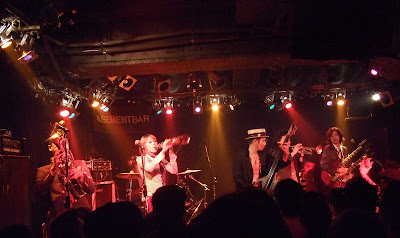
Moving on, the third act was the organizer of the event, Little Elvis Ryuta and his band, the S.R.P., and the Elvis that Ryuta was emulating was that from the 1970's Las Vegas gigs: he punched and kicked a few karate moves, and, at the middle of the set, he got into a blinding white jumpsuit with a gem eagle chest piece and other attached jewels. Little Elvis Ryuta learned his lessons well from the King—he really got the audience going. There was a girl in front of me, who must have been in her early-twenties at most, to whom Elvis was a historical figure at best, but she told a pal you HAVE to see Little Elvis Ryuta because he's amazing. And she was right—Little Elvis Ryuta said we should make so much noise that the King in heaven can hear us, and maybe we succeeded, so that he looked down from his cloud-made Graceland and diamond juke joint to see us all in that little basement club under a liquor store in Shimokitazawa, one of the hardest live houses in all of Tokyo to find.
***


Closing the event was Asakusa Jinta, one of my favorite live bands in Tokyo, and, yet again, their show got some of the young ones so excited that at the end they began a slam-dance that wasn't that far away from a regular fist-fight. Well...what can you do? A space in the middle was spontaneously created so they can pursue their pleasure, while the rest of us listened.

I didn't find this out before right before their show, by the way, but Asakusa Jinta's accordionist has left the band indefinitely due to health reasons, according to the band's website. That's too bad—her accordion sound really added to Asakusa Jinta's cool, retro Japan feel, and, besides, she was quite a beauty. Hope she gets well.

Saturday, May 10, 2008

Waffles & Tornado Tatsumaki At The Que

Why did the Waffles never become huge? Why hasn't Tornado Tatsumaki hit the bit time? And how about Pop Chocolat?

Seeing those three groups together at the Que got me thinking about breakthrough success. Each of those bands had a lot of momentum at one point, but none of them became household names. The Waffles, for instance, was one of the most successful turn-of-the-century college pop bands and was involved with a major label. Tornado Tatsumaki was signed to Victor Entertainment. Pop Chocolat was for a period heavily promoted in the indie scene. Now though, each has a sizable fan base, but none is Perfume.

I can guess at some of the reasons. There has to be some combination of trendiness of sound, catchy melodies, musical innovation, and talent (though, that last category seems very much optional...). These guys never quite got the combo just right, if they were trying to do so in the first place. It's not a secret, though, that I much prefer a band like the Waffles or Tornado Tatsumaki to the vast majority of musical offerings on TV. The Waffles of the world are doing real music, in my view.

In any case, the Waffles opened the four-band show, and I didn't recognize them at first because vocalist/pianist Kyoko Ono had made a hair change: from straight shoulder length to an orange-colored perm with bangs. But the first song started and the style was unmistakable—facing the ceiling, eyes closed, she performs like she is breathing in and consuming happiness, even though she's singing lines like “I hate Time, it's a thief that pretends to give in abundance (Jikan nante daikirai, michiteku furishita dorobouda)”—that from “Tsugi No Hikari (The Next Light)”, one of my favorite Japanese pop songs. Their show reminded me of the way that, around 2003, when I seriously caught the Japanese music bug, I listened to the stirring opening notes of their album One, and mistakenly thought there would be a whole scene out there with many songs as good as these—no, there are certainly lots of brilliant musicians, but none can quite match the Waffles at what they do best.

Several people seemed happy about my report in the last post that advantage Lucy is releasing a new single; I'm pleased to say that the Waffles are also due to release a new work around the summer, and played several of the new songs, which were good.

After the Waffles was a band called Stainless that had its rock moments but wasn't quite as rust-free as their name would suggest, and then Tornado Tatsumaki came on. Bravo. Tornado Tatsumaki's set blew me away so much that I couldn't get it out of my head during Pop Chocolat, and I ended up taking off in the middle. To get back to the original issue: why doesn't Tornado Tatsumaki rule the world? I suppose their jazzy, alternative pop may be a little too adventurous for the masses, and somewhat lacking in easily identifiable catchy lines, but it's still a mystery. They are one of my favorites, a member of my alternative pop Trinity along with advantage Lucy and Spangle call Lilli line.

Tornado Tatsumaki's vocalist Makiko Naka is an Okinawan girl with a sweet, acidic voice—a shikuwasa voice is the vision I had—and it goes perfectly with the band's indie piano rock sound. I was struck, in particular, by her rendition of a song called “Anata No Koto (About You)”, which is in their last album Fureruto Kikoe and is almost blues-like in the way it builds up simple lyrical lines to come up with a powerful emotional edifice. It wasn't everyone's favorite when I broadcast the song on my radio station a while back, but maybe people's view would change once they see how much emotion Naka puts into it live...

Wednesday, April 30, 2008

AL Airlines (advantage Lucy)


At the start of advantage Lucy's show at the Que on Tuesday night the static-y sound of an in-flight announcement buzzed out of the speakers and a voice suspiciously similar to Lucy vocalist Aiko's came on and said, “Welcome aboard AL Airlines. We sincerely thank you for flying with us and making this a fully booked flight”—giggles—“Today's captain is Ishizaka”—more giggles—“...during the performance we might hit some rough patches, and rapidly lose altitude, but there's no need to worry because we will soon stabilize”—big laughs—thus beginning the musical evening solo flight of Advantage Lucy Airlines, with Captain Ishizaka on guitars and Aiko, serving, I guess, as the musical co-pilot, navigating a jam-packed Que cabin through two hours of their old hits and some new songs. There was one brief period of turbulence, but otherwise the flight was smooth and pleasant.

In spite of the intro there wasn't any airliner cosplaying or anything like that, and I speculated that maybe the idea came to Aiko because she had just vacationed in the Maldives, a long plane ride away. During a break she talked a long time about the islands, saying how there there's only the sound of the waves, wind and birds, a refreshing change from noise-overflowing Tokyo. Aiko also talked about an inter-island volleyball match she went to watch, with the islanders pounding on drums on the boat over to the competition, and how the two teams feasted together after the game but she noticed that many of her (hotel) team's players were quietly shedding tears of frustration because they were defeated, which suggested a straight emotional quality that we city slicker types may have lost...

Anyway...good news for Lucy fans (or, as we call ourselves, the Lucy-min): they are releasing a new 3-song single on May 20!! At the show the band played all three, and they were great: a pop song, a rocking number, and one gorgeous ballad called “Shiroi Asa (A White Morning)”, which sounded like it was infused with emotion, if not created, in the beautiful Maldives.

(Photo credit: Plectrum Takata's blog)

Sunday, April 27, 2008

The Perfume Bubble


Perfume's out of control! A Perfume bubble is puffing up in Japan.

Only a few months ago, I was planning to write about this idol trio to say that one of the standout things Capsule music creator Yasutaka Nakata has done is to become these three's producer and write great songs for them, so that it became at least semi-respectable to love Perfume in spite of their being otaku magnets. And I really enjoy some of their songs, including “Vitamin Drop”, “Monochrome Effect” and “Computer Driving”.

But now, they're out of sight. Their new album Game is number one on the Oricon charts. Their latest national tour is completely, hopelessly sold out. They are top draws on every music variety shows on TV.

Part of it is that, yes, they're managed by a big entertainment agency that markets them well. But that's not the whole secret. They're more than skillfully-sold merchandise. Somewhere along the way Perfume became a genuinely 'hip' item for a lot of people. Look at the Village Vanguard store in Shimokitazawa, the epitome of counterculture cool. Their small music section now stocks Perfume (it's unimaginable that they'd sell any other idol group's music), and they tout the unit's music like they are the Second Coming of Kawaii. Mixi's Perfume community has more than 36,000 members, and its intro calls their beloved three “this century's most powerful girl pop unit”.

Perfume's formula is a combination of things: the way their voices go together perfectly, being one of the best sounding J-pop girl vocal ensemble since Puffy; the stylish and catchy music by Capsule's Nakata, a techno pop sound that seems novel in the idol arena; the android-like, sharply choreographed dance moves; and the three's down-to-earth, humorous public persona—three girls from Hiroshima who toiled for years without being recognized, before hitting the big time, now.

But one YouTube is worth a thousand words, and the video above, just 53 seconds long, is one of my favorite.

It's actually a cover of a 1980's single by the Japanese techno group Juicy Fruits called “Jenny Wa Gokigen Naname (Jenny's In A Bad Mood)”. I salute the excellent taste of Perfume, or whichever manager that got the three to perform it, because this song is one of the more revolutionary of J-pop: as far as I know it's one of the first where a female vocalist sang in that high-voiced, super-sweet, coquettish way that became so common later on (and the strange thing is that in none of their other singles does the vocalist of Juicy Fruits sing that way); for its time the lyrics were risque for prime-time TV, with the main line being that “we will sleep together hugging, because that would calm me down a bit (daki atte nemuruno, sou sureba sukoshi wa ki ga osamaruno)”; and the entire band came on the TV screen dressed up in fruit costumes, a big singing peach, guitar-playing banana, etc. Even as a kid when I saw Juicy Fruits perform this song it was a shock, and I'm happy that Perfume is bringing it back (a YouTube of Juicy Fruits playing the song is below—hmm, in it there's stuffed fruit strewn on the stage but the musicians aren't wearing them. Is my memory false??).

The 53-second clip above shows just how hyper a Perfume live is: listen to the way the male fans shout out the names of the members; see how A~chan cups her hand to her ear to mean 'make some noise' and a few moments later says 'arigato-!' in a very Western Japan accent; and in general, witness the way that three cute dancing girls totally put the crowd under their spell (and I see on the wall a sign saying it's the Harajuku Astro Hall, a relatively small venue—now it's nearly impossible to buy tickets to catch them at the Zepp Tokyo, one of the city's biggest halls...)—I'd love to have been one of the nerds sweating it down in the audience pit.

A Budokan show will be the next thing for Perfume, a gig at a mega-live house like the Zepp being a stepping stone to an appearance at the fabled martial art/concert hall (in fact, ha ha, I checked their official website and it looks like they JUST announced yesterday they are playing TWO NIGHTS at the Budokan in September...). But... after all that, what happens? Fads have been known to happen in Japan, and this Perfume bubble can't keep inflating non-stop. The Perfume three will have to fall back down Earth one day, at which time will we be able to actually get tickets to see them at a 'smaller' live house like, say, the Liquid Room or the Quattro? In any case, these three are a unit to watch.

Thursday, April 17, 2008

Japanese Bands To Completely Cover Pink Flag

Just found out that Call and Response Records is putting together a compilation album whose concept "is to take Wire’s debut album Pink Flag and cover the whole thing, track for track." Says Ian of C.A.R.:

I’ll talk more about my reasons for deciding to do this at a later date, perhaps when people will have a chance to listen to it and decide for themselves whether it succeeds or not.


What a crazy idea! Can't wait to check it out--the album is to feature veterans of the Akihabara Goodman-Koenji post-punk-prog scene such as Panicsmile and Tacobonds. (I imagine the reco-hatsu will be quite an ero-guro-nonsense bash of degeneracy and inebriation...)

Saturday, April 05, 2008

Mondialito + Club 8

Whatever musical genre you can think of there's bound to be a group of its fans somewhere in Tokyo, and Swedish pop is no exception. It was no surprise that devotees packed the O-Nest on Thursday night to welcome Swedish indie-pop duo Club 8 in their first visit to Japan.

A longing for the exotic is one reason why, I think, many Japanese fans are into a group like Club 8 (though, of course, they love the music too). Somewhere in the music fan's mind there's a wish to be a blond, Swedish musician who goes on stage dressed in an all-white outfit (something you hardly ever see a Japanese person wearing), and acting friendly but a bit aloof in the face of adoring fans. Maybe in another life. And that's even if the person is happy or satisfied with his days in Japan.

This wish to be someone foreign isn't unusual outside of Japan, but it does seem to be an especially big thing here, for reasons that I'm not sure of. Do we have to go all the way back to the Meiji Restoration, catching up with foreign powers, etc., in search for an answer? Or is it a mental reaction to a society that encourages conformity, a way to keep yourself free by dreaming you are someone else?

In any case, Club 8 was a charming act (the vocalist Karoline said they've been wanting to come to Japan for something like 15 years), and their performance had this light and sweet feel you don't experience that often with Japanese groups' gigs. I don't have any empirical evidence for that, but I did feel it and many in the audience must have as well, and it made the time flow in a different way than usual.


***

Two Japanese bands opened for Club 8: my beloved 4 Bonjour's Parties, and a unit I've wanted to see for a while, Mondialito. From what I understand, the French-singing female vocalist of this latter duo now lives in Paris so they don't play in Japan very often—another 'emulating the exotic' thing? There was something regal about her whispery-voiced performance (a clear, chilly, mountain spring-like voice it was).

Maybe it was the way she stood erect in a velvety green dress while two seated guitarists and a wood bassist at her sides toiled away at their instruments. Or, perhaps it was the way that her eyes glittered dramatically throughout the show, looking down at her subjects (ok, audience...). She didn't bother spending too much time between songs communicating pleasantries. It would have been better if she didn't wave at her friends from the stage before the show—she should have marched on stage wearing, say, an ermine cape...

Saturday, March 29, 2008

REALLY Japanese Music

I've been getting into REALLY Japanese music. That is, music that gets its inspiration from Japanese sources, rather than America, Europe, etc.

J-pop, J-rock and J-whatever-else aren't bad, of course, but they're all derivative of foreign styles. I want to listen to music I know is from the Land of the Rising Sun, and nowhere else. It's something you start thinking of after a while, living as a music fan in Japan.

***

The first REALLY Japanese musicians on my list are Asakusa Jinta, whose album Sky “Zero” was my favorite album of 2006. These guys have resurrected the sounds of the late-19th/early 20th century 'jinta' Japanese brass bands, and put them in a contemporary context by adding to the horns and accordion sound an electric rock guitar, drums, and, most distinctly, an explosive ska bass that pounds out beats like machine gun rounds. Their new mini-album Fes! Fes! Fes! shows that the first album was no fluke—this time they combine old festival music sounds with rock conventions to come up again with something unique.


***

Number two is Umekichi, a shamisen player/songstress who performs old popular songs known as hauta and zokkyoku ('old' as in, going back to the Edo and Meiji periods...). These were originally geisha songs listened to over sips of sake, and from there they went on to be performed at rakugo shows, comedic entertainment for the masses in Japan. Rakugo continues to be popular and its performances are like vaudeville shows—the comedic monologues are the main acts, but they are interspersed with various other entertainers such as guys who spin plates at the end of a pole, scissor artists that cut portraits out of paper, and traditional singers, which is what Umekichi does.

I bought one of her CDs expecting music that is quaint and traditional, but was pleasantly surprised to find melodies that are old-fashioned but appealing, and unexpectedly swinging rhythms. Umekishi's singing is high-voiced, nasal and sweet, and her style is playful but unsentimental: what I'd imagine geishas sound like when performing in tea rooms. I'd like to see her one of these days at the rakugo theater. I also heard she's toured the U.S. before—anyone seen her over there?


***

Moving on, number three isn't a 'musician' per se, but what she does involves music: Yamazaki Vanilla is a narrator of silent movies, a woman who is reviving a disappearing art. If you're in Japan you might have seen on TV, clad in a kimono and a blond short-bob wig, narrating black-and-white movies while plucking a taishogoto. Watching her working the crowds—fluently explaining the movie's setting, reading out the actors' lines, and mixing in humor and mentions of current events—I was able to begin to understand one reason why silent movie fans rued the introduction of talkies: watching a movie was much more of a community event in the days of narrated silent films.


***

Finally, one of the strangest and most fascinating Japanese pop culture developments these days is the emergence of Jero, the 26-year-old black (and one-quarter Japanese) singer from Pittsburgh, dressed in hip-hop fashion, who belts out excellent enka. The Times U.K. has a nice profile of him and enka; I didn't realize until I read it that the music mainly developed in the post-WWII era:

Although originally a form of 19th-century political oratory, enka in its current form began in the late 1940s when its singers and its audience were predominantly young. The music – in many ways the theme tune of the Japanese economic miracle and the birth of the salaryman culture – subsequently grew up with them.


This article and others make the point enka is becoming more popular with a younger audience due to Jero. Who knows whether enka will end up as anything more than a passing fad among the youth, but in any case it's a good thing that it's getting more attention. Enka will never be cutting-edge music, but I do believe that its lyrics are a window into what regular Japanese people (as opposed to Harajuku hipsters or the Roppongi rich) think and feel, and there's really no other music to listen to in some old, wood-built izakaya away from the big cities, over some hot sake and dried fish.


***


The cherries are in full bloom in Tokyo, and that's a good excuse to mention the words of bestselling erotic-romance novelist Junichi Watanabe: cherry blossoms are like a mistress, while plum blossoms are like a wife. Cherries are attention-grabbing, flashy but of short duration, like a fling with a lover, whereas the more subdued but long-lasting plum flowers are spousal, says Watanabe-sensei. He also says peach flowers are like cheating housewives, but I can't remember what his reasoning was on that...

Wednesday, March 19, 2008

Go To Hell Youth Graduation Ceremony: Yamada Jackson Band

I had a feeling my friend's show would be fun when I read in his invitation e-mail: “People tend to think of us as weird guys, but we're very serious about what we do”. And I wasn't wrong.

The first sign of the whackiness ahead was when I entered Club Que on Sunday afternoon and saw that it had been transformed into a school auditorium on graduation day: on stage was a grand banner in red, pink and white, saying, in Japanese, 'Die and go to hell youth graduation ceremony'. A high school anthem played in the background. And all of the audience members had been given mini pom poms to shuffle around during the upcoming celebration.

Soon the lights went out and out came my friend Mr. Navetin in a shirt and tie as the school principal, stiffly MC-ing for the graduation proceedings. He said special guests had been invited for the ceremony, and immediately a gang of black-Prussian-uniformed men piled on to the stage: the Ouendan! With expressions of samurai-in-sword-battle seriousness and concentration, they went through school cheer routines.


What these guys were parodying was the Ouendan ('oh, N, dan'), who are fixtures at high school and college sporting events, crews of grim-faced men clad in heavy black wool uniforms even on the most humid Japanese summer afternoons. They move and shout through military dance routines as one guy swings a huge school banner the size of a small truck. (The flag-bearer is one of the top posts in these groups, reserved for a senior member, and it's considered a deeply humiliating thing if the guy ever has to put down the flag, according to the Japanese Wikipedia's 'ouendan' entry...) Ouendan guys never seem very popular with girls, but I think a lot of Japanese have a soft spot for them because they represent something Old Japan.

Once the Gamushara Ouendan finished their act, Yamada Jackson Band came on stage, and proceeded with a show that was hyper and crazy during every second of its duration: the singer, Yamada Jackson, began by climbing on top of an audience member taking a photo of him, collapsing together and then spending a big chunk of the act singing in the audience pit rather than on stage.

This band's gag is that they're punk-rocking high school teachers. Teacher Yamada Jackson air-guitars on a big wooden triangle ruler. Lead guitar Flask is “a chemistry teacher who makes his students conduct weird experiments during class. Big explosions and queer voices are heard sometimes from the chemistry lab but no one knows what he's up to. Also, no one has ever heard Teacher Flask's voice,” explains the band's website. The green wigged girl dancer/teacher Grammar/Glamour is “a high-tension, hysteric English teacher. She stands up to authority, and calls the school principal a 'bitch'”.

On stage these guys were power pop + rock + punk without all its cliches and just the energy and anarchy. Great melodies and ceaseless activity (teacher Grammar/Glamour gave the audience the Finger after each song)—I hadn't had so much fun at a show in a long while. At one point Teacher Yamada Jackson said this graduation ceremony is actually for the band, i.e. implication is that they're going to be quitting, a statement that was met with puzzled silence, but then, at the very end of the show he said, no, that's a joke, they're never going to really 'graduate', and will continue playing. Great! Thanks! Because I want more!

Friday, February 29, 2008

Little Lounge Little Twinkle At 8 Bit Cafe

Up a flight of stairs in a bland Shinjuku building is a Shrine to nerdy teenage living in the 80's, a Temple of Famicom, manga and anime figurines. It is called 8 Bit Cafe.

Well, actually, it's just a cafe, but a remarkable one. 8 Bit Cafe's website says its concept is “recreating that after-school hangout” you had when you were a kid—and the kid they have in mind is the 80's Japanese boy who spent too much time battling friends on Nintendo, or, on Mondays, lying around flipping through the latest issue of Shonen Jump. But this hangout is more stylish than any playroom ever was—the walls are painted white in the trendy Tokyo cafe fashion, and on the wall are artsy, framed portraits of cartoon characters. Scattered everywhere are old Famicom consoles and cartridges, manga books and toys and figurines.

What blows my mind is that there was someone for whom those teenage days of game-playing and manga-reading at home were so important that the person decided to open up a business to glorify them. I played the Nintendo too—but was there really that much there? Is this a hangout for people who don't want to grow up (and if so, why don't they want to)? The cafe weirded me out a bit (the same way a lot of the Akiba places and the whole Cult of Famicom—a big thing among some of the piko piko groups—weird me out). But the concept is novel, and I suppose that's a necessary thing for a cafe...

Anyway, I was there to see Little Lounge Little Twinkle, who put on a brilliant solo show. They fit in well at the 8 Bit Cafe: many of their songs have a playful, kid's music feel (one song uses a strawberry-shaped music sampler toy, for example), which shares something with the cafe's concept. But, still, behind all their fun little songs are solid arrangements by classically-trained musicians (I wrote more about them here), and their kiddy songs aren't very Famicom-like and more like handmade, wooden European toys, if that makes any sense at all...

Saturday, February 23, 2008

Ore Wa Konna Mon Janai!

Ore wa konna mon janai could enter a weird Japanese band names competition and go pretty far. It means “you ain't seen nothing of me yet”, something a guy might say after messing up royally at work, being yelled at by the boss in front of all his co-workers, and shedding some hot, frustrated tears in a bathroom stall. Why this prog/psychedelia/rock quintet named themselves this is anyone's guess.

In any case, OWKMJ was my one fresh discovery at disk union event in Shinjuku on Saturday night. The event was held at the Marz and Motion, two live houses on the same block in Kabuki-cho, and you could go back and forth between the two, and, if you so desired, grab a meal outside or make a convenience store stop while doing so (actually, since the event went from 2PM to past midnight, there would be nothing stopping you from catching a movie or involving yourself in other Shinjuku activities and when you return, the event would still likely be going on...). The Motion is on the 5th floor, so after a show if there was a good band coming up at the Marz, a big line formed at the elevator to get out of there.

I was at the event to see 4 Bonjour's Parties (photo above) and henrytennis (photo below OWKMJ), and OWKMJ's set was between theirs. It started out like some sort of new religion gathering, the sax/snare drum guy spreading out his arms to welcome the converts while moaning and smiling. It developed into an exhilarating blend of prog, psychedelic rock and jazz, and the band especially had good moments when the sax guy pounded on his snare drum, creating complex beats along with the main drummer.


Ore Wa Konna Mon Janai

Here's a good description of OWKMJ's sound:

Mixing psychedelic rock with mysterious ambient spaces lends a timeless flavour to their music, while at the same time remaining immediate and captivating. Each song is a journey in itself, with a host of influences giving you a backpacker's view of the road less-hitched. From Moroccan desert themes and solemn pastural melodies to bastard noise-punk from the inner-city, OWKMJ covers every inch of the musical terrain with intensity and originality. by cal lyall(soundispatch)


***

The more shows I go to like this one where you can go in and out of the venue as you wish, the more I grow to dislike the Tokyo live house convention of not allowing re-entry into the club once you leave. The Marz even had a sign saying, 'please try to watch all the bands and not just the group you're a fan of, because all those bands have something they want to communicate to you'. Which is no doubt true, but really, to quote from Boogie Nights, that's YP, not MP: if I can help it I'd rather not waste hours listening to bands I don't like, and I appreciate musicians that subvert the Tokyo live house convention by letting fans know beforehand what time they will be playing. (And, of course, there's hypocrisy involved on the live house's part—maybe they want you to see all the bands, sure, but they no doubt don't mind the added drink revenue that comes from keeping the audience in their clubs for as long as they can).

I admire the Shibuya O-Nest in this regard: partly because they have their own bar on a separate floor from the live space, they let people go out and come back by showing the ticket stubs. Other Tokyo live houses! You can do it too! Open up your doors!

***

As an LA guy, I couldn't help but crack up seeing this Engrish street sign...

Friday, February 15, 2008

Hola, Swinging Popsicle!


I've just found out that Tokyo pop group Swinging Popsicle will be playing in Monterrey, Mexico (!!!) in early March! I'm tempted to hop on a plane across the Pacific to witness what will surely be a musical fiesta extraordinaire, but I don't think I can afford to... Here's the press release by JapanFiles.com:

February 13, 2008 - Japanese pop pioneers Swinging Popsicle have been invited as the first-ever musical guest for the 32nd Convencion de Juegos de Mesa y Comics in Monterrey, Mexico. The event will be held March 7-9, 2008, at Monterrey's Cintermex Center, hosting thousands of Mexican fans of Japanese entertainment.

Swinging Popsicle was requested by the event's coordinators based on their 10-year history and their status as one of JapanFiles.com's all-time best-selling artists. The band is currently nominated for Best Japanese Pop Band by Shojo Beat magazine.

Swinging Popsicle has appeared previously at Fanime Con (San Jose, CA) and Anime Mid Atlantic (Richmond, VA). In February 2008 they played a special concert in Seoul, Korea for their Korean partner-label, Pastel Music.

Swinging Popsicle appears at Convencion de Juegos de Mesa y Comics by special arrangement with JapanFiles.com and Entretenimiento Creativo.