Saturday, June 25, 2011

This & That Volume 4 In Roppongi


Photo by Daniel H. Rosen


This & That Cafe is a neat event that a Tokyo-based artist named Daniel Rosen holds every two months or so at the Super Deluxe in Roppongi. First off, it's free, leaving you with more money to consume beverages including Tokyo Ale. Secondly, it features an eclectic mix of performances, which, when I stopped by a few weeks ago, comprised Yuyake Lamp, my beloved piano pop band, the Watanabes, a gaijin ensemble from Ehime Prefecture, another female vocalist and a flamenco group, a live painting, and animation projected on the stage wall. It's an ideal way to spend a Friday night, listening to good music at a place with a free feel.

The Watanabes, who started with a fun song about living in Ehime as foreigners, are based close to Yuyake Lamp vocalist Yunn's hometown in the western Japan prefecture, by coincidence. I wonder what it's like to be a foreigner band in a place like Ehime...


Photo by Tomohide Kimura


Saturday, May 28, 2011

Terayama Shuji Music Festival


I heard about Shuji Terayama a long time ago, but in one those things you never quite get around to, I'd never really read any of his plays or poems and other works of this avant garde writer. So, when I saw that there was going to be a 'Terayama Shuji Music Festival' at the Hatsudai The Doors club, and Asakusa Jinta was playing, I was interested. Plus, as a bonus, Panta, the singer of the legendary left-wing 70's rock band Zunou Keisatsu, or Brain Police, was also on the bill.

Terayama was active in the 60's and 70's, and a lot of the crowd in the small Doors club seemed to be about the age that they probably saw Terayama plays when they first came out. They were a quiet audience, with gray, fuzzy hair. Maybe they were once radicals, protesting, attending Brain Police shows, taking in Terayama's literary experiments. Maybe, to an extent, they are still radical, which is harder to be than, say, in your 20's.

It probably wasn't an easy crowd for Asakusa Jinta, accustomed more to playing for young punk fans, but they pulled it off, helped along by a few diehard fans in the audience who had come to see them, and getting polite applause from the Terayama followers.

MCing the event were a playwright named Ei Takatori, who had collaborated with Terayama and whose background is also interesting, with 'manga criticism' listed in his resume, and an idol singer named Mika Hashimoto, who is the 'chairwoman' of the School Uniform Advancement Committee, which is how I guess I'd translate an idol group called Seifuku Koujou Iinkai. I missed SKI's set, but they appear to be a group of about a dozen schoolgirl singers who motto is to be “pure, upright and beautiful,” according to their website. The special guest was the actress Hitomi Takahashi, a tall, somewhat fox-like beauty, who had been scouted by Terayama when she went to see one of his plays as a student in her school uniform.

Brain Police's Panta played as a duo with another guitarist. A 61-year old rocker with still-long hair wearing black clothes, Panta did an acoustic set, and the highlight was a song whose message confused me. It was a song that was ostensibly about a baseball team, and its nine players, but in reality it was about the nine hijackers of ANA's Yodo-go plane in 1970, the baseball theme invented to prevent the song from being banned. It seemed weird...I only have wiki-level knowledge of the Yodo-go incident, but the gist is a group of radicals took over the plane and had it fly to North Korea, where the nine would be able to join their comrades. It wasn't a critical song. If anything, it seemed to glorify them. Maybe the song made sense in certain circles at the time it was written, but, in 2011, it seems strange. I'm curious what Panta's take is on all this.

For the encore, all the performers got together and sang a famous song that Terayama wrote called , “Sensou wa Shiranai”, a beautiful, if somewhat sentimental song about a girl getting married whose father she doesn't remember died in the war. The title means, literally, 'I don't know war', but I guess the 'know' in this case means more than just knowledge or experience, and is talking about lives where war is no longer something that exists, at least not in Japan, for now.

Sunday, May 08, 2011

2011, From Here


2011, From Here was an earthquake charity event at the Club Que featuring a three-band roster that was hard to beat if you're into Japanese guitar pop: Harqua, the husband-and-wife collaboration of Harco and Quinka, with a Yawn, Kuki Kodan and advantage Lucy. Ticket proceeds, donations and sales of buttons made by artists (showing the prefectural birds of the quake-affected areas) went to a quake relief fund.

More than 200 people crammed into the Que, and the event ended up raising over 500,000 yen, about $6,000.

Highlights of the event for me included:

Harqua's performance. I'm a huge Quinka far, and chose her Field Recordings album as my favorite for 2008. I also like Harqua's CD a lot—I don't think there are many married duos that sing as beautifully together—and this was my first time see them on stage. One of their best songs is “Thank You”, the first tune on their album, and Quinka said that when she wrote it, the message was that you shouldn't miss the opportunity to thank loved ones closest to you, but after the quake, the message became bigger, and now it's also a song to thank people from far away, strangers with a heart. Enamored of the song to begin with, and thinking about its newfound significance, I was emotionally overcome during its performance.


Kuki Kodan's lyrics. Vocalist Yamazaki Yukari writes with everyday words that mysteriously turn into sung poetry that's hard to forget. I could see several fans mouthing those words that mean a lot to them. Yukari sits the side edge of the stage, singing as if she's alone in a living room, and then sometimes looking up, surprised she's on a stage in front of a crowd.


Advantage Lucy. The organizers of the show, whose intention was written on their website (and take a guess who translated it into English :) ). What can we do in this situation? We can start helping, from now, each in his or her own way—that was the philosophy.

But when vocalist Aiko first tried to address the audience, and saw how many had shown up, she was overwhelmed and covered her eyes with a towel. The words eventually came out, and they did a fantastic set of their new material, but for the encore, when they did “Kaze ni Azukete”, and she sang that line, one of my favorite of all Lucy lyrics, because it's so real:

Kimi kara koe ga todoitara nandaka

When your words reach me

Onaka ga suitekita

I start to become hungry


she choked up again. Maybe, I think, because we were there, the fans and musicians, and our voice, of support and agreement, did reach her. (And we did go grab a bite afterwards!)


Sunday, April 24, 2011

Pop Planet Nights In Seoul

One of the discoveries I made during a weekend of pop shows in Korea was a Japanese band—the Fishmans.

I knew about the 90's reggae-pop group, and owned two of their CDs, but it wasn't until I heard their music booming in a Seoul club called Kuchu Camp—itself the name of a Fishmans album—that it clicked. Now, back in Tokyo, I don't know how many times I've listened to songs like “Night Cruising” and “Shiawasemono (Happy Guy)”, bewitched by the high-voiced, yearning vocals.

At the Kuchu Camp, on the wall behind the stage is a famous photo of the late Shinji Sato, the Fishmans' singer, with eyes that are playful, challenging, penetrating. His image watches over every show at Kuchu Camp. Right now, somewhere there must be someone listening to his lines, from “Shiawasemono”:

Kanojyo no koto dake wo yoku shitteru

I only know a lot about my girl

Soshite ongaku ga mune no naka de itsumo natteru

And music is always playing in my heart

Kanojyo no koto dake wo yoku shitteru

I only know a lot about my girl

Soshite itsu datte yume no naka made oikaketekuru

And she always follows me into my dreams

***

On Saturday night, at Club Ta, decorated with a Middle Eastern feel with cloth on the walls, I remembered what a great audience Koreans are, clapping in rhythm spontaneously to songs, and cheering groups they were seeing for the first time (as well as excellent local bands, like my co-conspirator Wonyul's blues-rock ensemble One Trick Ponies and the veteran, sweet pop unit Linus' Blanket).

Yuyake Lamp translated one of their songs into Korean, and the pronunciation must have been rocky because vocalist Yunn doesn't speak the language. But despite that, after, and even during the song, there was a roar of approval. Yunn blogged—when she was memorizing the Korean words, it felt like learning magical spells, but when she actually sang them on stage, they were like a real magic spell that brought the audience closer.


***

I loved the casual elegance of my Korean friends' daily moves, the way they put a hand over the heart as they poured a drink for you, or placed a hand over a forearm as they received a drink. We're friends so pour my drink with one hand rather than two, don't be overly formal, said one friend. There were a lot more hugs, handshakes and pats than I was used to back in Japan.

After a few nights that went by so fast of music by great bands—Ninon, Kounotori, Three Berry Icecream, Yuyake Lamp and the vocalist Mayumi Hozaki from Japan and Do-Lu, One Trick Ponies and Linus' Blanket from Korea—and drinks, laughter and talk with new friends until dawn, we from Tokyo and Osaka were all smitten by Seoul, wanted to stay longer and return again soon—as I knew would happen.


Friday, April 08, 2011

Seoul! Pop Planet - April 16-17!


Seven years ago (but just yesterday!), I went to Seoul with a bunch of musicians—advantage Lucy, Plectrum, Lost in Found and Miniskirt—to attend a music event called Melody Go Round. It was one of the best trips of my life—getting to know my favorite artists in person, making new friends, and witnessing moving scenes of the musicians of two neighboring but very faraway countries creating beautiful sounds together. Seoul became a special place for me.

Now, some of us are returning. Bands from Japan will be performing together with Korean musicians at a two-night event called “Pop Planet” next weekend. On Saturday, April 16, they will play at Club TA, and on the 17th at Kuchu Camp, both in Hongdae. If you're in Seoul, come join us!

The bands are:

Linus' Blanket, a wonderful Seoul indie pop group influenced by bossa nova, French pop and Bacharach;

One Trick Ponies of Seoul, a cool blues rock band from Seoul, led by my friend Wonyul;

Do-Lu at the Kuchu Camp show, a charming trilingual (K-J-E) staff band of the Seoul club;

Three Berry Icecream from Tokyo, the brilliant indie pop unit of vocalist and accordionist Mayumi Ikemizu, a central character of the Shibuya-kei scene, who was a member of Bridge;

Yuyake Lamp, one of my favorite Tokyo bands, the unit of nature-loving, world music-embracing, high-voiced singing wonder Yunn;

Hozaki Mayumi from Osaka, the gorgeous voiced pop vocalist, formerly with a unit called Margarets Hope;

And, two Osaka groups associated with Minsung Kang, formerly of Linus' Blanket and the organizer of the Melody Go Round event mentioned above: Kounotori and Ninon. I haven't listened to them, but being Minsung's groups, I have no doubt they're excellent.

***

Minsung wants to do another Melody Go Round event in Seoul later in the year—its idea is to bring musicians of different countries together, going from one country to another—and this event shares his vision and features some great bands from both Korea and Japan. I can't wait for the evenings of music, friendship, soju and Korean food!

Monday, April 04, 2011

Apollo 18's Tokyo Landing

Apollo 18 landed in Tokyo—and then crashed through the ground and got stuck in the Basement Bar.

...

Well, OK, the space mission is actually an alternative rock trio from Korea, and the hardcore cosmonauts were flying back not from the moon but from the U.S., where they were on a two-week tour, including gigs at South by Southwest and The Valley of the Vapors Independent Music Festival. On the way back they were playing at the Shibuya Kinoto and the Basement Bar in Shimokitazawa.

I found out about the show because a music blogging comrade from Korea, Shawn Despres, got in touch about it. They were voted "Rookie of the Year" at the 2010 Korean Music Awards, he said.


The performance was great—Apollo 18 was spirited, intense, musically proficient...and funny. The probably unintended joke of the evening was that Apollo 18 was playing to a crowd that most likely didn't listen much to their brand of hard core and metal meet post-rock. It wasn't quite the Blues Brothers doing 'Rawhide' behind chicken wire. But judging from the other bands and the fashion, the audience was one that favored the sort of introspective, sentimental alternative pop/rock that seems common in Shimokitazawa these days (album covers showing a sunset bordered by Tokyo buildings...that kind of thing).

To their credit, Apollo 18 got even this crowd going, triggering modest head swinging and foot tapping and shouts in basic Korean and Japanese. The guitarist guy said “Konbanwa (good evening)” at the start, and then in English apologized that unlike the other 'country' music bands tonight (I think that's what he said...), they just did rock 'n' roll, before plunging into an explosive set, he diving into the audience at one stage and doing a solo from the floor.

I would love to see them again in Tokyo, but maybe next time playing with groups like Asakusa Jinta or henrytennis, if that could be arranged.

***

This was my first show since the quake. Nightlife is gradually reviving, and the streets of Shimokitazawa were fairly crowded, though not as much as pre-quake weekends. On the walls of the Basement Bar were signs saying that shows may be canceled if there's big shaking, that the hall may become dark if there's a blackout and that they are limiting the use of air-con and lights to save electricity.

***

Speaking of Korea, my friends are going to be flying in to Seoul to play two weekend events on April 16-17. The bands will include Yuyake Lamp and Three Berry Icecream from Japan and Linus' Blanket of Korea. More on that later...

Saturday, March 26, 2011

Spring, Tokyo, 2011


Radiation, hay fever-causing pollen and floral scents in the air—what a strange spring this is.

After the disaster, Tokyo streets are darker and the crowds are gone at night. Shops and eateries close early to save electricity. Bottled water and bread are gone from store shelves.

I haven't been to any shows since the quake struck, but I imagine they're more subdued, with a smaller audience. Going down to basement clubs while aftershocks are still frequent isn't an appealing prospect, and there's guilt about using electricity for performances at a time of shortage. Some musicians I know are already playing, some as charity events. But I'm not ready to go back just yet.

I've been listening to a lot of Judy and Mary, whose CDs had been gathering dust in my room before the quake. Maybe it's a reminder of a Japan that's gone, temporarily. Now people are serious, public-minded, careful. All good things, but I miss the excesses, the crazy city noise and lights, the drunk crowds, flirtations and jokes. And Judy Mary, as you see in this video, vocalist Yuki over-the-top coquettish, the guitar and bass hyperactive, distilled all that energy into the form of a band.

Wednesday, March 09, 2011

Eel Nests At The O-Nest


I didn't get Eel at first.

The first time I saw the girl who calls herself Eel perform live, she was opening for advantage Lucy, and as it was one of the first times for me to see Lucy and I was overwhelmed by the experience, Eel didn't leave much of an impression other than that the performance seemed wild and chaotic (...not necessarily bad things).

The years have passed, and now I'm a fan. Especially after listening to her great new album, For Common People, and a compilation of her earlier works called Kung Fu People Etcetera, I wonder why I didn't get into Eel earlier. Her cute vocals, catchy melodies and inventive noises are things I like.

I headed to the O-Nest for the Tokyo leg of her For Common People tour. While at past shows she's sung karaoke fashion to music from a Mac, this time Eel had a band for the first half, in addition to an ever-present interpretive dancer guy in a pink suit and feather boa. She wore aqua-rimmed sunglasses, a green-yellow hooded sweatshirt and shorts over pink sweatpants.


At one point in the show she said, “I actually quite like punk”, in what context I can't remember, and it got me thinking. Wasn't punk rock when it started out a funny, eccentric, experimental style, and the cliches we associate it with now are later developments? And musicians' unhappiness about what 'punk' was becoming led to post-punk and new wave? Maybe then, someone like Eel, from Osaka, cute, colorful, stylish, outlandish, eclectic, is truly carrying on the legacy of punk?

It's an idle thought, and maybe Eel herself wouldn't feel the need to be bound by labels (her website says her style is 'cute and funky pop with electric punk music as a base'). In the meantime, like in an early punk show of my imagination a lot of wackiness is happening on stage, five male 'dancers', including the pink suit man and a guy with a wig, a paper cutout mask of Eel's face and the Stars and Stripes bopping to her tunes, and for the finale, as many of the audience as can fit the O-Nest stage join them to hop along to her song “Jump”.

Saturday, February 19, 2011

Tokyo Pinsalocks At The Que


What a perfectly casted band Tokyo Pinsalocks are.

Singer Naoko is the sunny, outgoing one. Bassist Hisayo is her lunar counterpart, cool and composed. Drummer Reiko is cute and petite. They look great on stage, though, in reality, it was probably coincidence rather than casting that brought them together, 11 years ago.

The girl trio played at the Shimokitazawa Que at the end of a Japan tour. Naoko wore a big cloth rose in her hair, which descended like a golden avalanche, and she had on a mime-like stripe shirt and what looked like a tutu. Hisayo, tall with long black and silver hair, wore a green blouse with an illustration of a parrot, and shocking pink-colored tights.

On stage there's the classic, rock-band fire and ice contrast between those two, but like the yin-yang symbol, the separation between black and white isn't perfect. Naoko is the show-woman, but you can tell some of it is an act. Hisayo is almost expressionless, but there's passion in her performance that come out to the surface.

They have a spare, New Wave sound, Hisayo pumping out aggressive, distorted bass lines, Reiko drumming in a precise, mechanical fashion, and programmed music from a Mac and Naoko's vocals taking care of the rest. Tokyo Pinsalocks just released a new album called Kurukuru to Guruguru, onomatopoeia for things spinning around, and they played one of the best songs from it, “Kimono Japonaise”, which is an internationally-minded Japanese pride song, with lyrics like:

We're sensitive to fashion [on stage, Naoko holds her stripe shirt]

And our hearts are sensitive too [she touches her chest]

Our legs are short [she points down at her legs, with a frown]

But we dance without care anyway [she dances]

Saturday, January 29, 2011

5 Favorite Japanese CDs of 2010

#5. Spangle call Lilli line
View


My favorite SCLL album since Or, View highlights the band's long, luxuriant stretches of indie pop melodies, guided by the fragile-sounding vocals of Kana Otsubo.


#4. Yuyake Lamp
Uminomori


These are musicians I've been following since 2004 (when they were called Orange Plankton), and they're now friends. So, maybe there's a bias, but I do think their piano pop music stands out. Vocalist Yunn has two gifts: an unmistakable, dazzling high voice, and a talent for weaving memorable musical lines. The piano, bass, drum and flute arrangements are often jazzy. The album title means 'forest in the ocean'.


#3. Soutaisei Riron
Synchroniciteen

These guys have converted me. I liked their previous album, Hi-Fi Anatomia, but was put off by their strict policy against publishing their image, and wondered how they'd follow up on Hi-Fi. Synchroniciteen shows it wasn't a fluke. The melodies are still catchy and the lyrics playful, but what I noticed most was that vocalist Etsuko Yakushimaru's singing intensity had increased, from Hi-Fi's low-blood pressure whispers to something more rocking. It's a good change.

'Sanzenman Nen', or 'thirty million years', is my favorite track, with opening lines that go, ' I've been in love from thirty million years ago/I ride a train from Gakugei Daigaku-mae', an example of the eccentric way they arrange their lyrics. Soutaisei Riron's lyrics favor word play and sometimes the settings are science fiction or fantasy, things they share in common with other contemporary bands, whereas bands a decade ago seemed to be more into describing their lives and feelings with straight words. A sweeping generalization, and there are many exceptions, but that's the impression I get. What caused the change?


#2. Serani Poji
Merry Go Round Jailhouse


This is the first album in five years by a unit that started as a virtual girl pop unit led by a Sega musician Tomoko Sasaki playing music for the game 'Roommania #203'. Before, Yukichi of Cecil was Serani Poji's singer; this time, returning to recording, Sasaki herself is the vocalist of pop tunes that are like updates of the best of the 90's Shibuya-kei sound—my favorites are 'Toward the South', about a 7-year-old girl who dreams about running off to a southern island with her lover; 'Robot's Happiness', Kafka's Metamorphosis with a happy ending about a girl who enjoys her new life as an android; and 'Laughing Frog'.


#1. Ego Wrappin'
Naimono Nedari No Dead Heat

My biggest musical surprise of the year: I knew of Ego Wrappin', and even owned one of their albums, but didn't pay much attention, thinking they're a retro-jazz outfit, which isn't my thing. What was it that moved me to pick up this CD at Tower Shibuya? It led me to music that was both familiar and new. Some of it is like 60's psychelic rock, like 'Kuroi Sweater', an elegy about a granny who knit a black sweater for the singer. There's also jazz with horns in songs like the lounge-feeling 'Love Scene', which, despite my previous avoidance of Ego Wrappin's jazz, has become my favorite song of the album. Bringing alive this band's innovation and re-interpretation of classic rock and jazz are the powerful, passionate vocals of Yoshie Nakano, like a Japanese Grace Slick.


***

Returning to 2009, there was one album I didn't know about at the time, but has become a favorite of mine, not only for that year but for all time—Bice's Kaerarenai Koi no Tameni ('For Love that Can't Be Changed'). Sadly, the woman who was Bice passed away last year. The poems whisper-sung by Bice (pronounced Bee-che) are about love, life and death—one song is titled 'The Two of Us Will Be Gone In 100 Years'—and the directness of the emotions is something I've rarely encountered. One of these days I'll write more about a masterpiece of a song in this album, called “Ordinary Days”.


レッドバルーン

ビーチェ(bice) | Myspace動画

Friday, December 24, 2010

Yuyake Lamp At The Turkey

On a side-street in Shibuya surrounded by love hotels is the small club Shichimencho, Japanese for 'turkey'. I asked the manager why it was named that, and he said the Turkey was once a bar, and when the Mama of the bar got drunk, her face would turn into many different colors, like the bird. Red, pale, maybe even blue, green and purple...? And thus, the name. At the Turkey the entrance is right next to the stage, so for the minute or two while you pay for your ticket, you become part of the show (and some of the musicians encourage that, calling out 'Welcome!' as a new guest enters).

I was there to see Yuyake Lamp, who just released a great new mini-album called Umi no Mori ('Forest in the Sea'). The event brought together musicians that once lived in a cheap apartment called Shunpu-sou. It's usually not a good sign in terms of luxury if an apartment is called 'sou'. The nicer dwellings have western names—Mansion this, Casa that, Villa, Manoir, etc. Sou's are old, wooden apartments with small tatami rooms and communal toilets.

Maybe the most famous of them is Tokiwa-sou, where some of the greatest manga artists of the 20th century lived when they were starting out—Tezuka Osamu, the Fujiko Fujio duo, Akatsuka Fujio, Ishinomori Shotaro—talking manga, working together, emulating Tezuka. Yuyake Lamp singer Yunn joked that Shunpu-sou in Kyodo was a sort of Tokiwa-sou for musicians. Thin-walled, she could hear the songs neighbors were creating and practicing. Yunn was the only girl in the apartment, and one of only two Japanese. It was a friendly place where, if she screamed because she had an insect visitor, neighbors would rush into the room armed with brooms and slippers. Sadly, like Tokiwa-sou, Shunpu-sou no longer exists, torn down to build a 'mansion' or a 'manoir'.

At the Turkey, Yunn sang her new, beautiful title track, “Forest in the Sea”: 'green, green, blue, and the yellow of light, the forest in the sea'. Such a distinctive, high singing voice, as unique as Chara's. And a stage presence that comes from years of performing, in clubs and on the street, traveling and playing in all corners of Japan.

Friday, December 03, 2010

Advantage Lucy & Vasallo Crab 75 At Munekyun

Every year on November 26, advantage Lucy and Vasallo Crab 75 get together for a very touching event to remember their former guitarist, Takayuki Fukumura. The two bands meet up a few weeks before to think about ways to make that year's performance special. This time, the concept was a children's book. Wearing a wool cap, Lucy's Aiko and VC75's Daisuke Kudo came on stage to read about a lonely rabbit, lost in the woods, that meets other animals playing music. Their songs followed the short chapters. It was a fable about Fukumura's life.

The event is called Munekyun Arpeggio, 'mune-kyun' being a word Fukumura used in an ad looking for musicians for a band he wanted to create that would later become advantage Lucy. It's that feeling you can't describe when you experience something lovely, like, in my case, listening to an old advantage Lucy song for the first time in a while. Lucy guitairist Yoshiharu Ishizaka's take on the arpeggio is that it's a musical form of kindness. But he also said there's an element of eros in them.

Fukumura was a young master at crafting those 'kindly, erotic' progressions of musical notes. For each of the bands' finales, a song starting with a signature Fukumura arpeggio was played.


VC75's was their best song, 'Vicious Circle', and it was a rousing performance. Lucy's finale was that song that begins with my favorite rock intro, a six-second, miraculous wall of guitar sound—'Red Bicycle'. Lucy singer Aiko once wrote that Fukumura composed that intro in a Shinjuku recording studio, and, after hearing it, when she walked out later she felt the world outside had turned dazzlingly bright. Listening to it brings back to me memories of those early days back in 2003 and 2004, when I first started hitting the Tokyo clubs, walking the narrow alleys of Shimo-Kitazawa, Shibuya and Shinjuku in search of new music, making discoveries, meeting the music-makers, getting a floating feeling in the face of boundless possibilities.


Aiko's eyes reddened as she sang the finale. I didn't see Ishizaka-san, but a Lucy fan named Patrick, who took a midnight bus all the way from Tottori prefecture to see the show, said the guitarist was in tears by the end.

I was terminally mune-kyun for the next few days.

Thursday, November 25, 2010

Asakusa Jinta One-Man At The O-West

Walking to Shibuya listening to Asakusa Jinta on my iPod, I had one of those moments when I suddenly remember I'm living in a strange little country called Japan. In the middle of the most fashionable town for young folks, I was going to see a band that got its inspiration from early-20th century Japanese popular music.

One of the lovely things about Asakusa Jinta is that even though their music references old styles like enka, chindonya and jinta music in addition to punk and rockabilly, young punk kids who probably have little familiarity with those sounds get off on the music anyway. At their 'one-man' show at the O-West, the front-center part of the audience was occupied by a few dozen kids who slammed their bodies together during the fast numbers and rested during the slow songs. They passed around a mini-keg of Asahi beer that the opening band started up on during their last song and then donated the remainder to the Asakusa Jinta audience. Will listening to Asakusa Jinta expand these kids' musical horizons, inspiring them to dig through old records? But I don't want to sound superior, this band has done the same to me. When I hear their sound a crack appears on the shell of my musical knowledge, and what's beyond it is so bright and rich with possibilities that it makes me tear up a little.

For all their seriousness as musicians, on stage they're wholly devoted to entertainment, in a way few other Japanese bands can equal. At first, lights hit the huge Asakusa Jinta banner on the rear wall; two band members come on stage waving the group's flags; and then it's all action, the horns pointing skyward, the tubist marching through the audience pounding a bass drum, the leader slapping a meta-framed double bass with explosive precision. The band talked about how, B-Ken, the mohawked euphonium player, who is the most hyperactive member on stage, diving into the crowd at one point, got nerves before performances. He sits in the dressing room looking pale and making barfing noises. He's following in the tradition of great artists like Elvis and Koshiji Fubuki that suffered from stage fright before coming on to electrify the fans.

The two-and-a-half hour show, one of the best I've seen in a while, was one where just being there changes you a little, and the world outside feels more alive and colorful.

Saturday, October 30, 2010

Risette's 15th Anniversary At The Loft

Grand Old Shinjuku Loft. That legendary Tokyo live house where Southern All Stars and Judy and Mary once played. I always get lost getting to it. Maybe I get distracted trying to steer clear of the colorful Kabukicho street people near the club—touts, Japanese and foreign, hosts in shining suits and mullets, and, sometimes, gangsters. The Loft is in the basement of an incredible building that is otherwise filled with adult entertainment establishments.

After walking down the stairs and paying at its caged ticket booth, you enter one of the ideal live houses of Tokyo. Mysterious vents and pipes crisscross its ceiling and unlikely pieces of Americana cover its walls (is my memory false, or was there a Miller Lite sign somewhere?). There's a bar with food separated from the live music area. And everything in it is stained with the memory of ten thousand rock shows.

Hearing that Risette will hold its 15 year anniversary gig at the Loft surprised me a bit because they seemed more of a Shibuya or Shimokitazawa act, but when I got there it made sense. A veteran band like Risette shines in an old club like the Loft. The music, the act and the atmosphere come together to create something you can only feel in that space.

One of the bands that Risette invited to play that night was a group that's been around for two decades called Yes, Mama OK. I'd heard of them and even own a tribute album for them but this was the first time for me to see them live and listen to their music. Instant conversion. Catchy rock tunes, abundant stage action, and general silliness—one of the members is a sax/harmonica player who chugged a bottle of wine during the songs where he had nothing to play. The vocalist and guitarist, Takeshi Kongochi, is also an actor, TV personality and the fourth best air guitar player at a Finland world championship, according to Wiki...


Risette itself played both an acoustic and an amplified set. Its singer Yu Tokiwa has a clear, sparkling voice that advantage Lucy's Aiko once said she wished she could put into her throat like a cartridge to sing with, and it mingles perfectly with the two, dueling lead guitars. Ex-Cymbals Reiji Okii guest-bassed for some of the songs. Not showmen like Yes, Mama OK that preceded them, Risette nevertheless charmed with the beauty of their melodies and the intensity of their performance. Not great orators on stage either, when they said simple thanks to the audience and the other bands, and Tokiwa said “Ureshiidesu (I'm happy)”, it felt like the most genuine appreciation I'd heard in a long time.

Saturday, October 16, 2010

Hoover's Ooover At The O-West


I have trouble with big concert venues. A phobia of sorts. Ax, Zepp, Tokyo International Forum...I'm not a fan of any of them. Visions of animals being herded through the slaughterhouse... But these places can't always be avoided. Some good musicians are going to be successful and play the big halls, and I still want to see them. Recently, finally, I got into Ego-Wrappin, and bought a ticket to see the popular group at a large venue. I even considered catching Perfume at the city's ultimate mega-venue, Tokyo Dome, until figuring out the tickets were long sold out. It's clear I need to build some tolerance to these places. So, in that respect, going to see Hoover's Ooover's Japan tour final show at the O-West was probably a good thing.

The O-West is, along with the O-East, Quattro and Liquid Room, one of the second-tier live houses in terms of size. It was pretty full with Hoover's Ooover fans. The band was dressed up as usual in hipster-looking dark jackets and ties. They alternated between rocking renditions of songs from their latest album, 0.025%, and somewhat inane chatter about topics such as competing to push the 'stop' button on buses (to be first, should one press it right after passing the stop before one's own, risking the driver thinking you're pushing for that stop, or should one at least wait for the announcement to begin? etc). It was also Hoover's Ooover's 10th anniversary—on a show held on the tenth day of the tenth month of 2010. During the song “Mamimumemo”, some in the crowd spun one arm over the other, imitating the girl character in the music video. For the encore, Masami came on stage wearing a hand-made Thunder God headpiece, consisting of a green afro and horns (they played a song called “Kaminari Moyou”—signs of thunder—about a girl unhappy about her boy friend coming home in the morning) .

The show seemed shorter than other bands' “one man” gigs I'd been to, at about an hour and a half, which felt like an extended regular performance. Maybe that's their style. It was good show, and the band especially shined when doing faster songs like “Mamimumemo” and “Collection”. But there wasn't the close-up view of the band at a small place like the Basement Bar, and the musicians themselves seemed to have less movement and expression, though that might have been because I was watching from the back of the hall. At a Basement Bar show a few months back, I liked the way that Masami whipped her body away from the mike after song phrases. I've been to lots of great gigs at the Basement Bar...little places like it are always going to be my favorites.

Monday, October 04, 2010

Yuyake Lamp At Azuma Soba Sake House

I wrote before about the Udon Rock of Asakusa Jinta. On Saturday night, I listened to Soba Pop.

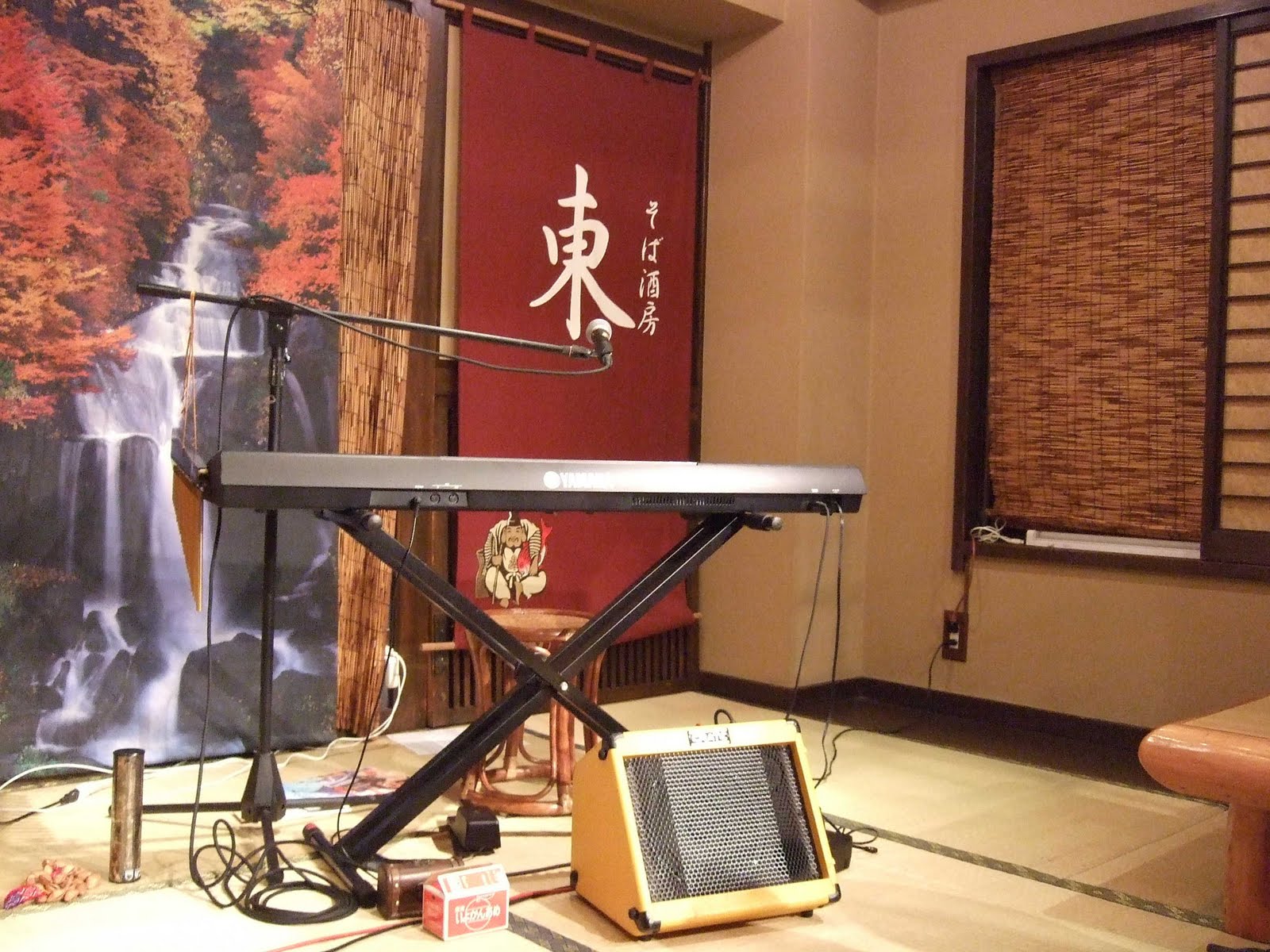
The venue was Azuma Soba Sake House in Asagaya. Performing was Yuyake Lamp's Yunn on keyboard and Tamarou on cajon, the Peruvian percussion box.

The soba joint was designed like an old-fashioned Japanese house, with tatami mats and wooden pillars. The air smelled of soy sauce; kitchen noises accompanied the music.

As the crowd slurped noodles, Yunn sang and played the piano in that way of hers, as if it's only for her most trusted friend, as if the audience aren't strangers.

She said the office that produced the band's last CD (Yuyake Ballad) went bankrupt after the Lehman shock, so their next album will come out at first on iTunes. Yunn, who devours National Geographic-type programs on foreign cultures, marveled about how a financial crisis also brings the world together.


The soba that the waitress brought me was thin and al dente—on a normal night it would be eaten last, after getting through some sake and dishes like sashimi. The waitress was casual and didn't seem too concerned about formal manners. A straightforward, unpretentious Chuo line personality, I thought. (Tokyo has somewhat different personalities according to the area, I think.)


The only thing I wished for was for the audience to treat the show more like a party, chatting and drinking, and less as something serious like a Classical concert. A little hot sake, talk with friends, great jazzy pop music in the background, and soba to wrap it up—that would be perfect.

Sunday, September 19, 2010

Three Berry Icecream, Acoustic Soft Parade

Many of the musicians friendly with the group Three Berry Icecream live in that rectangular zone in Tokyo west of Shibuya, surrounding Shimo-Kitazawa, along the Inokashira-line and east of Mitaka. It's a (relatively) green area, with modest homes for the most part, school kids, locally run shops and restaurants, and a feeling of community. Tokyo is a huge metropolis, but inside it are lots of neighborhoods that are like small towns. Leaving those communities, their residents are swept back into the anonymity and isolation of Tokyo's large crowds.

I thought about these communities because I knew that the musicians playing an afternoon gig at Mona Records belonged to them. Living just a few blocks apart, bumping into each other in the local market, chatting on the street—those are important things.

Mona Records is one of those nice local cafe/clubs in this community. I hadn't been there in a while. Before, people performed on the second floor, taking off their shoes to play on the raised floor, in their socks or bare-footed. Now they had taken over an old Go club on the third floor and made that into the performance space. The windows were open and I could see on the roof next to the club a platform to hang laundries, next to a vined wall.

The musicians have known each other for years, giving the event a relaxed reunion feel. Kiyotaka Sugimoto, the vocalist and keyboardist for the late Orangenoise Shortcut performed together with Shunsuke Kida, the leader of Little Lounge Little Twinkle; Mayumi Ikemizu's Three Berry Icecream also featured Little Lounge's violist Keiko Tanaka, Corniche Camomile's guitarist Yasushi Sakurai and Sugimoto.

A third group that played that afternoon, Acoustic Soft Parade, was a happy discovery. They played soft pop with tropical-sounding percussion, and the whisper-voiced vocalist had a shapely, round stomach—she was due the next month. As she sang, little kids screamed in the audience section, but that was fine—it was a crowd that included young parents, and they were used to children. As fans of Shibuya-kei grew up and became parents, time passed in other ways too. Another friend of Ikemizu's, an artist named Bice, had recently passed away, in her late-thirties. Three Berry Icecream covered one of Bice's songs, in memory.

Saturday, September 11, 2010

Luminous Orange And Furukawa Miki At Unit

Luminous Orange, Rie Takeuchi's shoe-gazing, My Bloody Valentine- and Sonic Youth-influenced band, is my one of my favorite Japanese indie groups. They just released a new album called Songs of Innocence, which I liked a lot, so I went to see their gig at the Unit.

Appearing as a 'special guest' at the show was someone special indeed, Miki Furukawa, former bassist and vocalist for Supercar. For someone of my age and with my musical preferences, Furukawa is almost legendary—Supercar's ever-evolving alternative rock must have inspired the launch of a ten thousand Japanese indie bands.

Others may have shared my awe, because when she came on stage there was a whoop from the audience. She was tiny with short hair and a small face that contains that over-sized lipped mouth that looks like something internet ads try to sell to women. Saying only hi at the start and thanks at the end (I seem to remember that Supercar never talked on stage either), she put on a decent performance, with a powerful female drummer standing out most in my mind. Luminous Orange came on next, and during the entire first song I thought the keyboardist was Takeuchi because she was at the center of the stage and also singing (though it was actually chorus), when in fact, Takeuchi was at the very left of the stage, so I didn't see her at first. It was a spirited performance too.

But...ok, to be honest...I was a bit bored during both sets. It's unfortunate, but I think live bands like these suffer from the legacy of the shoe-gazing style, and the belief that music should be listened to for its own sake. There's not that much engagement with the audience. I can understand how the attitude must have come to be, as a reaction to the excesses of over-produced musical performances, and I sympathize with that. But what does the musician offer instead? Maybe great live music? What I heard at the Unit, though, didn't seem to go much beyond the recorded music. I also no longer can keep up my interest in musicians just because they were legendary for me at some point in the life, if they don't have the goods now. In other words—for the first few minutes, I'll be thinking, 'wow, that's Furukawa Miki!' But unless then the gig really rocks, I'll start pondering where to get dinner afterward. It might have been better if it was at some intimate live house with character, where the music fuses with the atmosphere of the place. The Unit remains one of my least favorite venues in Tokyo, with apathetic, unfriendly staff.

Before the hate mails are typed, may I remind readers that I am huge fans of both of these groups, owning all of Luminous Orange's CDs as far as I know, for example. I just didn't come away on fire from the show.

Friday, August 27, 2010

GREAT SONGS: advantage Lucy's "Nico"


The ballads of advantage Lucy! Japanese musical national treasures!

Songs like 'Koko de Oyasumi (Rest Here)' from their Memai EP; 'Today', the B-side of the Hello Mate! single; 'Hibikasete' from oolt cloud; and 'Nico', from advantage Lucy, back when they were still called Lucy Van Pelt.

I could write about any advantage Lucy song; all of them are good. But the ballads are especially beautiful, marrying Ishizaka's genius for creating melodies with Aiko's poetry and heart-felt vocals.

Nico of the song's title is the late German singer, model and one-time Velvet Underground collaborator. Except in the song title, she isn't mentioned at all. Maybe it's that the mood of the song is like something that Nico herself would have written. Or, maybe the song takes place in a scene where Nico records are playing in the background.

The lyrics are impressionistic. A girl wakes up before sunrise, hearing rain outside. She lights a candle. And she walks outside. The mood is of sadness, resignation and faint hope—though the causes of these emotions aren't given. (I wonder if Aiko was aware, when she wrote the lyrics, what a tragic figure Nico ultimately became?)

The candle that the girl lights, irritated but wishing, becomes a “lonesome heavenly body (sabishige na tentai)”.

And then, those ever-shining lines:

Moshimo kotoba ga hoshi yorimo

Kazoekirenai hodo arunara

Tsutaerareru kamoshirenaikedo


If words were numberless like stars

Maybe then I could explain


But she thinks it's not that important. And she goes for a walk, expecting the morning to be bright when the sun comes out.

And that's where the song ends. But leaving me with a feeling I'd also try to describe, if only words were as numerous as stars...

Thursday, August 19, 2010

My Seoul

I went to Seoul, after a too-long absence of six years. In 2004 I traveled to Korea together with Japanese bands like advantage Lucy, Swinging Popsicle and Plectrum, getting to know them for the first time.

This time the mission was simply to meet friends and to consume lots of Korean food and booze. Soon enough, in the summer heat, I was sweating garlic and soju. A new discovery was makgeolli, the Korean rice wine—I had it before, but never realized what a variety of flavors it can contain, from super-sweet and bubbly to mild and subdued. At a great makgeolli bar in Hongdae called Taste of the Moon, they served many different types of the wine, and North Korean beer too (it was decent, but I wondered who was able to drink it in that country). As is always the case, kimchee accompanied the makgeolli. Red and white, spicy and sour and sweet and effervescent—unique combinations. Korean food is often explosive—there's a little green pepper that destroys the taste buds for about 10 minutes, paralyzing and burning the tongue, and nothing seems to be able to cool it down. The BBQ places are smoky and the floors slippery with grease.

I went to a show at Hongdae's Club Ssam with my friend Martin, but it wasn't very satisfying. The couple of bands that performed were technically skilled and acted like they were playing an arena, when in reality it was a small club with a couple of dozen fans and the music wasn't that original. But the show made me wonder about the musical impulse. What inspired the musicians to form a band? How long will they continue? Will careers end their bands? And who are the fans? Why did they choose to spend a Friday night at the club rather than some other place?

Over beers I talked with another friend, Wonyul, about Korean music. He thought the problem with Korean pop music is that it's almost uniformly influenced by Japanese enka, usually even without the musicians' knowledge. It's a legacy of the Japanese colonial era, and Wonyul thinks the enka influence prevents Korean musicians from creating their own sound. His answer is to look elsewhere for inspiration, to try out music that isn't listened to much in Korea like blues. But while experiencing new styles of music must be worthwhile, I wasn't sure whether it could, just by itself, help a unique new sound to come into existence, and felt that that would be my friend's big musical mission in coming years.

He gave me a pile of indie Korean CDs that I'm now working my way through, including a nice album called Hanei Sky by Cosmos.


In the sweaty summer heat we hopped from one beer joint to the next, one on the third floor reached climbing what looked like a fire escape. Behind the counter at a couple of places were shelves filled with CDs and LPs and barkeepers who were serious about music. Knowing no Korean, I had to rely on my friend's interpretation, reading body language and guessing to figure out what was happening and what sort of ideas and thoughts occupied the people. But only in Seoul for a few days, it wasn't possible for me to get a very good sense of what the people were like. Still, that's my Seoul. It's a different Seoul than what someone on a tour package may see. It's a Seoul presented to me with the help of good friends, vivid and flavorful, populated with people that care a lot about music.