Not sure what it was but when Umekichi came on stage in her light pink kimono and started a traditional dance, my eyes started watering up, and they didn't dry during the first few songs. It happens sometimes—perfected art makes me emotional. And Umekichi's dance—confident, flowing, graceful, and bearing the weight of centuries of tradition—was indeed beautiful.
I've written before about Umekichi, a singer of old popular tunes and geisha songs. The last time I saw her was in an auditorium, but this time the venue was more intimate, a live house in Daikanyama with the unusual name of Haretara Sora Ni Mame Maite, which means, 'if the sun comes out, toss beans at the sky', apparently a line from a poem.
It's a small hall with aboriginal-looking illustrations of branches and vines on the orange walls, and in the back is an elevated stage with a red umbrella where audience members can sit on the floor. The crowd was a mature one, mostly over thirty, many gray hairs, and 'around-forty' ladies who drank draft beer. But there was also one little girl who shouted a big 'Hai!' when Umekichi asked if anyone had come specifically to see her.
Umekichi's show was like entertainment from another era, less self-important about the music, more of an effort to make it feel like a casual gathering, even though the professionalism was obvious. The songs, accompanied by the shamisen and the sparse beats of the taiko, were mostly over in minute or two, and the singer filled the rest of the time with talk, elegant, humorous, sometimes mildly flirtatious. Umekichi often does her sets at rakugo theaters, and her act reminded me of the spirit of that storytelling art: be an artisan of words, giving it your best effort to put the audience at ease and to get them to have fun.
***
The event also featured a genuine rakugo artist, in addition to a woman who played what might be called koto jazz. The rakugo guy was the 28-year-old Kichibo Katsura, a practitioner of Osaka-style rakugo. I'm no expert, but it seems that rakugo has always been big in Tokyo and is making a come-back in Osaka. Rakugo is a spoken art so knowledge of Japanese is probably needed to enjoy it, but if you know the language, it's great entertainment. It's uncanny the way that when reciting a comedic rakugo tale, just one man in kimono sitting on a cushion can play multiple roles and seamlessly switch between one character to the next solely with a turn of the head, a slight change in expression, an adjustment of the voice. Kichibo had that down. But I think it's a deep art—how could it not be when you're expected to keep an audience interested and laughing with just your words—and I got the feeling that to really master it, to learn to draw the crowd into the tale and to lead them to that ultimate, sublime rakugo punch-line, is something only decades would bestow.
Alas, at the moment I can't think of a nice, round '10' favorite albums for 2009, and can only come up with eight. I'm not sure if that's because it wasn't a good year, or I just wasn't looking hard enough (always a possibility). Still, there were some bright spots—my two favorite albums of the year were also a couple of the best in the last few years, for one thing.
#8. Soutaiseiriron Hi-Fi Anatomia
For reasons explained in a previous post, I'm not a huge fan of the Soutaiseiriron's activities as a band. I don't like it that they've imposed a media black-out on their image. Maybe I'm traditional, but I want more than just music from favorite bands: also desired are their words, their visuals and fashion, the whole package. So, the 'faceless Soutaiseiriron' falls short for me. But, judging solely by their music, it does appear that Hi-Fi Anatomia is one of the better albums of 2009. The melodies are unfailingly catchy, and then there are the vocals of Etsuko Yakushimaru—soft, sleepy, yet also emotional and sexy, a wavering desert mirage voice. If these guys can make a few more albums as good as this, I may have to forgive their tiresome image control policy...
#7. Perfume [The Right Triangle Album]
Moving along to about the most un-indie Japanese group one could come up with, a trio of dancing girls who don't even write their own songs, still, it's impossible for me to dislike the effervescent, bright plastic sound of Perfume. Their latest album has its share of skippable fillers, but “Love the World”, and, especially, “Dream Fighter” and the finale “Negai” are great songs. One interesting thing about Perfume is how wholesomely inspirational some of their lyrics are. “Dream Fighter”, for example, is a song about striving to do your best: “It must be evidence we are living that we take this endless trip to seek perfection” goes one line. Perfume's brilliant young producer Yasutaka Nakata (also of Capsule) is responsible for the trio's lyrics, and it makes me wonder whether lines like those were commercially-inspired—being the sort of stimulating lines that young consumers like to see accompanying appealing melodic hooks—or whether it reflects his own feelings. Probably, both. (The album title is an image of a right triangle, so I'm calling it the Right Triangle Album.)
Hoover's Ooover was probably my biggest discovery of 2009. Well...actually, I knew of them since at least 2004 or so, but it took me fully five years until I figured them out. And repeated listens were required of past songs like “Palette Knife”, “Propane Gas” and “Rival Wa Rickenbacker” before I recognized them as classics. Even now, it's hard to put into exact words the attraction of Hoover—some combination of Masami Iwasawa's Literature-conscious lyrics, the distinct emotionalism of her singing, and the driving rock. Moving on to this album: I still don't really get it. With the exception of the exhilarating, quick-paced “Mamimumemo” (for which the band made an animation video), I haven't found a tune as good as their past stuff including the three mentioned above. But, considering the long time it took me to turn on to Hoover in the first place, I'm reserving judgment and putting it in as a favorite, on the assumption that I'll eventually see the light.
Combine an 80's New Wave-like synthesizer pop sound with a powerful singer who seems to dive into an ocean of feeling with every phrase of a song, and you get one of my favorite groups, Nirgilis. Their latest, RGB, isn't one of those albums you finish listening to on fire with the fresh realization of what an album can be; it feels more like a collection of singles; but they're excellent singles, including “Rainy Day”, “Koi no Resistance” and “Update”. As with their other work, RGB is a pick-me-up sort of album.
This Osakan punk quartet KO-ed me twice: the first time when I saw their frenetic live show at the Loft with Asakusa Jinta, and the second, when I listened to their album, which I hurried to buy after the Loft gig. What makes their high-energy but pretty ordinary punk rock special is the vocals of Junzo, a tomcat voice spouting lines all in Osaka dialect, his words tapering off at the end like flaming jet plane tracks. I've only listened to this album a few times, but I'm going to be punk rock about the decision and immediately declare it my fourth favorite of last year.
Number three is by one of my recent big favorites, Quinka, With A Yawn, the solo unit of Michiko Aoki. Quinka's Field Recordings was my best album of 2008; [Su] is great too, but it's lower down on the list because most of the songs are new versions of previously released tunes. Still, this is an album that puts on vivid display the poetry of Quinka songs and the growing, touching expressiveness of Aoki's singing. I particularly like “Harunire”, which I wrote about recently, and “Story”, a ruby of a song that comes at you like dream music during a twilight nap.
Cupra took me by surprise. I'd been a fan for a while of Frenesi, another one-woman unit, but even so this album far exceeded my expectations. It doesn't sound like anything Frenesi's done before; it doesn't sound like anything I've heard before. Frenesi takes a big gamble with these songs—everything is on the verge of just not working, the vocals almost, but not quite, too child-like, soft, out-of-tune, the music almost, but not quite, too silly, forced, the lyrics on the verge of being senseless and self-absorbed, but in the end, not. Instead, by taking things about as far as they can go, Cupra ends up with songs that walk in new territories ...Unless you don't have the ears for this sort of music, and something about it makes it fall flat for you. That's Frenesi's gamble—this isn't music that will appeal to everyone.
My favorite songs are “Kasou Kako (Virtual Past)”—like a children's TV song that mutated into an alternative hit; “Sky Bus Tokyo”—wherein our heroine sings place names, 'Chidorigafuchi, Kasumigaseki, Tokyo-eki, Marunouchi' etc. to underwater kingdom background music; “Watashi no Yes-man”—a bossa nova piece that seems to hide within it something icy and tragic; and “Lowitz Arc”—like an unexpected karaoke gem in a far frontier disco bar.
I dig Asakusa Jinta's vision: the way they unearth old and obscure Japanese sounds, mix them together with modern ingredients like punk and rockabilly, and end up with something totally new; the engaging theatricality of their performances, the bright, hipster costumes, the dancing horns, the waving banners; the retrospective, Showa-feel of many of their melodies and lyrics, that nevertheless speak to us, music lovers of the 21st century.
Their latest album, going even further than their previous, dazzling Sky Zero, establishes them as hard-working, talented inventors of new sounds. Setsuna ranges from a tune out of a fuzzy pre-war radio (“Junpuu Yakyoku”) to a frenzied drum-and-horn cabaret number (“Grand Cabaret”) to a ballad that could accompany some energy-overflowing 60's Japanese youth movie (“Star”) to an epic, deep rock anthem (the title track) to my favorite single of the year, “Tokyo Sabaku De Jidanda”, an unstoppable musical orgy of fast, exploding bass notes, far-gone screams of horns and guitar, and in the background a super-cool but insistent Japanese male singing about the Tokyo sabaku, the metropolitan desert.
Amazingly, it all holds together. And it tells a story, purely musical, without plot, about what Asakusa Jinta is.
Setsuna is a Buddhist word that means the briefest moment in time. The 54 minutes of the album is also not long, like the dream on a spring night. But it's vivid.
***
ONE EXTRA:
I only found out until after I created this list that the girl solo unit formerly known as Hazel Nuts Chocolate, now named HNC, released a new album in December called Cult. A few listens and I'm fighting the urge to possibly prematurely declare this new work a masterpiece—but wow, is it good...After more listens, it might turn out to be one of my top three favorites of 2009. Yuppa, the HNC girl, has jettisoned her image as a children's picture book-made-into-music type of composer, and transformed herself into techno-addicted, random-sampling-manic (meows, 'uno, two, tres, four'), sexually-sometimes-sorta-explicit ('all day long walk a girl/with a little lips/little crack/little fxxk/every little girl things' goes one line in the great song “Girl Things”), edgy-cover-art artist. “Girl Things”, in particular, I love, with its attractive melody, and the feel that it may be one of the first steps in a new movement, of songs written by girls, for girls, about girl things.
Strange how standing on the concrete floor of the Que can feel sofa-like, at a pal's pad, when there's good music.
And there was, including Contrary Parade. Their drummer always sends me invite emails to their shows when they come in from Osaka. Now they're all moving to Tokyo, so I'll be able to see more of them. Contrary Parade sounds to me post-Waffles, which for its part is probably a post-advantage Lucy band. I like the way the three girls at the front of the stage (they're all girls except the drummer) giggle elegantly during breaks between songs.
Ashigaru Youth, also from Osaka, featured two male vocalists/guitarists with full cheeks, double chins, and round stomachs (photo at the top). 'Ashigaru' means a samurai foot soldier, but its literal meaning is 'light-footed', which may be ironic in this case. But the duo sang beautifully, and the band's power pop was pleasing. Their girl fans were lined up in front of the stage, dancing along to their songs. I may have been affected by a beer and a glass and a half of whiskey and soda by then, and though it might have partly been flattery to the venue, even so I was touched when they said they've dreamed about playing at Shimokitazawa's Club Que and were therefore very excited to be there.
Wrapping up the event was Plectrum, a great band I wrote a lot about when this blog was getting started. I eased off on the reports on them after a while even though I continued to see them, just because I'd said so much already. But seeing them tonight reminded me that when they start playing it can be space warp-like and I'm in a place where time is filled with pleasurable music action. I remember why I was so crazy about them. Fourteen years as a band, and they were probably good to start with. And it feels very worthwhile that they are making music like this. Times like that, the real message I want to send is: there was something there.
I knew Japan-Kuruu-Special was a band worth checking out when I took a look at their website, the funnest I've seen in a while.
It parodies a sports tabloid, with eye-catching primary colors. Where the breathless, huge tabloid headline would go is an announcement that Kuruu is going on a national tour. The cover art features four bosozoku-looking guys with gigantic pompadours and afros, astride an old Japanese automobile shooting out from the Rising Sun (and there's a fineprint in the corner saying, 'Note: We're not actually bosozoku [biker gangs]).
Their profile page is headlined, “Not Again, Osaka! Japan's Most Powerful Violent Music Organization Is Formed In A City-Run Slum Housing Project”. In the corner is a picture with the caption, “The Osaka city-run housing project where the incident occurred”. Taking up all the left part of the page is, as if introducing secret pictures of notorious gangsters, another headline saying, “EXCLUSIVE: Pictures of the four members!!” The drummer, whose afro is bigger than his face, wears one of those ominous surgical masks that bikers are said to wear with a red line cutting through the middle.
Crazy Osakans!
Anyway, Kuruu was on tour and playing with Asakusa Jinta at the Shinjuku Loft, so I headed over. It had been a while since I last walked through Kabukicho on a Friday night, and I lapped up the town's erotic, drunken, seedy, money-hungry energy, the hostesses in their dresses, the hosts with their long locks and shiny suits, the real and phony gangsters. How many other towns are there like this in the world, this Far Eastern Sodom? Maybe it's the recession, or maybe it's a reflection of Tokyo's increased internationalization, but several touts invited even me, an obvious gaijin, for an evening of flirtatious conversation in cabaret clubs. Ignoring them, I walked down the stairs to the Loft in a building whose every other tenant appears to be a girl bar or red light establishment of one sort or another.
Kuruu lived up to their “exclusive” photos: they did have monstrous poofy pompadours and afros. They were like a cross between the Ramones and Carol-era Eikichi Yazawa. The singer, Junzo, stood nearly the whole time at the center with one leg permanently on the stage speaker, and he went through every cliched rock gesture there was, but since he did a new one on every single beat, twirling the mike stand on one beat, doing a clenched fist the salute the next, kicking the air the next, etc, it was great fun to watch. In front of them in the audience section was spirited slam dancing, including a few guys in business clothes, maybe letting off some steam after a hard day at work. This was a good band—Junzo said between songs, in a joke-filled, earthy Osaka dialect, that they're aiming for the Budokan. Who knows whether they will make it there, but these guys might become popular.
***
It had been a few weeks since I last saw Asakusa Jinta and when I heard Osho slapping the bass while setting up for the show, those precise sonic explosions, it came back to me what this band was all about. His bass comes down like bomb runs, destroying our day's banalities and boredom. And the band's music, a beautiful fusion of hard rock and horns and old Japanese popular music, illuminates something inside me I'd forgotten about.
Their latest album and title track are called Setsuna, which is a Japanese word meaning the briefest moment of time. It's actually a Buddhist term—according to trusty Wikipedia, it comes from the Sanskrit word ksana, and if you divide one day by 30, and then divide that again by 30, and then divide that by 60, and finally divide that by 120, you get a setsuna. So one literal school of thought says that a setsuna is 1/75 of a second, but another denies this, saying that you can't measure it.
The period of time watching Asakusa Jinta is always a pleasurable one. These guys are professionals of entertainment, proud shokunin, artisans, of music, and they are committed to making the show fun for the audience. The 30 minute shows like these are dense in content, but go too fast, though maybe that's because this is another sort of setsuna, just a blip in the long flow of time.
Until quite recently, I had no idea there was surfing in Fukui prefecture. In fact, it never really occurred to me that people surf on the Sea of Japan side. Which is ridiculous if you think about it: if there are good waves and a beach, surfers will come.
Anyway, what awoke me to the realization there's surfing in Fukui was the discovery of a great surf pop-punk band called Browny Circus from that prefecture. They were one of those groups whose CD I bought but didn't listen much to, until that one moment, when, during a random listen, suddenly I got pounded by their brilliance. I remember when. I was walking in LA, listening to their album SURF-TRIP! on the iPod, when the song “Ride On” came on. When it was over, I repeated it. And then again. And again...
An energetic but fairly run-of-the-mill 2-minute pop-punk song, the thing about it that got my attention was the vocals. It was an unusual female voice that was sweet, nasal and kid-like. But there was also electricity that ran through it—it tapped into some rock current. It was a cherry coke voice, spiked with some rum or vodka.
When I got back to Tokyo, I bought their other albums, and found great tunes like “Super Surf Jet Girl”, “Happy Days”, “Summer Beach” and a nice cover of Sadistic Mika Band's “Time Machine ni Onegai”. I also learned that while Browny Circus had disbanded, the vocalist Kaori had formed another group in Fukui called the Capris. I daydreamed about traveling to Fukui, about a four hour train trip northwest of Tokyo, to see them perform in their local scene. Fukui wasn't a strange place for me, in any case. I'd been there one winter, and had one of my most memorable seafood dinners ever—fresh shellfish popping over a fire, the meatiest crabs...
I wanted to see what Fukui surfers and surf rockers were like, and the characteristics of their scene. What was a Fukui live house like? Did the musicians talk in a Fukui dialect, stretching out vowels at the end of words in that distinctive way? Mostly though, I wanted to see what Kaori and her new band were like on stage.
But, alas...a few weeks ago I read on their website a short notice saying they've decided to call it quits. Now the website itself is gone. My Fukui pilgrimage to see the local surf punk wasn't meant to be. Unless...perhaps Kaori will one day form yet another band?
***
By the way, one thing I've been pondering recently is that fact that so many great Japanese girl rock bands and groups led by girl vocalists were formed in the 90's, and what was behind that band boom. Just listing my favorites, this was the period of Browny Circus, the sublime Teeny Frahoop, Mix Market, Ketchup Mania, the Automatics, and the genius Supersnazz. What were the factors that came into a perfect alignment to lead to the birth of bands like those? A major thing is there must have been a shift in consciousness that made it normal, acceptable, and cool for girls to play together in a rock band. How did that happen? (And I'm not saying there weren't girl bands before the 90's, the idea of them just seems to have become more normal in the 90's. Am I wrong?) K.O.G.A. Records' Mr. Koga must have been one big impetus too: all of the bands I listed above except Supersnazz have recorded on K.O.G.A. I don't know how many of that label's CDs I own.
What's the status of girl rock bands now, nearly at the end of the turn-of-the-century decade? Honestly speaking, I haven't discovered that many good ones recently. Sometimes I wonder if (for reasons I haven't worked out), rock in Japan is reverting to be a guy thing. Or am I missing awesome great girl bands I should know about?
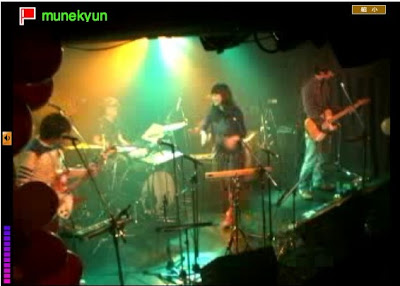
How remarkable it is that you can now watch a live Tokyo rock show 5,000 miles away on the internet. From LA, on a vacation, I caught advantage Lucy and Vasallo Crab 75'sMunekyun arpeggio show. Sitting cross-legged like a Buddhist monk, I meditated on the MacBook plopped on a stack of futon, that beamed in live music from Club Que in Shimokitazawa.
The picture quality from the single, stationary video camera was basic: the performers looked like little dolls in a toy box, their expressions indistinct. The stage lights melted and trickled down as colored boxes of pixels. But the sound was surprisingly good, crisp, and giving a feel for what it must be like to be at the Que. Also, this time, unlike when I watched Munekyun TV, the signals were stable, and the webcast never froze—I'm not sure if that's because the organizers fixed things or it was because I had a better set-up here in LA (which would be ironic if I can watch a webcast better 5,000 miles away than 3 miles or so away from my Tokyo home...).
What's missing, of course, is that feeling of being in the live house. The huge noise that envelops you. The perfume and sweat of strangers. The wonder of seeing favorite musicians up close, creating music for that moment that will never be repeated again. Maybe one day technology will find a way to reproduce even those things...
I have to confess I only watched about an hour and a half of the show, because it began at 2:30 AM LA time, and I was wiped out by 4. The portion I saw was fantastic: the concept was to have continual performances on the stage, without breaks between bands, and instead having new musicians walk on to play as each song ended. The guest musicians were all people that were friends with the late Lucy and VC75 guitarist Takayuki Fukumura, whose memory this annual event celebrates, people like Three Berry Icecream'sMayumi Ikemizu, the Primrose's Keiji Matsui and Round Table'sKatsutoshi Kitagawa.
Here's an excellent review of the show from someone who actually went. This person put into words something I've always felt, but, in one of those forehead-slapping realizations, in 400-plus posts I don't think I ever wrote down (though I hope the spirit of this has seeped through to the surface in my stories...):
What made the performance really really special, aside from the guest musicians, was how the two bands engaged the audience. This is probably the one thing I love about Japanese bands, indie or not. They make an effort to let you now that hey, you exist and we know you’re standing right in front of us now, enjoying our music. It’s a real interactive, human experience that I don’t get with most of the Western bands, who while enjoy themselves on stage seem to be going through the motions of performing yet another time.
These webcast shows are neat because they embody musical freedom. Anyone with an internet connection anywhere in the world can tune in for free. They are the opposite of strictly supervised, exclusive, expensive corporate music events. Until the picture quality improves enough that I can see the performers well, I probably won't be watching many webcasts of artists that I'm not already fans of. But I have a feeling things will get better fast. And in the meantime, I hope bands continue with this great idea.
Brain Police, also known as “the radical protest band” Zunou Keisatsu, is near the zenith of the celestial list of legendary Japanese rock groups, so when I heard they had reunited and were doing a national tour, I was intrigued. But, for a variety of reasons I ended up not making it to the Tokyo shows, a major one being that the tickets were pricey, about three times the cost of regular live house gigs. Did anyone go?
Zunou Keisatsu's legend and notoriety stem mainly from their involvement with radical leftist politics in the 70's, and the banning of their first two records because of the controversial lyrical content. As Julian Cope writes:
They were formed in the late ‘60s by vocalist and guitarist Panta, who had formerly played with festival obscurities Peanut Butter, Mojo and Spartacus Bunt, and Brain Police songs were all built around the guitarist’s fist-in-the-air people-at-the-barricades lyrics. Taking their name from the early Mothers of Invention song ‘Who Are The Brain Police?’ the band survived long enough to make six LPs and continued until the end of 1975. However, there are two obvious peaks in their career, the first being their rousing duo performance at the GENYA anti-airport protest festival, when Panta and conga player Toshi shared a bill with Blues Creation, Masauki Takayanagi’s free rock New Direction For The Arts, and Keiji Haino’s Lost Aaraaff. Performances of the songs ‘Pick Up Your Gun’ and the seven-minute chant ‘World Revolutionary War Declaration’ received such a positive response from the crowd that the nihilism of closing act Lost Aaraaff was greeted with large rocks hurled from the Sanrizuka fields.
One thing I wonder about this band is the extent of its interaction with the Japanese Red Army. There's the matter of their first album containing a song called "Red Army Soldier's Poem", though, in an interview with the great Jrawk.com site, Panta says the song comes from a Bertolt Brecht poem about the Red Army in Germany, “but politics in Japan were so sensitive that nobody bothered to pay close enough attention to find that out.”
OK...but then Zunou Keisatsu's website also says that in 1972 the guys performed at a memorial event for the three Japanese Red Army members who were killed at the Lod Airport massacre (is this a mistake? I thought that two of the three perpetrators died, while the other was arrested). A few questions come up for me: did they sympathize with the purpose of the event? If not, was this just an instance of musicians playing at a show because it was happening? What did they think of the 26 people killed by the Red Army trio?
And, moving on to the 21st century, what's this about Panta and ex-Red Army leader Fusako Shigenobu exchanging letters and writing songs together?
I'm assuming that this all reflects how Revolution was in the air in early-70's Japan, that Panta liked the idea of a worldwide communist uprising, but that he was first and foremost a musician rather than an activist. Was it all radical chic? But I am curious about what he thinks about the legacy of the Red Army and his verdict on people like Shigenobu. I haven't dived deeply into the literature on all this; I just read some stuff online. So maybe the answers are out there...
Anyway, the show. It was two weekend nights at a place called The Doors, but the tickets were 6,000 yen (about $60), way more than the usual price of around 2,000. And I thought that leftist bands were supposed to ask for donations—kanpa (short for the Russian word 'kampaniya'), so that the workers attending their shows pay as they are able? However, as a friend said, 'you need money to fund the revolution,' I guess. Plus, the shows were sold out or nearly so, and, with exceptions for those by favorite bands I generally try to avoid sold-out gigs because they really pack you in Japan at those events and you start having flashbacks of rush-hour Keio Line trains... If anyone caught them, I'd love to hear if they lived up to the hype.
(A final pedantic note: the Japanese for 'brain' of Brain Police has been spelled both zuno, and zunou. The problem is that the last O in zuno is a long vowel—you stretch it out when you say it. The formal, academic way to write it would be to put a macron, a horizontal line, above the O. Most rock 'n' roll types can't be bothered, so they spell it Zuno, macron-less. I like the way it's rendered in kana, with a U, after the No character—that seems to give a good feel for the pronunciation.)
It was a live internet broadcast of advantage Lucy and Vasallo Crab 75, ahead of the Nov. 26 Munekyun Arpeggio show, and for me it was unstable at first, the screen froze often, but toward the end it became smoother, and I had no trouble seeing their performance of a song that Fukumura-kun wrote, which was fantastic.
And the Nov. 26 show is going to be broadcast on the internet too!
What a great idea...though one day we're going to laugh about how much trouble it was to watch these things, and the young will wonder why it was such a big deal for us to do something as simple as broadcast something online to the world...
The sixth anniversary of the passing of advantage Lucy and Vasallo Crab 75 guitarist Takayuki Fukumura is approaching, and in Japanese Buddhism it's an important occasion, so the show this year on Nov. 26 is going to be extra special. The bands are even planning an internet TV event this Sunday to get prepared for the event, called Munekyun, which in a previous post I described as "a favorite word of Fukumura's—it's that feeling you get when a cute or lovely thing bulls-eyes your heart".
So, if you are a fan, and understand Japanese, or don't but want to see it anyway, tune into this site here, at 9PM on Sunday the 15th for fans in Japan, or 10AM Sunday for those who love Lucy in Brazil, or 7PM for the true believers in Indonesia, or 1PM for the smitten in Sweden, or 4AM for the sleepless in California, etc. etc.
I don't know if it will work in all these places, but I hope it will where you are.
I doubt many people will ever make it to the Mori no Terrace in western Tokyo, but I like its concept so I'll write about it anyway.
The 'Terrace in the Forest' is a two-story home in the city of Chofu, about a ten-minute walk from Sengawa station, and the ground floor living room with a grand piano is used for mini-concerts. It's in one of those neighborhoods in suburban Tokyo that amaze you with their quiet and peacefulness if all you've seen of the capital is its crowds and bustle. The Terrace is reached walking down stone steps amidst trees.
I was there to see Three Berry Icecream, the band of singer and accordionist Mayumi Ikemizu. Unfamiliar with the area, it looks me longer than I expected to get to Sengawa: from Shinjuku, I first got on the semi special express to Meidaimae, then took the express to Chitose-karasuyama, and finally boarded the local for a one stop ride to Sengawa. Wonder if there was an easier, faster way? The living room was already packed; but I could watch the show from above the room, through a window with wooden railings. Later on, I sat and listened to the other performers in a Japanese room, with tatami mats. The brown and dark orange wood, the trees outside, and the incent smell of a burning mosquito coil reminded me of when I was a kid.
The show's concept was to be a music concert a mom could bring her baby to, and there were lots of little kids running around and exploring the garden. Songs were punctuated by the screams and cries of the children. On the pamphlet for the event was a note saying that “there is a diaper-changing and breast-feeding corner in the Japanese room next to the entrance.”
This isn't where cutting-edge music is made; but I still like it. I like it that people have made their home into a little music hall, performing music locally. And it's good to see people continuing with music, and not dropping away after their twenties, like so many sadly do.
***
An after-show party was held in a funky old yakitori joint near the train station, and at the table next to ours I saw a guy meeting his fiancee's parents. He was doing all the right things, and the parents seemed to approve: he sat on his knees in a seiza style; he spoke formally and with respect; and he asked the dad for advice. But...this was happening in a yakitori joint? And all four were wearing casual clothes? There were some mysteries for me, but then again, I was only eavesdropping...
I've been curious about a band called D.W. Nicols, mainly because of the name. It must refer to C.W. Nicol, the Wales-born writer and environmentalist, who lives up in the hills of Kurohime, Nagano Prefecture. After adventuring in the Arctic and Ethiopia, Nicol came to Japan to learn karate, wrote a book about whaling, befriended authors like the late Takeshi Kaiko, and is now a Japanese citizen. Are these guys fans? I tried to find an explanation of their name, but was unsuccessful.
D.W. Nicols was playing with advantage Lucy at the Que, so I had a chance to see them. A two-guy, two-girl quartet, they were unusual in that the girls made up the rhythm section, while the two guys took care of the guitars. Their overall sound was blues-rock and country-rock. The songs were well written, the playing skilled, and the lead vocalist guy had a good voice and was an engaging character. But, in spite of all that, they didn't leave a deep impression with me. Maybe it's because they're still a young band.
Advantage Lucy were great. They're an innovative band, always trying novel things, without sacrificing their melodious pop goodness—a new song they played that night used not one, but two melodicas! There's assurance in the way they perform, a product of a decade-plus career plus talent. Some of the old songs they played, like “Citrus”, “Kaze ni Azukete” and “Memai” I've listened to so many times that they feel like a part of my body. Hearing them played live reminds me they're part of me, the way its pumping makes me remember the heart, or the stomach asserts its presence after a great meal.
I heard Lucy vocalist Aiko say once that, although it may appear so, she doesn't actually cry during songs, because it ruins her voice, and she thinks about other things to avoid it. But now I'm not sure if she was being entirely honest. At the Que show, during those old songs, her eyes became noticeably red, even seen from the back of the crowd where I was. She has also said that she knows a melody that guitarist Ishizaka-san writes is good when it makes her cry.
***
During the two shows, at the front-center of the crowd was a petite Japanese man, who hopped manically during the shows, the height and speed of his jumps appearing to increase in line with his excitement level. He stood out in a relatively staid audience, and there must have been a few funny looks directed his way, but I liked the guy. I dreamed he didn't actually exist, but was some spirit of rock 'n' roll, absorbing the great music and becoming energized by it.
Just one line from the Quinka, with a Yawn song has gripped me. It's a simple line. Vocalist Michiko Aoki sings, in the [Su] version of “Harunire”:
Anata wo shiawase ni shitai.
Translated to, not very poetically, “I want to make you happy.”
Or maybe the nuance is more like, “I want to bring happiness into your life.”
It's the way she voices the words. She takes them slow, filling them with emotion over a dozen seconds. They make you feel like you are eavesdropping on some scene of an outpouring of love that you're not supposed to be witnessing.
And there's also a whiff of the radical about the line, because this is something that usually, in Japan, you'd expect a man to say to a woman when proposing. She's going against conventions—it's as if a woman is proposing to a man.
I was talking with a friend about Quinka, with a Yawn, the solo unit of Aoki, and he said Quinka wasn't his thing because the music is just too pure, too unspoiled and unbending, and his adult taste was for music that was more crooked. I could understand the view, but I like the purity. Aoki has a distinct singing voice that may take some getting used to, but I've found that the direct emotions of the singing have always won me over.
This “Harunire”, which means 'Japanese elm', is the second recorded version, the first having made its appearance in an earlier album called Micro. I have to confess that I overlooked that version—the melody was pleasant, but it just didn't have the emotional impact of this latest version in Quinka's new album, [Su]. (The version in the YouTube video above is the first one, from Micro.)
It seems that Aoki has grown a lot as a singer. Or, maybe more accurately, she's gotten so she's able to express emotions more deeply in songs. This is just speculation, but I wonder if Aoki's marriage with singer Harco has helped with this—her singing in the two's combined work, Harqua, is also outstanding. The couple are environmentalists, and they collaborate on various shows and projects with 'eco' themes. From what I've heard, they are pretty adamant about the cause. Maybe the 'purity' that my friend mentioned makes her dive deep into the eco thing, and also lets her sing in a breathtakingly direct fashion about love. As an impure adult, I almost envy the steadfastness.
One other thing about the [Su] version is that many lines she not so much sings as she declares musically, and that highlights the poetry of the words. The lines leading up to the 'I want to make you happy' climax are especially beautiful:
Dorodarake no watashi, nagasanaide (Don't wash away, mud-splattered me)
Toki ni ame yo (Rain of time)
Chiisa na ai wo (This little love)
By the way, the album title, [Su], is Japanese for 'nest', but 'su' can also mean 'plain', or 'unadorned', perhaps reflecting that this is an unplugged type of album, containing both new songs and gorgeous new covers of old ones. Recent tunes of hers like “Harunire” have convinced me that Quinka's Aoki is one of the best Japanese pop musicians out there these days.
There they were, the band I'd been wanting to see, the 21st Century group that cherishes the 60's and 70's, the creators of a mini-CD called Theme of Atami Sex Museum—Salome Lips. To a bittersweet kayou melody that made you forget you were in Shinjuku 2009, two girls go-go danced in shimmering pink and aqua, while between them, the stunning diva sang. What I noticed most were her glistening eyes, on a little face always wearing a restrained expression—the eyes acknowledged the melodrama of the lyrics, and accepted it. They made her seem like from some other place, the eyes of a sad cabaret singer in a desolate port town, in a time long past. What an enchanting actress! She sang in a low voice while her partner, the bassist in 70's hair, boogied to the retro resurrection.
Salome Lips were beautiful and captivated me, but other parts of the Shinjuku Jam event made me realize that retro music for retro music's sake can fall flat. The mediocre stuff is at an even bigger disadvantage because the music is already so old. Lovers of past music still need to create their own sound—and I think of the epitome of that, the great Asakusa Jinta.
***
The Lady Spade's MC-narrated, hip, nostalgic karaoke is nice too, but the third time around, I knew the act, including the dancing. A first time Lady Spade sighting is a shock, and should be included in any music lover's Tokyo visit itinerary if possible, but for the benefit of the regulars I hope they continue innovating.
Wow, the Jam was packed though, and there was one bartending girl to take care of the whole, mostly all-you-can-drink crowd, resulting in long lines—I was thirsty at first. They were lucky it wasn't, say, an Australian or English audience.
***
I liked this article on Tokyo, by the way, though some of it seemed to verge on the fantastic. Still, it's true in many nameless, cramped buildings, you can feel like you are in a dungeon or maze of the unexpected, something that you don't experience much except in big Asian cities.
There's something about live houses like the Shimokitazawa Shelter. They're dives—dark, dusty, falling apart—but only in these clubs do you get that sound.
The other day I went to a certain brand new live house in Tokyo, and it wasn't the same at all. The sound was clear, but a bit harsh. A friend who was there said that part of the problem might be that the speakers etc. are new—they get better with age. I'm no acoustics expert, but I do know that some people seek out old speakers exactly for that reason, for their warm, enveloping sound. The Shelter's sound system has gone through a lot, and its walls are stained with the memories of a million rock shows. The Que is like that too; as is the Jam, definitely, and the Loft.
***
A band I'd never seen before, Rangsteen, was a perfect group for this Shelter sound. A hard-rocking trio, they had the sort of muscular, angry, direct delivery that I hadn't seen in a while. I was thinking it was becoming like an endangered species; but maybe I've just been traveling in the wrong musical continents. In any case, they were my favorite band of the night.
Next up was Supersnazz, ex-all-girl rockers and now a girl-guy quartet, who were in good form as usual. Vocalist Spike was in LA Lakers colors (probably not consciously)—yellow T-shirt and purple mini-skirt. One moment of their show really impressed me: during a vocal break Spike turned around to take a swig of water, but it seems some of it went the wrong way, up her nose. You could tell even with her back to us she was coughing hard; the Shelter's stage attendant guy had this look on my face that said, shoot, what should I do, the vocalist is choking. But, right at the moment the vocal parts were to resume, she turned around to the mike, and continued with the song. Professionalism, even at a small place like the Shelter!
Band number three was a band I'd heard a lot about, but had never seen before: Firestarter. After the show I surfed the web to find out that they consisted of members of the punk band Teengenerate and the vocalist is a vocal veteran of the Tokyo indie music scene (there's this interesting interview, for example—that looks like a fun bar to visit). They were tight, they knew how to get the crowd going (at one point a middle-aged-looking man struggled to try to crowd surf, got deposited on to the stage, was escorted off of it by the attendant, was taken through the dressing room to the exit and then re-emerged later from the club entrance), and the punk/power pop music was good but, I have to confess, I didn't really get them. Or, put it another way, I didn't become a Firestarter convert on the spot, ready to follow them around to see all their future shows. It might just be that I was unfamiliar with their music. I later did take exception, though, to the vocalist's opinion in the above-mentioned interview that Japan has only produced a handful of great bands, a notion that is so self-evidently untrue that it made me wonder about his judgment...
Asakusa Kurawood may have just become my favorite Tokyo music club.
Declaring that after just one or two visits may be a tad risky—the experience could have been made rosier by the quality of the shows—but it can't be denied that this new live house has a nice vibe.
I even like the walk over there. If you have time before the show, you can stroll through the Asakusa old town just a few blocks away, seeing the temples and shrines and little shops and eateries. En route to the Kurawood is an old restaurant with wooden walls and paper lanterns outside, the Komagata Dojo, which serves dojo, a fish that looks similar to an eel and called in English 'oriental weather loach', according to Wikipedia. (The kana spelling of the restaurant is old-fashioned, so 'dojo' looks like 'dozeu'.) Also nearby is the Bandai toy company, with statues of Gundam, Ultraman and other characters on the street outside.
Entering the Kurawood, I noticed that the ticket counter girl was friendly—a contrast to older live houses, where the staff can be apathetic or worse. There was a small bar area separated from the music hall—always a nice thing for when you want to take a break from the show and have a drink in peace—and the guys at the bar were also into their jobs, plus, a bonus, the drinks were a little cheaper than other clubs, at 400 yen per glass.
But, in the end, maybe it was the crowd that made me so keen on the Kurawood: they were Asakusa Jinta fans, there to see the band in the band's home town, and you got the sense that they understood and supported the band's vision of creating music based on traditional Japan as found in Asakusa. In other words there was a clear sense of community. There were lots of little kids, and people the age of the band members' parents, and all ages in between.
The fashion for the most part was Yokohama rockabilly, Hawaiian shirts, caps and tattoos, and this was a dancing crowd. DJ-ing between bands was Ego-Wrappin's Masaki Mori, who spun old Japanese pop singles. The music, the dancing, the rockabilly hipsters and beauties around me all gave me visions of being in a 50's teen flick. Or, maybe, a scene from a Ayumi Tachihara manga.
I missed most of the first band, Tokyo Howling Record, but I liked what I did see. Calling themselves a modern kayou swing rock band, they had lots of energy and nice melodies, with a cool horn section and a girl playing the double bass. They seem to be regulars at the Kurawood, so, hopefully I will see a full set of theirs soon.
Up next was the ever-entertaining fisherman rockers Gyoko. I wrote about them in a previous post, but the gist of it is they're a rapping trio centered around Captain Tsurizao Morita, who runs a fish shop in Chiba when not rocking the crowd from his Gyoko stage. Between songs, Captain Morita talked about how commercial fishing used to be a big thing in the Tokyo area too—the city of Urayasu, where he's from and which is home now to Tokyo Disneyland, was a fishing town—“The town was more Norakuro than Mickey Mouse,” he said—and the captain's grandfather was a fisherman, but a decline in business forced him to quit. Still, he wanted to stay involved in the fish business, so he established the shop that Captain Morita now operates.
The last band was Asakusa Jinta, and it was a touching set because, as I said earlier, the crowd were genuine band supporters, and it was apparently the first time in a long time for the band to play in Asakusa, so there was a lot of back-and-forth between the band and the audience. Vocalist Osho said something mysterious about the fact that while he loved Asakusa, he was also down on some of the annoying aspects of the town (he used the Japanese word 'dorodoro' which I have no idea how to translate into English...), including that people had called the cops on him many times (??), and so hadn't played the Kurawood in a while, but that it was great to be back. I came out of the show enveloped by that warm feeling you get after seeing a great gig surrounded by a happy crowd. But, surprisingly, the band itself apparently didn't think it was their best effort; maybe they were tired after a grueling schedule that included an appearance at the Fuji Rock Festival. In any case, they are planning these Kurawood events, called 'Rocking' Shintenchi', once a month, and I'm sure they will be bringing along other great bands, so I want to go to many of them as I can.
***
By the way, Nippon Rock has a great review of Asakusa Jinta's latest album, Setsuna. I agree with it that Setsuna is one of the best Japanese rock albums of the year.
It is pretty unusual for a Japanese woman, who is a mime, to do her act during a rock show, at a club in Shimokitazawa, right? I'm beginning to become unsure about these things. I've certainly seen stranger stuff.
In any case, the female mime was part of Vasallo Crab 75's 'one-man' musical extravaganza earlier this month that I'm now time-traveling back in my head to write about. I was really impressed by the mime—the only image I had of mimes before was of those white-face-painted guys in striped shirts patting imaginary walls in the air, the kind of thing they parody in Hollywood movies. This mime was dressed in fairly ordinary earth-toned clothes, and even spoke a bit when not in her act. She mimed along to Daisuke Kudo's solo acoustic guitar, and the cool thing was that it was an all-body performance: the legs, arms, head, neck, eyes, mouth all working together to create imaginary action. I wonder if there's an active mime community in Japan? Maybe one day this site will change to Japan Mime...
Vasallo Crab also got a funky dancer to shake her body on stage along with a couple of their songs, and the beginning of the show started with a recording of the choral part of Beethoven's 9th Symphony. It went on far longer than I expected, they played about 10 minutes of it, including the solos and the grand chorus, before they came on stage in their pimp/glam costumes, to play some funky rock under a spinning disco ball. So over the top, to choose as your stage intro the 9th Symphony's chorus, but that's Vasallo Crab 75, tongue-in-cheek, funny, but also one of Tokyo's best live bands I know.
Vasallo Crab 75 started out as two shy friends from high school who recorded atmospheric indie pop songs at home. Now, many years later, they are six guys who expertly energize the audience, with a music that's a combination of pop, rock, funk, and anything else the members like, including Yasuhito Kawabe's violin Bach solos and keyboardist Akihiro Yoshida's jazz improvisation (and the band played a Michael Jackson cover that night because his passing was recent, and vocalist Kudo grew up listening to Jacko).
You never know quite what will come out of a VC75 gig, but one thing you can count on hearing at their big shows is a song called “Vicious Circle”, which is one of their best and also one of my favorite Japanese pop tunes of this young century. It was one of the last songs that Kudo and his old high school friend Takayuki Fukumara made together before Fukumura passed away, and that simple, unforgettable guitar line was a creation of Fukumura's (he was a master of simple guitar licks that stay in your mind—the incomparable guitar intro to advantage Lucy's “Red Bicycle” was his, for instance). Below is a video of “Vicious Circle” performed at another place.
Saturday night was one of those evenings when I was forced to choose between two equally compelling possibilities of live music entertainment, with one of those options probably being much more promising on the pleasing-eye-stimulation front—that was the futurepoplounge event at the Shibuya O-Nest, featuring among others the sexy dance and song troupe The Lady Spade as well as beauties such as Marino and Eel. In the other corner was the post-punk party organized by Call and Reponse Records'Ian Martin, who, as he does every few months, brought together his favorite indie groups, most of whom I'd never heard of before, for an evening of aural adventure and bacchanalia at a dingy Koenji club of his choice. The former, the O-Nest event, was certainly tempting—one of the performers was Frenesi, whose recently released album Cupra I love—but I'd seen most of these people before. And I felt I was overdue for another Ian-organized Koenji experience. So, I got on the Yamanote line to Shinjuku, transferred to the Sobu line to Koenji, got out of the north exit to head to a funky alley of bars, food joints, and 'health' parlors decorated in pink and other pretty pastels, until I was at the Okinawa-themed building that housed the Club Roots.
Right away I was glad I was there—there was that Koenji live vibe, where it's obvious everyone is there because they like the music and are in search of new sounds, and at the same time there's a community feeling and a lack of nervousness about foreigners (the event was organized by one, after all). These guys seemed polite—there were little 'excuse me's when they had to walk through tight space in the audience section. I got the feeling that this was for the most part a college-educated, intellectual, petit-bourgeois crowd (some bands in Tokyo are proleterian, as are their fans—some of those I'm crazy about too; maybe one of these days I'll write about this divide).
Act one was Mir, who I'd seen before, a trio featuring a girl wearing a bunny rabbit headress and using a carrot antenna. Self-described as new wave/experimental, they were an eccentric, minimalist ensemble that played forlorn-sounding tunes. But at the end of the set they all came down off the stage and led the audience into a conga line.
Next was a lovely duo called Cottonio, two girls in tropical shirts with pink feathers in their hair, who created with guitar, bass, wooden synthesizer (?) and do-re-mi carpet what sounded like Hawaiian or exotica on hallucinogenics. I really liked them.
The last three acts were sort of a blur, though they were all excellent, playing energetic alternative music with fast, challenging rhythms and unusual chords. Indie rockers Owllights had a super-skinny vocalist who liked to jump into the audience pit; the Mornings were described by Ian as “the wildest, noisiest, and most athletic live experience in Tokyo” and indeed had head-bang-inducing virtuosic prog/punk techniques; Hyakka, 'a Hundred Mosquitoes' from Fukuoka was similar to the Mornings, but with a more punk grounding and male-female vocals. They were great, and made me start fantasizing about a trip to the southern, Kyushu city of Fukuoka to check out the scene, not to mention the local gourmet offering such as tonkotsu ramen, mentaiko pollock roe, food stalls in general and shochu. Hyakka's encore was a rousing punk number that got the already overexcited male portion of the front row audience into a frenzy of friendly slam-dancing, and for once I was very sympathetic to the physical outburst.
Owllights
The Mornings
Hyakka
Probably by coincidence, every band except Cottonio included a single female member, the drummer in the case of Owllights and the Mornings.
Ian said, by the way, that if the show wasn't done by 10PM the club would charge a 10,000 yen fine, and the Hyacca show did put the finishing time after ten, meaning it may have been a 10,000 yen encore. Well, to me it was worth more than $100, but I wasn't the one paying it, and I'm not sure whether the organizer got the fine in the end and if so, what he thought of it once he was sober again the day after the show or so...
I went to see a show in Kyoto, in a part of town away from the temples and tourists, at a cafe on a big street that could have been on any city in Japan. From the cafe's window you could see the auto parts shop Autobacs; just down the street was a Jusco supermaket; this was an ordinary man's Kyoto. I was in a strange town again to see Yuyake Lamp on the road.
When this band was called Orange Plankton, I followed them way down south to Nagasaki and Okinawa. When they quit and then were reborn as Yuyake Lamp, I crossed a sea to see them play in Taiwan. And it's a rare thing for me to miss them in Tokyo.
In other words, I'm a devoted fan. Maybe you haven't heard of them—they've released a number of albums and done a lot of shows, but have never really hit the big time. Their membership has dwindled over the years, so that now it's basically just vocalist Yunn and whichever musician accompanies her. But in my mind they are one of Japan's great bands. Their piano pop melodies are always catchy and memorable. The lyrics are pure poetry, and about everything from love and friendship to our planet's precambrian era and the wonders of the human body. Above all, though, there's the vocals of Yunn—with her high, almost child-like voice, she has this way of bringing to life the words she sings.
Here's a video of a show she and flutist Kopan did at a Shinto shrine somewhere (it's pretty good but it shows so little of what a great Yuyake Lamp show is like...):
For a select few, Yuyake Lamp's music seems to have the ability to stimulate a nerve that controls the tear ducts. Someone at their Sendai show, part of their current national tour, commented that the joy of seeing them again and the emotion of the music caused her to cry. A friend I saw after their Tokyo gig said she was in tears from the first song to the last. I also felt the water well up at the first song of that show, when they played a tune called “Nami Wo Nuu Kaze Yo Te Yo” from the album Yuyake Ballad, a rarely-performed classic that I like to think of as extraterrestrially inspired, because it's hard to imagine such a strange, slow, beautiful music being germinated in the human mind...
Having said all this, if you do give Yuyake Lamp a listen and the music doesn't do it for you, that's okay. Tastes differ. But what I want to say is, you should have a band like Yuyake Lamp in your life. If you are alone in thinking a band or musician is genius, you are right, ignore the others. If a band's music makes you happy, it's the right thing. And that's the sort of band Yuyake Lamp is for me.
I looked forward to, but also somewhat dreaded, Club Que's sold-out Hoover's Ooover and the Collectors two-band event, because a sold-out show at the Que can be an ordeal for an older guy like me. There won't be any free space in the club—the entire place is packed with fans. Good luck going to the bathroom or getting a drink at the bar: it will be a challenge to come back and reclaim your spot, unless you have a friend guarding it. Most people stay put.
At this show I had an additional problem: during Hoover's Ooover's gig, I stood behind two tall guys who blocked my view of the petite vocalist Masami. In front of me was one guy, with samurai-like, long, straight hair; to his front was a man with a poofy, curly do; those two heads created various visual obstacles, with Samurai Hair sometimes coming down like a black curtain in front of my eyes, and Poofy Head forming an uneven mountain range of hair, through the recesses of which I could sometimes glimpse the stage. To get a better view, I could stand on my toes or crane my neck backward. But then I'd become worried about the diminutive girls I knew were behind me, who were also having problems seeing the band. Maybe I've been in Japan too long worrying about these things...
The stage-view issue aside, though, the show wasn't bad at all. Hoover's Ooover was in prime form; it still surprises me how deep and strong a voice singer Masami has, contrary to her fragile looks. She said that the Collectors were her favorite band and that the song “Collection” was named after them. They played it, and maybe because the band that inspired the tune was right there, it was a passionate rendition, the rapid-fire vocal phrasing even sharper than usual. (There's an old BBC clip where they are playing “Collection” below.)
By the way, though the band didn't say anything about this during the show, their latest flyer says a new Hoover's Ooover album will be released on Sept. 2, called A-gata Sentimental (Type A Sentimental). Yay!
***
At the end of the Hoover's set I went to get a beer and staked out a spot near the door, so I could leave early if I wanted during the Collectors' show. I'd listened to their music before, but had never seen them live.
But...
No.
There was no way I could leave once the Collectors got started.
The club became theirs.
And it became a different club.
I liked the Collectors' music, but I had no idea how great they were as a live band.
They've been playing their British Beat-inspired rock for 22 years, and they've done big concerts, so maybe it's the experience, plus talent and energy.
Whatever it was, the Collectors had that thing that made you forget you were in a small, cramped hall, and instead feel happy you could share this time with the crowd around you.
They were a regular four piece with a vocalist, guitar, bass and drums, but there was nothing regular about their sound—incredibly tight, and the musicians were superbly skilled. And the vocalist was a true showman, singing facing sideways looking like a fencer, then marching all over like it was the biggest concert hall stage, and high-fiving and hand-shaking the crowd (and also griping that all the fans in the front were guys rather than girls...). These guys weren't kids anymore; the singer had a bit of a chin; but when they played that didn't matter, they were sexy and you could see why they had oodles of female fans.
***
During the Collectors' gig, at the back of the club, above the partition that separated the audience space from the dressing room, I saw a couple of faces in the darkness: they were Hoover's Ooover, probably standing on chairs behind the partition, watching their favorite band.
 Not sure what it was but when Umekichi came on stage in her light pink kimono and started a traditional dance, my eyes started watering up, and they didn't dry during the first few songs. It happens sometimes—perfected art makes me emotional. And Umekichi's dance—confident, flowing, graceful, and bearing the weight of centuries of tradition—was indeed beautiful.




 There they were, the band I'd been wanting to see, the 21st Century group that cherishes the 60's and 70's, the creators of a mini-CD called

 There's something about live houses like the Shimokitazawa Shelter. They're dives—dark, dusty, falling apart—but only in these clubs do you get

 Asakusa Kurawood may have just become my favorite Tokyo music club.
 You hear a lot these days about Japanese guys who are 'herbivores'—gentle, cooperative fellows who aren't very aggressive on the courtship front—and maybe part of the appeal of Gyoko is that they're the opposite of that. They are rough, macho, fish-eating men of sea. To the background beat of huge taiko drums, and wearing expressions of serious, unsmiling concentration, they shout staccato their paean of fish and the ocean. But that's all for show, and a lot of what they do is tongue-in-cheek: at one point, two of the guys, still looking stern, began cheek-dancing to a song, until one of the guys broke away into the crowd to dance with men in the audience. The final guy who was picked was a red Hawaiian-shirted rocker, who was a good sport about the whole thing, spinning the Gyoko guy around and going on stage with him. The climax was, as always, a live tuna cutting demonstration, and giving away some of the fish to audience members.

 It
It 
 Saturday night was one of those evenings when I was forced to choose between two equally compelling possibilities of live music entertainment, with one of those options probably being much more promising on the pleasing-eye-stimulation front—that was the


 I went to see a show in Kyoto, in a part of town away from the temples and tourists, at a cafe on a big street that could have been on any city in Japan. From the cafe's window you could see the auto parts shop Autobacs; just down the street was a Jusco supermaket; this was an ordinary man's Kyoto. I was in a strange town again to see

