Saturday, August 19, 2006

Supersnazz & VooDoo Hawaiians At NHK-FM

I have mixed feeling about NHK, Japan’s public television station.

On the one hand, it does great documentaries, history programs, and the like. Only on NHK can one find former sumo great Konishiki dressed up as a red ogre, singing and playing the ukulele for kids.


And its fang-baring monster mascot, Domo-kun, is the definition of cool.



But there are also reasons to dislike NHK. For example, it dispatches a gang of semi-thugs to collect your NHK bills, which you are required by Japanese law to pay, though there’s no penalty for not doing so, other than having to put up with the NHK collectors (if you lie and tell them you won’t pay because you don’t own a TV, they’ll ask to see your living room). NHK then uses your money to build lavish recreation facilities for its staffers.

Last night, though, my scale of feelings about NHK tipped to one side, the ‘NHK is cool’ side, because of one thing: their FM station was going to feature a live performance of great garage rockers Supersnazz and VooDoo Hawaiians, and invited fans to watch the gigs for free. Of course I headed to Shibuya to watch the radio recording—Supersnazz is one of my current favorite bands, and I’d also heard about and have wanted to see the VooDoo Hawaiians.

The NHK headquarters in Shibuya is a gray, government-ministry-like building complex, but the security was surprisingly lax—despite my being a sketchy gaijin, when I told the guard I was headed for ‘Studio 505’, he let me through with no questions asked and no IDs shown. The studio was a professional one with uneven, puzzle-like walls for acoustics, and was designed to hold many more than the several dozen people that showed up for Supersnazz and the VooDoo Hawaiians.

Before the first show, a staffer in a purple T-shirt got on the stage and said: “Can we practice applauding? There are a bit fewer audience members than usual tonight, so could each of you clap about two persons’ worth?” We proceeded to practice clapping for a minute or so.

When Supersnazz started, though, the clapping and cheering were entirely spontaneous. The band told jokes between songs.

“Since I’m going to be on NHK, I decided to wear a morning suit today,” the guitarist told a radio audience, who wouldn’t see he actually had on a shapeless gray long-sleeved shirt.

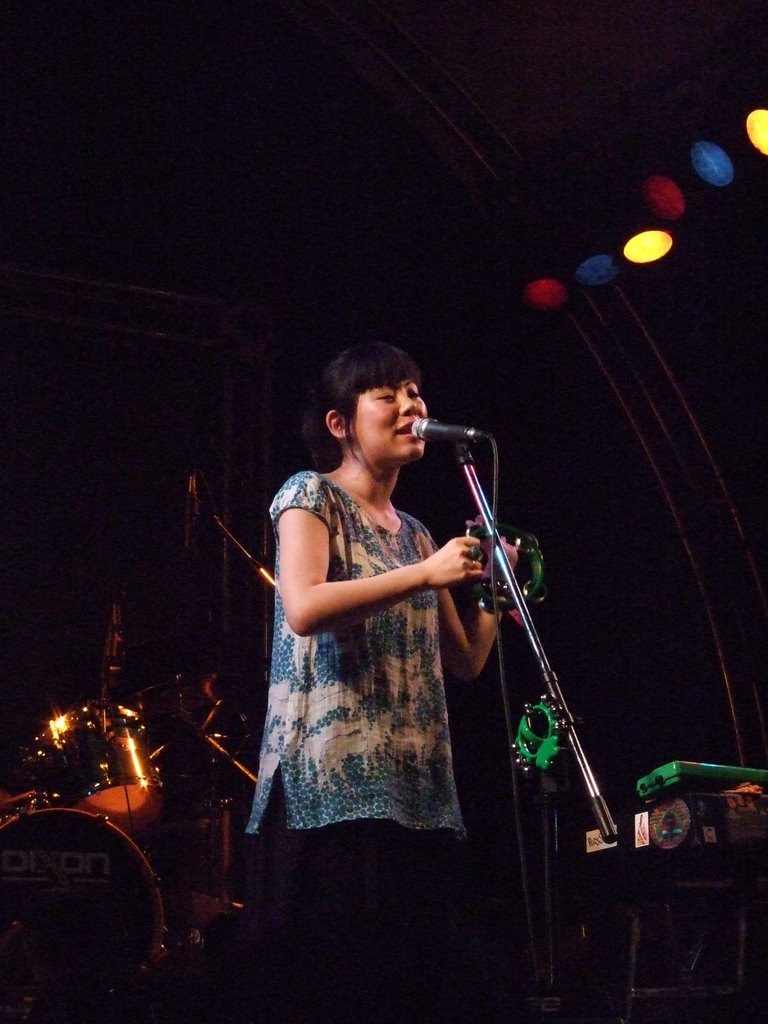
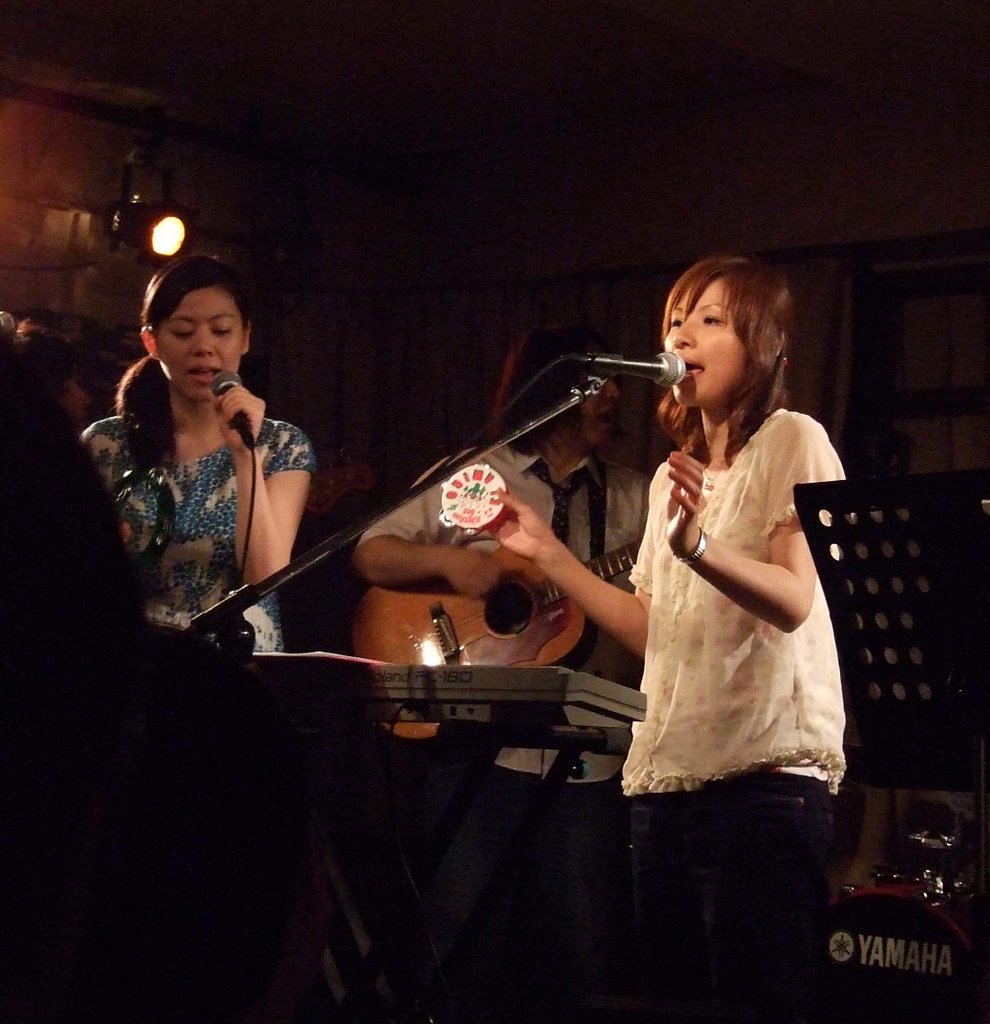
“Oh, well, we’re wearing yukata,” the two girls in the band said, and proceeded to compliment each other’s imaginary summer kimono (singer Spike was in reality wearing a navy blue summer dress with a plum blossom design, and bassist Tomoko had on a black X T-shirt).

They also did a new song about Ichiro, and when Tomoko was introducing the number by talking about the Seattle Mariners, she called someone involved with the team a ‘kichigai’, meaning a nutter, and definitely not a word that could be broadcast on public radio. So she started over with the introduction, but then one of the fans yelled out “Kichigai!”, and she ended up doing the intro for a third time.

***


VooDoo Hawaiians, in contrast to Supersnazz, hardly said anything between songs, and focused on their music, which was hard rock with long jams at the end of each song. The female vocalist looked like a classic Japanese doll, only with red-violet hair and wearing a bright red dress that said Pepsi-Cola. The other members, all guys, were hollow-cheeked, cigarette-stained rocker types, and the lead guitarist clearly had a Keith Richards thing going.

Mysteriously, the fans that showed up to see VooDoo Hawaiians were almost all un-flashy ladies in their twenties—I couldn’t work out why their music appealed to this demographic group in particular. The band rocked enough that I thought they should be embraced by a much wider audience.

***

All in all, it was a fun change of pace to see bands in a radio studio, but there wasn’t the booze and atmosphere of a live house, and I also sensed that going to see a band play at a radio event is more of a thing for hardcore fans to do (partly because you have to go through hoops to make it to the event, including sending a letter to NHK to get on the guest list), and though I’ve fallen hard for Supersnazz, maybe I’m not quite that hardcore yet, so I sorta stood out. Still, it was worth it—for one thing, because of the awesome acoustics, I was able to hear all of Supersnazz’s instruments crystal-clear and was able to appreciate more fully what great musicians they are. And I got to see VooDoo Hawaiians, who I’ll be checking out more in the future.

Tuesday, August 15, 2006

CDs Of Note: Spaghetti Vabune, The Caraway

Two great Japanese ‘guitar pop’* albums just came out:

One is Guitar Pop Grand Prix by Spaghetti Vabune. This strangely named sextet from Kobe has been growing in popularity, and I’ve been a fan of their ultra-catchy pop for a while. But their latest album took me by surprise: while their debut effort Summer Vacation, Sunset Vehicle was good, this second album of theirs marks a quantum leap in artistry. It’s my favorite Japanese album so far this year.

Opening with an anthemic declaration of their musical loyalties, ‘this is guitar pop!’ (‘this, is, guitar, pop, and you love I love guitar pop’, the song goes), the album runs through one after another bright and upbeat tunes that stick in the mind. Spaghetti Vabune songs are instantly recognizable because of their girl-guy twin vocals: neither is in any way an accomplished vocalist, but that’s part of the charm of this band. The female singer Chee’s style in particular is distinct, a warbling, nasal voice that seems to come out of the corners of her mouth—it’s probably an acquired taste, but one that you get hooked on once you do acquire it. Overall, the album is more bass-heavy than the lighter debut album, and the songs are lined up in a more focused way, to progressively jam up the listener’s voltage. The only shortcoming I can think of is that Spaghetti Vabune’s songs don’t have much variety: they’re all fast, energetic, sunny pop songs. But maybe that’s the Spaghetti Vabune sound, and moving away from it will make them a different band.

I also like Guitar Pop Grand Prix for its colorful art and design, all created by singer Chee, and for the fact that the lyric sheet includes chords, in case you want to play the songs yourself.


***

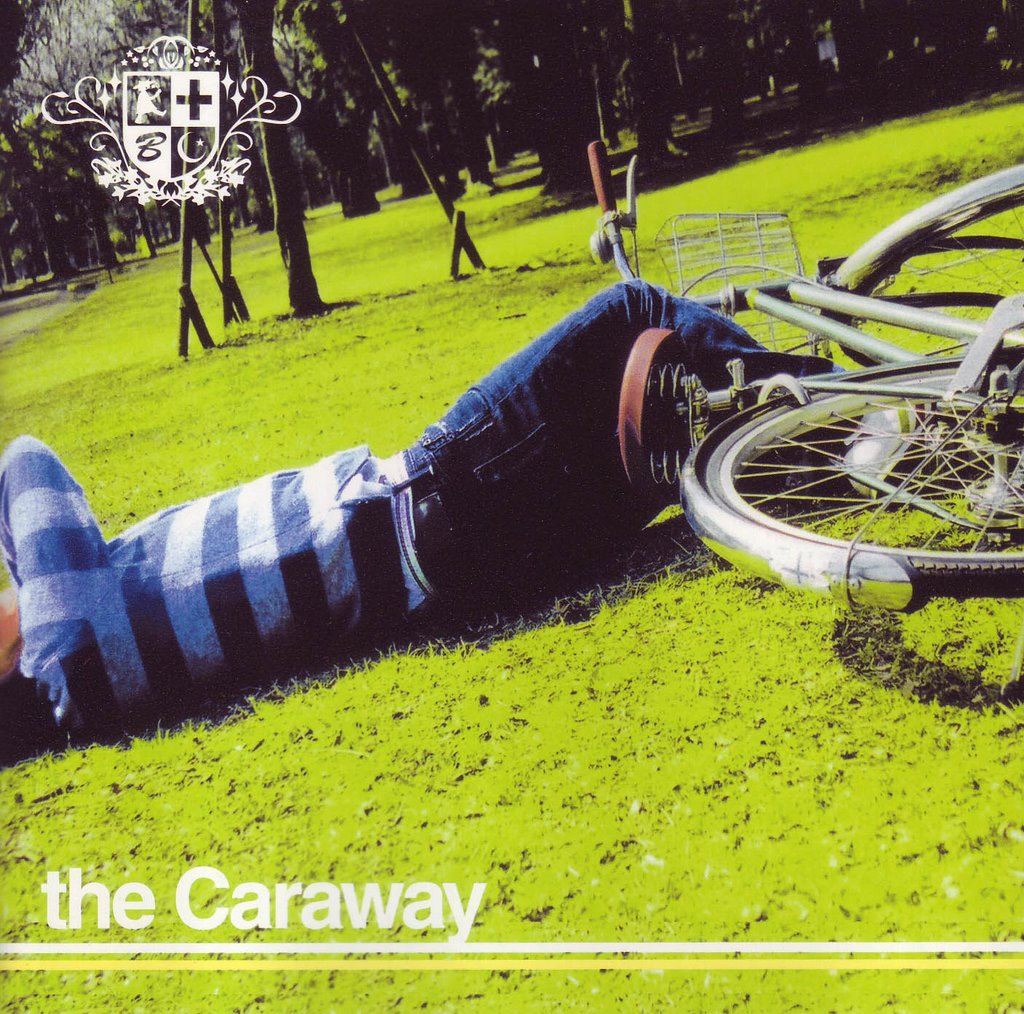
The other nice album is the self-titled debut CD of the Caraway, the trio led by Swinging Popsicle guitarist Osamu Shimada. Shimada is a connoisseur of American and European indie pop and rock, but his biggest love is the Beach Boys, which he says he listens to every day. And, indeed, this album from perennially overcast Tokyo is California sunny in sound, every tune joyful (Shimada plays for several bands, but he always seems to be having the most fun when performing for the Caraway). Shimada sings in all the songs but one, ‘Dislike You’, in which keyboardist Miyuki Yoshida does lead vocals, and it’s a good change of pace. Shimada says the band will be featuring her singing more in the future, something that will make their sound richer.

I’m listed in the ‘thanks’ list of this album, by the way, partly because, for reasons I won’t get into, I provided the band with a childhood photo of myself…

*Guitar Pop is a hard-to-define musical genre that I haven’t seen mentioned much outside of Japan. Think the Cardigans and Smiths.

Friday, August 11, 2006

Japan Live Radio Updated: Mellow

Japan Live Radio has been updated, this time featuring lots of mellow songs by artists such as Kuki Kodan, Nikaido Kazumi (thanks for the recommendation David!), Cibo Matto (thanks for the recommendation Justin!) and Frenesi (though I also managed to fit in the garage rock of Supersnazz, the Clicks and Teeny Frahoop...).

One thing to note: although I describe the station as 'the best of Japanese indies music', I also play music from Korea, Hong Kong and elsewhere from time to time, and feature major label music that I like. I note this because this time I included Aoi Teshima's 'Teruu No Uta', a big hit from the animation movie Gedo Senki's soundtrack. There's nothing remotely 'independent' about the producers of this song, but it fits the mellow theme well, and the 19-year-old Teshima's vocals are fragile and lovely, like a song heard from faraway in a grand open space like the Mongolian steppe.

By the way, for reasons I'm not aware of, the number of people listening to the radio has shot up in the past few weeks. I'm talking a three-fold rise... A lot of the listeners are from Japan and big groups of them seem to tune in at the same time. I'm wondering whether there's something wrong with Live 365's listener tracking system, but then again, maybe it's something more interesting, like a class full of schoolkids with computers all listening to the radio at once, for example...

Tuesday, August 08, 2006

Frequently Asked Questions

I think it’s about time for a Frequently Asked Questions post.


Q. Who are you?
A. I’m an American guy from LA who has spent more than a dozen years in Japan. I have a full-time job in Tokyo.

...

Can we leave it at that?

Q. How do you afford to go to so many shows?
A. I work.

Q. I will be going to Japan. Can you recommend some shows for me to see?
A. This is the question I get the most from readers, and I usually make the same recommendations.

First, go to Tokyo Gig Guide, which has a good schedule of shows and directions to all the major live houses. Pia has a more extensive schedule, but it’s in Japanese.

The live houses I often go to include the Que, Shelter and Club 251 in Shimokitazawa, O-Nest in Shibuya, and the Red Cloth and Loft in Shinjuku. Check their listings.

If you have any specific Japanese bands you like, try their websites too, because they might just be playing while you are in town.

Q. My band wants to play in Japan. How can we do it?
A. Not easily—I’ve written about this before, here.

Networking might do the trick. A suggestion: if there’s a Japanese band you like, offer to help them come to your hometown and do gigs there. Then, they will probably return the favor when you say you want to go to Japan.

Or, if you live in a big city where Japanese bands go on tour, chat them up after shows (buying their merchandise will help) and become friends with them.

You can try sending clubs your demos and press packs, but don’t expect miracles. Writing them in Japanese will also help, because this is, after all, Japan.

Q. Can I send you my CDs, MP3’s, etc.?
A. Yes, of course!

But if you mean, can I review and write about them in Japan Live, no, probably not. I write (mostly) about Japanese music, and only about music I like.

Q. Can you recommend some good Japanese bands and musicians?
A. The ones I write about in Japan Live are all good. The ones listed on the left, in the section “Bands-“, are among my favorites.

Check out the music I play in Japan Live Radio too—those are all musicians I like.


That’s about it for now. Feel free to write me anyway even if this answers your questions, though, because I always like getting e-mails.

Saturday, August 05, 2006

advantage Lucy & Three Berry At Formoz Festival


Loo-shee.

'Lucy'.

That’s what everyone calls advantage Lucy for short.

When the Japanese say it, it sounds like ‘Loo-shee’. Friends of the Japanese band also say ‘Lucy’ when they are talking about its two members, singer Aiko and guitarist Yoshiharu Ishizaka, like, ‘Lucy is staying at that hotel.’

I followed Lucy and another Japanese unit called Three Berry Icecream to Taipei to see them play at the Formoz music festival. For a long time I’ve wanted to visit Taiwan anyway, and thought this would be a good opportunity.

Taipei was hot and the sunlight strong, and many shopping streets had arcades to avoid it. Walking in town, sometimes out of nowhere came the smell of burning incense and herbal medicine. At temples and shrines, people bowed holding lit incense above their heads and tossed red crescent-shaped tablets to the ground to tell their fortune. It seemed to me that traditions lived on in Taiwan that had largely died out in mainland China because of the communists.

The festival was in a big children’s recreation park filled with ponds and pavilions and Chinese-style houses. Once the sun went down, bands from Taiwan, Japan and elsewhere performed at stages named after natural elements—wind, fire, stone, etc.

I saw a Taiwanese band called 悲情土台客 (which I guess means something like ‘the sadness of the Taiwanese’?). They were an interesting bunch: the guitarists all had little flags on their guitars, and they had up banners in Chinese characters. They did songs that sounded like canto-pop, and the singer told jokes between numbers in Taiwanese, which of course I didn’t understand. Someone told me later that they aren’t a full-time band but rather a gathering of various well-known musicians.

Other than them, I wasn’t able to spend much time seeing the many local groups at the festival, for various reasons, and that was my only regret about this Taiwan trip. I really only saw advantage Lucy and Three Berry Icecream…maybe next year.


advantage Lucy rehearsing

Three Berry and advantage Lucy both played at the Electric stage, which was next to a pond where carp swam. It was also next to the bigger Wind stage, where all the top acts performed, and because it directly faced Electric, at times it was a battle of noise between the stages. Three Berry plays gentle, semi-acoustic pop and was competing with the Taiwanese rock band 1976 next door; it lost the battle. During Three Berry’s first few songs, 1976’s hard rock was always in the background, and you had to make an effort to distinguish Three Berry’s accordion, glockenspiel, viola, bossa nova guitar and piano sounds. But the audience did and liked what they heard, and the 1976 set ended about midway into the gig so the second half was quiet, and the happy crowd asked for an encore.


Three Berry Icecream

I had heard there are advantage Lucy fans in Taiwan, and at Formoz I saw them for myself: the crowd roared when the band went on stage around ten in the evening, cheered again when the band played a few warm-up notes, thinking the show had begun, roared when singer Aiko hit the stage, and cranked up their cheering to maximum volume when the performance finally began with the song “Red Bicycle”. During some of the songs, incredibly, the Taiwanese crowd sang along to advantage Lucy’s Japanese songs, and I did too, utterly moved.


advantage Lucy

The Taiwanese reaction to the Japanese bands was a great thing to see. I’ve lived in China and studied its language, and was happy to see Chinese-speaking people discover and enjoy Japanese bands. Another thing was that for historical reasons and other reasons, the Chinese and Japanese haven’t gotten along, and it seemed like something that gives hope to see they could at least dig each other’s music.

After a wonderful set, Aiko and Ishizaka sat down at a table and started autographing CDs for fans. A lengthy line formed of fans who waited to get autographs, shake hands and take pictures together. The two must have been there for an hour or more, after a long day and a performance. This was amazing for me because I had heard that Aiko wasn’t in the best physical shape when she left Tokyo (she wore boots to hot Taipei because she was worried about the air-con) and knew she must be tired. In fact, during their time in Taiwan Lucy spent a lot of time in the hotel and didn’t even hang out much with Three Berry Icecream, who are some of their closest friends. One of the evenings I had dinner with them, but they must have been thoroughly exhausted at that point—at the restaurant the group occupied two tables, with Lucy and the other Japanese at one, and the Taiwanese at another. There was little interaction between the two sides, and it made me a bit uncomfortable to be there, like I was peeking behind the curtains at something I shouldn’t see backstage. But it sounded like at other times there was much more friendliness so that on the final day at the airport, lots of tears were shed.

A thing I missed that I regretted was an “After-Party” show at a club called the Wall the day after the Formoz festival ended. There, Lucy sang their one Chinese song, ‘The Season Of Apricot (杏の季節)’, and the audience apparently sang along in a grand chorus. Damn, damn, wish I could have been there!

Wednesday, July 26, 2006

Hello Again, Supersnazz (At The Shelter)


After Supersnazz crashed into my life like a hell-flaming meteor at the Loft, I went out and bought all of the band’s CDs I could find: I got two albums of theirs that are still in print, Invisible Party and Rock-O-Matic, and bought used copies of Diode City, The Barba Rockets Patrol, I Wanna Be Your Love and The Devil Blues Youth. For a few weeks my musical world consisted almost solely of their fast, sweltering girl garage rock. The last time I saw them all of their songs were new to me, but when I caught them at the Shimokitazawa Shelter on Saturday night I knew almost all the tunes and in addition I had invested in them emotional significance (such as, ‘this song I listen to when I need a lift’, etc.).

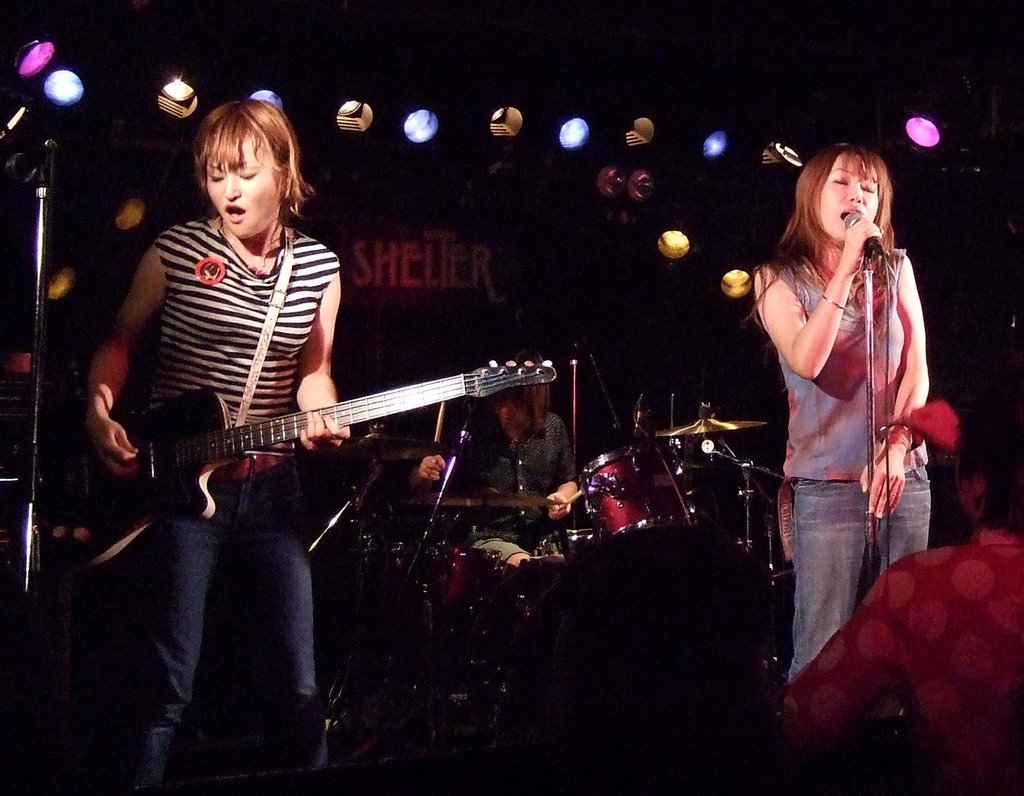
Supersnazz got its start as a four-girl band in 1990, and in a decade and a half has toured all over Europe and the U.S. and once recorded with Sub Pop. What a terrific group they are. During the Ron Ron Clou set before them, the two current female members, singer Spike and bassist Tomoko, peeked out nervously from the dressing room, checking to see how many were in the audience. They continued to look stiff as they set up on stage. But then when the house lights went down and the show began, suddenly they were different people—rockers who had knocked out audiences hundreds of nights, and were ready to do so again tonight.

The fans raised their plastic cups of beer in a toast to the band, and repeated that during climactic moments in the songs. Spike, the singer, coughed painfully throughout the gig, a result of a bad summer cold, but never stopped shouting out the words to their pop-punk songs. One of those was a great tune called “Shelter” from the album Invisible Party, and listening to it at this cramped, dark club with the same name as the song, I wondered whether that’s what it’s about. Listening to it again at home, it seemed possible, with English lyrics like “I’m shouting/ I’m turning [?]/ I’m headless in the Shelter/ I’m crying/ I’m smiling/ I’m dying in the Shelter/ I just can’t walk on by tonight…”.

They are releasing an album of cover songs in October, and did a few of those, revealing their influences: they covered the Replacements and X, as well as “Brown Sugar” by the Stones (on a related note, the guy guitarist had a tattoo on his biceps saying ‘MC5’).

Monday, July 24, 2006

Odds & Ends

* Spangle call Lilli line, who I've interviewed, is releasing a new album on September 6 called Since. The trio hasn't officially announced this, but music store websites like Tower Records, HMV and CDJapan already list the album.

* Advantage Lucy, who I've also interviewed, is due to release a mini-album in another couple of months. I was somewhat involved in its production so will say nothing more other than that it looks like it will be great (but no surprise there).

* I really like this Live365 Internet radio station called Indie Beginning, which features independent music from Hong Kong . It's the sort of radio station I would have wanted to make if I were in Hong Kong rather than Tokyo. Japan Live Radio has also been updated, by the way, with new music.

* I'm headed to Taipei from Thursday to attend the Formoz Festival there. If anyone knows of any Taiwanese music CDs I should definitely buy while I'm there, please let me know.

Saturday, July 22, 2006

Yunn & Yuyake Lamp At Grapefruit Moon

For several years now I’ve felt that Yunn and Yuyake Lamp’s Yumi, formerly of Orange Plankton, is one of the most expressive Japanese singers I’ve ever seen. She transforms the stage into an orchard of sound, growing with her soft voice shoots of unique musical phrases, the stage lights her sunlight. She squeezes out songs with her entire body—her voice makes even those not interested in the sort of gentle piano pop she plays stop and take notice. I always know going to Yumi’s shows that I’ll come away filled with new energy.

But at the same time, sometimes in weeks between shows I have slight doubts: was she really THAT good, as good as I describe, for example, in this post?

Wednesday I saw Yunn and Yuyake Lamp at the Grapefruit Moon in Sangenjyaya, and I immediately knew I wasn’t wrong. I’ve seen hundreds of singers perform in Japan, but very few have her ability to make you visualize what she is singing about and pull you into her world. In one of the first songs of the night, with a tiny wavy gesture of her arms she brought to life the sea, the subject of that song.

The crowd wasn’t big. I saw three or four Chinese characters 正 (‘right’ or ‘proper’) marking the number of fans who came to see the band, meaning that at five strokes per character, fifteen to twenty had come. But it was an interesting cast of characters: there were, among others, a pro wrestler, a TV commercial director, and a young, pretty actress, all in some ways connected to Yumi’s music.

Wednesday, July 19, 2006

advantage Lucy, Swinging Popsicle, "Mine-Mine"


Aiko and Mineko

At Sunday night's Club 440 show, advantage Lucy singer Aiko said her band has been recording new music day and night so that even now on stage, she wasn't sure whether she was awake or dreaming. She was joking, but for me, there was indeed something almost dream-like about this event: it brought together advantage Lucy and Swinging Popsicle, two of my favorite Japanese groups. It was the first pairing of the two bands in many years, though they've known each other since both got their start about a decade ago. They are both wonderful groups that have stuck it out in Japan's volatile music scene and continued to make good music, creating new fans in Japan and abroad along the way.

Advantage Lucy went first and began by doing two songs unplugged, just Aiko's singing and Yoshiharu Ishizaka's acoustic guitar. That brought out Aiko's striking singing voice, which is delicate but strong and clear, an icicle voice. For the second tune they did a cover of a song from the animation movie Gedo Senki, which I found out is based on the Earthsea fantasy novels that I spent days and nights reading as a child. After that the rest of the band came out and they turned up the volume much louder than usual at a cafe like the 440. They played mostly oldies like "Memai" and "Red Bicycle".

Swinging Popsicle's set featured several new songs, including a gorgeous minor-chord ballad called "Kanashii Shirabe (translated to something like 'A Sad Melody')", and a rocking new number called either "Crash" or "Clash" (you can't tell when it's pronounced in Japanese--I think the former though).

Advantage Lucy's Aiko claimed later that she and Ishizaka-san listened to Swinging Popsicle's set in the dressing room and told each other they need to become skilled musicians like them. And Popsicle was good, rocking the crowd in an almost business-like manner (though, at times, Shimada the guitarist and Hirata the bassist flashed little smiles at each other as they played behind singer Mineko, like two school-kids exchanging jokes behind the teacher's back).

For the encore, the audience got a treat: both Lucy's Aiko and Popsicle's Mineko came on stage for a performance of a rarely-heard unit called Mine-Mine ('Mine' pronounced 'mee-neh'), a reference to the 'Mine' in Mineko's name and Aiko's family name Hiramine. With members of the two great bands on stage, the Mine couple sang a cover of The La's "There She Goes", their voices blending prettily and all the musicians seeming to have maximum fun.

Saturday, July 15, 2006

The Caraway & Guitar Pop

The Caraway is a Tokyo pop band led by Osamu Shimada, Swinging Popsicle’s guitarist, and they just released their first album, The Caraway. To celebrate its release they headlined an event at the Shinjuku Motion, also featuring Three Berry Icecream, Orangenoise Shortcut and Sloppy Joe.

What struck me most about this event was how many people showed up. It was sold out. Before the show dozens of people lined up at the grimy stairwell leading up to the club. It’s not a big venue at all, holding around a hundred people at most, and the Caraway and others are fairly popular, so maybe it shouldn’t have come as that much of a surprise that the place was packed. But compared with punk and other currently popular types of music in Japan, the music the Caraway plays, so-called guitar pop, is a genre favored by a small minority: a bit like people who would name Iceland or Belgium their favorite European country. So, as a fan of Japanese guitar pop myself, it came as a pleasant surprise to see the Motion so crowded with fans it took a big effort to move from one end to the other.

Of course, one of the great, distinguishing things about Tokyo is that for almost any sort of musical genre you can think of, somewhere there are musicians who play it for devoted fans. Hip-hop, country, blues, reggae, grindcore, rockabilly, zydeko, bossa nova, krautrock, you name it. People here like to let the music they listen to partly or wholly define who they are. I guess people do that everywhere, but it seems to be taken to a more extreme level in Japan, for reasons I’m not sure why. (On a related note, the other night I went to a bar where a harem of Japanese belly dancers was putting on a show. They danced skillfully, but also in a studious, decidedly non-flirtatious way.) In any case, the result is that there are groups of people who closely follow works by guitar pop bands and try to make it to their gigs.

(“Guitar pop”, by the way, is a term that doesn’t appear to be used much outside of Japan, and I’ve started to wonder whether it’s a Japanese invention. It’s not in wikipedia, for instance, and it’s not listed as a genre in Live 365 radio. As a description of a type of music it’s pretty vague, referring to bright, guitar-centered pop influenced by British New Wave, Swedish pop and indie pop bands.)


I like going to guitar pop shows because the fans tend to be mellow, classy folks not prone to random drunk violence, and I’ve gone to enough events now that it’s like Cheers: everyone knows my name (or, at least, many do). At the Caraway event, when the first group Three Berry Icecream played, the young daughter of the singer called out to her mom between songs, prompting all the petite ladies in the front of the crowd to smile and laugh the way they would do to a little girl who had just ransacked the closet and came out dressed up in a way she imagined adults consider fashionable.

The event, organized by ultracool indie label Bluebadge, was one of those where I thoroughly enjoyed all the bands that played. A happy discovery was Orangenoise Shortcut, a group whose name I’d heard of but otherwise wasn’t familiar with: the audience seemed to like them as much for their joke-filled banter between songs as their upbeat, sunny songs.

During Caraway’s set, I was reminded again what a natural performer guitarist Shimada is: when the band was asked for a second encore, they hadn’t prepared any songs, so Shimada decided to play a new number from their new album called “The Rainy Day”, and performed it exactly the same way they did earlier in the evening, just because it’s a great song and Shimada wanted to do it again. And everyone loved it again.

Thursday, July 06, 2006

Ging Nang Boyz Plays... Berkeley??

Here's an amazing account of Japanese bad boy rockers Ging Nang Boyz making a punk rock pilgrimage to Berkeley's 924 Gilman Street (the musical birthplace of bands like Green Day and Operation Ivy) , and then, quite by accident, getting a chance to do an unscheduled mini-gig for a room full of Californians who had no idea who they were.

Keikaku.net's Bob Vielma writes:

Everyone seemed a bit dumbstruck by the unbridled energy of this unknown Japanese band, but that didn't mean they weren't having a hell of a time. Did any of them realize that they were seeing one of Japan's biggest punk bands? This band that could easily sell out a club of hundreds or even thousands was giving their all to a crowd of about sixty.

I wish I could have seen it!

Wednesday, July 05, 2006

Melt-Banana, The Ignored & Bad-Bee Bad Boys

I’ve been going to Tokyo rock shows for years but somehow never made it to the Jam in Shinjuku, one of the oldest live houses in the city. That changed on Friday, when I went there to catch badbee.net’s event featuring Melt-Banana, Nokemono, Factotums and Falsies on Heat.

The Jam is a small basement club that looks as plain as a shack in a suburban mall. You get there walking down a drab thoroughfare away from the rowdier parts of Shinjuku, going past a Shinto shrine. Once inside, I thought I felt the liquified essence of Rock Bands Past perspiring down the Jam’s walls (or maybe it was just the air-con was down).

The first band up was Falsies on Heat, an all-girl quartet that I thought was good the last time I saw them, but truly rocked this time. Maybe they come to life most in a little, low-staged place like the Jam, where there’s nothing separating them from the audience. Or, maybe I was in a more receptive mood this time. Either way, my opinion of the group went up. They said they were going to take time off from doing shows because the drummer was about to have a baby.

Speaking of being one with the audience, Simon, the singer of the next band Factotums and one of the badbee guys, placed one mike in the audience section and another on the stage, and moved between those two seemingly at random, staggering sometimes into the crowd and singing in their midst. With long hair reaching down to his tattooed shoulder and with drink-hazed eyes, he was every Japanese daughter’s dad’s worst nightmare of a furyou gaijin (‘bad foreigner’). But he sang well, like a 70’s rock star (the band reminded me a bit of the Dictators).


‘Nokemono’ (pronounced ‘no’, ‘kay’, ‘moe’, ‘no’), the name of the third group, means something like ‘the Ignored One’. It was hard to blow them off though at the Jam: their bass and guitarist both played bare-chested, while the singer, wearing shocking-pink full-bodied tights and a green leather (?) cap, shouted at the audience that Nokemono drove 600 kilometers from Kyoto to be at this show, so they better have fun, and went on to try to crowd-surf two times, a difficult undertaking because the crowd density wasn’t quite enough. Badbee.net describes their music as “mental psycho-delic rock ‘n’ roll”.

Melt-Banana, the last band, dashed though their fast, experimental, short (one minute or so) punk songs, and were amazing. I remembered once being bored at an extremely brainy Tokyo indie pop show, and one of the few high points that night was that the club showed a video of a very energetic, rocking group, which turned out to be Melt-Banana. After Melt-Banana’s gig, a friend said that they are one of those bands you don’t expect to be that good because all these foreigners that know little about Japanese music love them, but you go to their shows and it turns out that they are really excellent after all (a somewhat elitist opinion, to be sure). Their female singer, wearing a white, caped pullover, moves the irises of her eyes from one corner to another as she sings, like a Balinese dancer, though I wasn’t sure if that was part of the performance or just a nervous thing.

Monday, July 03, 2006

Japan Live Radio Updated: Pop


Japan Live Radio has been updated, this time with a focus on good pop tunes including those from Hideki Kaji's new album and the debut album of The Caraway, Swinging Popsicle's guitarist's band. I'm also broadcasting a few songs from Fresh Cuts From Japan, japanfiles.com's compilation CD. Check it out.

Friday, June 30, 2006

"Master Donut"


I love so many things about this tiny flier, the size of a name card, that I picked up at a club somewhere in Tokyo.

First off, there are all the funny characters: it's not clear why the girl in ponytails and the guy holding a single look surprised, but in the case of the guy on the bottom left, there's no mystery--I'd be pretty terrified too if I woke up to find a black demon banzai-ing over my bed.

Then, there's the fact that the band performing is called Mountain Mocha Kilimanjaro.

And that the event itself is called MasterDonut. Why? The backside of the flier explains that this is a "cult party" where DJs spin only 7-inch funk, soul and jazz records, Mountain Mocha Kilimanjaro plays, and--oh here it is--during the event donuts are provided free of charge, and audience members can eat as much as they please.

Wacky Tokyo!

***

I also got my hands on a flier advertising a gig by a band called Soshiki Bo-ryoku Yochien (組織暴力幼稚園) , or, Institutional Violence Kindergarten. They are playing with a group named Very Ape, which describes itself as a 'hentai, cross-dressing, deafening-noise alternative rock band'. I think I should go to this show (at the Ikebukuro Shuto/Chop on July 8)...

Wednesday, June 28, 2006

2 Cool Stories On J-Music Making It Abroad

Stumbled across two great articles on a subject I should probably be more interested in: how Japanese bands might hope to sell better abroad, especially in the U.S.

One’s a Japan Times feature called “The D.I.Y. route to rock stardom” by David Hickey, one of the guys behind Japanese underground music site badbee.net.

The other is a blog post called “Missionary Position” by Ian, the creator of the music review site Clear and Refreshing.

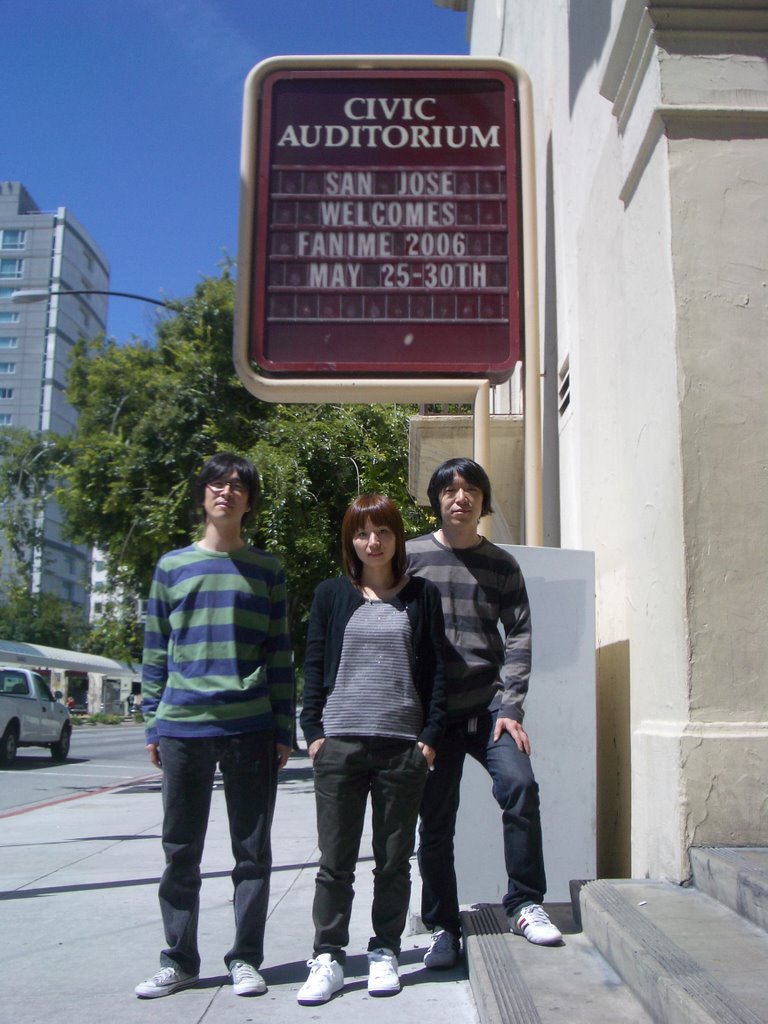
The first thing to note about the Japan Times story is that it has a sidebar article talking about Fanime Con in San Jose that leads with:


‘A grand collision of two Japanese subcultures—anime and Japanese indie music,’ was one blogger’s take on Fanime Con 2006…

Three guesses on who that ‘blogger’ is…

The lead article looks in depth at the fact that while other Japanese pop culture exports like anime and manga are selling well in the U.S., Japanese pop music, with very few exceptions, is getting hardly any play at all. Some musicians are trying to break into the U.S. music market on their own, the article says, by networking through MySpace and other message boards and by crashing U.S. industry festivals like South By Southwest. But big-time success has eluded the Japanese musicians because they just don’t yet have the connections and PR know-how that U.S. bands do, the story concludes. It's an interesting read.

Ian’s blog post, meanwhile, is a penetrating look at the current state of Japan’s indie music scene, warts and all. Here’s his description of his disillusionment at finding out that the band Afrirampo wasn’t quite as out-of-this-world different as they first seemed:


When I first saw them, they were like a riot of colour through the sometimes rather staid and technically-obsessed Tokyo noise circuit, but as the other pieces of the Osaka scene jigzaw puzzle fell into piece around them, what had seemed like a radical inversion of muso orthodoxy became more of a generic repetition of a locally prevalant wackiness-at-all-costs, performance-over-content motif. The wildness and discarding if inhibition wasn't something magical, beamed in from Mars to save us all; it was in fact a strictly enforced code of conduct, without which it would be nigh impossible for any Osaka band to get noticed.

In his view the major problem with Japanese indie musicians is that they are splintered into strict musical cliques. That means bands don’t communicate enough with musicians with different styles, preventing them from cross-pollinating and making music with crossover appeal, which is essential if they are to make it outside of Japan. “A lot of responsibility lies with the Japanese bands to make a mental leap outside their self-defined boundaries,” he writes.

(By the way, the geeky Japanophile that Ian describes in his post shares uncomfortably many traits with me: they “pass their days [in Japan] in a kind of happy stupor”, he says. Check. They go to anime conventions, he says. Check. ((Though I went to this year's Famine for the music rather than anime.)) They are dedicated fans who are friendly with band members. Check. They write for keikaku.net. Sort of ((I contribute interviews)). They hang around blogs. Check. Hmmm.)

For Japanese bands wanting to make it big overseas, I’d add that the language barrier is a big obstacle. There are, of course, fans that don’t understand a word of Japanese but still love J-Pop. I myself like songs in Korean and Cantonese, two languages I don’t speak. But the sad truth is that for many, lyrics in Japanese or any other language they don’t understand are a turn-off. Japanese bands could do songs in English, and many do. But then there’s the problem of pronunciation—it’s often hard to understand what is being sung. Plus, because English isn’t these singers’ native language, it's harder for them to sing with emotion. In Japan you don’t find a lot of bands like The Cardigans that aren't native speakers but have flawless English.

With anime, what leaves the biggest impression is the art, so that it doesn’t matter that much if the voice-overs sound strange or there are subtitles. And on top of that, Japanese anime has its own distinct style, whereas, for the most part, Japanese pop music imitates music from Europe and North America.

Maybe eventually more Japanese musicians will appear that sing like native English speakers and have their own style that appeals to foreigners. Or, maybe, there will be a revolution in global pop sensibility that will make Japanese music so cool that kids will want to buy it even if their knowledge of the Japanese language is limited to ‘sushi’ and ‘karaoke’. I won’t be holding my breath.

The thing is, I just don’t get that excited about how many CDs Japanese bands are selling, because I’m not in a band and don’t run a record label, and I like the music for the music and not for its popularity. If a band is good, it doesn’t matter to me whether they sell out multiple nights at the Budokan or they only get a few people to come to some tiny café on the Inokashira Line. Having said that, it is a good thing if more Japanese bands are traveling abroad, creating MySpace pages, offering MP3 samples on their web pages, and doing other things to make themselves more accessible to audiences outside of Japan, because, as I hope it is clear to regular readers, I do want people to know about good Japanese bands.

Thursday, June 22, 2006

Strawberry TV Show Meets Advantage Lucy

Last week was a good week for advantage Lucy fans—they did two shows within a few days of each other. Of course, I went to both.

The more interesting gig was the one on Saturday at the Shimokitazawa Que, featuring two groups from Seoul: Strawberry TV Show and Mongoose. Strawberry TV Show was especially wonderful. They are a seven-musician group that plays jazzy R&B and consists of guitar, bass, drums, keyboard and three dancing chorus girls, who, along with the woman on keyboards, wore matching, bright, polka-dotted summer dresses. The chorus trio was the chief attraction: they were pretty, looked like they were having fun, and their singing voices melted together pleasantly as if they were meant for each other, like strawberries and vanilla ice cream.

But after the show I had drinks with Strawberry TV Show and the other bands and found out that maybe the Que show wasn’t as fun for them as they made it look. In fact, it was probably nerve-racking. The problem was a familiar one in Tokyo: club audiences are often pretty subdued, not cheering much and clapping only quietly. To the Korean musicians, the low-key response must have felt like they weren’t going over well. I knew from going to shows in Seoul that an unknown band from abroad gets a much louder, more welcoming response from the audience. But in truth, that was just the Tokyo crowd being their usual selves, and the Japanese musicians tried to tell them that but I’m not sure if they were believed.

When I chatted with Strawberry TV Show they asked me what I thought of their performance, and when I replied “Cute!”, I gathered from their expressions that wasn’t the best answer. Maybe I should have said something about the music, which I did like enough I was ready to buy their albums and was disappointed to hear that the first CD wasn’t coming out until August at the earliest. Still, I stand by my view that this is a cute band—one of the cutest I’ve ever seen.


Strawberry TV Show

***

During advantage Lucy’s set at the Que, in front of me in the audience was a girl who kept on explaining to two guys she was with that Lucy was exceptionally good that night, which I found annoying, because I’ve been to most of their shows recently and I know that they’ve been playing at a consistently high level and the Que show was certainly no fluke. In their laid-back way, they’ve been intense these last few months. Guitarist Ishizaka-san said they are aiming to release an EP in August, and it does feel like a new work is around the corner (it’s certainly not years away).

At both the Que show and the O-Nest gig earlier in the week, they played a new song called “Late Show”, a lovely, quiet tune that starts out sounding bossa nova (they say they are working on lots of quiet songs now). At the Que show one of the Strawberry TV Show girls joined them in singing “Nanaramia”, a relatively obscure song from the album Station, a song that’s like a simple kid who doesn’t stand out in the schoolyard of advantage Lucy’s collected works, but it’s still a beautiful tune that shone in a different way when sung as a Korean-Japanese duet.

***

For the record, Vasallo Crab 75 and Condor 44 also played at the O-Nest show, and Gomes The Hitman and Mongoose performed too at the Que. They were all great, good enough I can write a post longer than this about each if I had the time.


advantage Lucy with Strawberry TV Show girls

Tuesday, June 20, 2006

A Store Called Janis

A long time ago, before iTunes and MP3s, before even CDs were invented, in the Era of LPs, there were record rental stores in Japanese cities where kids borrowed LPs to take home and tape. In Tokyo in the 90’s, one of those stores, called Janis, helped create a music scene.

Janis was one of the few (the only?) stores in Tokyo that stocked LPs by bands like the Smiths, Aztec Camera, Prefab Sprout and other New Wave and neo-acoustic artists. Guys like Keigo Oyamada and Kenji Ozawa, who formed the influential band Flipper’s Guitar and helped launch the Shibuya-kei scene in the 90’s, devoured Janis’ Ochanomizu store catalogue. They also left notes on comment cards on albums explaining what the music was like and whether it was good. These notes were the guiding lights for aspiring Tokyo musicians in the 1990’s trying to get a full view of all the good, new music coming out of Europe and North America at the time.

One of the kids who frequented Janis was Yoshiharu Ishizaka, advantage Lucy’s guitarist and composer of its music. He said he bicycled down to Ochanomizu from Adachi ward, a one-hour trip, to rent records at Janis. Then, after going home and taping a record, he sometimes took ANOTHER trip to Ochanomizu to return one record and borrow another, listening on a Walkman to the just-recorded album on the way and back.

Can you imagine, all those hours of bicycling to get one metal tape of a rock album? It’s hard to in these days of instant music acquisition through the Internet. But still, I can understand that willingness to spend hours to find a new work by some musician, who, to you, is the most mysterious, coolest, most perfect musician there ever was.

Another friend of mine, DJ Kamaage, also rented records at Janis, but not at the Flipper’s Guitar hang-out Ochanomizu shop, and instead at one in Ikebukuro. There, there weren’t all the Flipper notes to help make renting decisions, so DJ Kamaage said he picked records based on how the covers looked, thinking that if the album art was classy, so must be the music (a reasoning I believe has an element of truth to it). The end result was that many customers at the Ochanomizu store developed a musical taste in line with Flipper’s Guitar’s, whereas the tastes of the regulars of other stores were more varied.

***

Janis still exists, but as a CD rental store. The above entry is based on a conversation I had over drinks, and I never personally went to any of the Janis’s, so I’m not sure if I got it completely right, and would appreciate it if you would let me know if there are any things to add or correct.

Saturday, June 17, 2006

CHAT IN SAN JOSE 3: Miami


Miami's Ai Kajiya (PHOTO CREDIT: DAVID CIRONE / JAPANFILES.COM)

At the Fanime anime convention in San Jose, California I talked to a few of the Japanese rock bands that put on shows there (story here). I asked them all the same set of questions because I thought it would be fun to see how the answers would turn out differently.

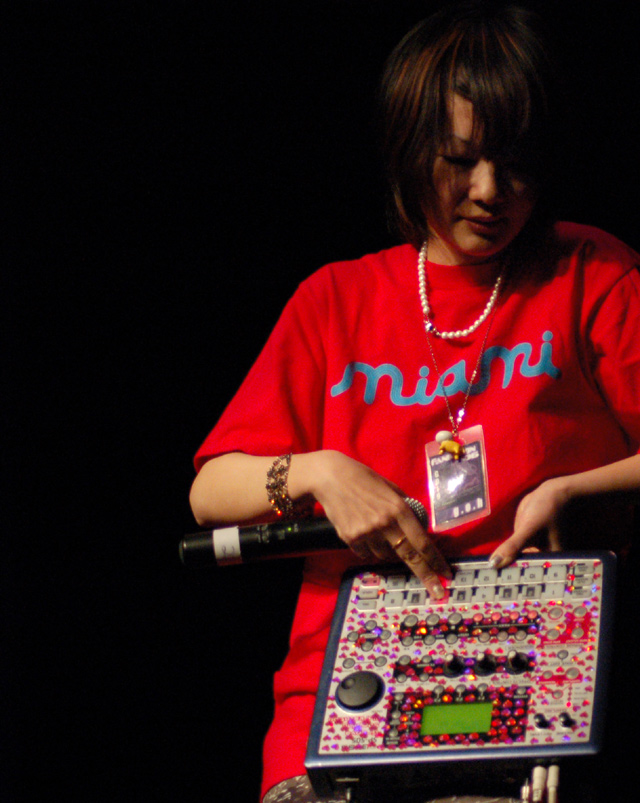
The third and final group I interviewed was the two-girl electric pop/rap unit Miami. Ai Kobayashi and Ai Kajiya create music that sounds both contemporary (they rap over digital samples) and retro (Kajiya plays the violin and some of their melodies sound early-20th century). The two Ai’s that make up Miami are a duo to watch.

JAPAN LIVE: What was your first impression of the U.S.?

KOBAYASHI: The American audience was the greatest! Everyone’s expressions were dazzling. We really had fun.

KAJIYA: I felt the same way. Their power to have fun was tremendous, and we were able to do a very fun show too.

JAPAN LIVE: How would you describe Miami’s music?

KOBAYASHI: Music genre-wise, it’s electric pop. Our sound and everything else have a free feel.

JAPAN LIVE: Are there any American bands or musicians that have influenced you?

KOBAYASHI: I like the Beastie Boys. But I guess that’s about it. To tell you the truth, I’m not much of an expert on music, and I haven’t listened to all that much. If we’re talking about America, the Beastie Boys are clearly my favorite.

KAJIYA: None, in my case.

JAPAN LIVE: How did you come up with the name “Miami”?

KOBAYASHI: It’s just something that we thought up. We’ve never been to Miami in the U.S. and it wasn’t named after that. Japanese girls often have names that start with Ma, Mi, Mu, Me, Mo, and those names have a round, soft image. “Miami” has a round, cute feel to it.

JAPAN LIVE: Anything else you want to say?

KOBAYASHI: Well, the main thing is, thanks so much for listening to us and watching us. We will remember this fondly, and we want to meet all of you again.

KAJIYA: We were welcomed warmly, and so we were able to do the best live we could. We wouldn’t be doing this if not for people like you, and we want to work hard and have fun together with all of you.

***

You can listen to samples of Miami's songs on their MySpace page, and their music is available in MP3 form at JapanFiles.com.


Miami's Ai Kobayashi (PHOTO CREDIT: DAVID CIRONE / JAPANFILES.COM)

Wednesday, June 14, 2006

CHAT IN SAN JOSE 2: Swinging Popsicle


From left to right: bassist Hironobu Hirata, vocalist Mineko Fujishima and guitarist Osamu Shimada of Swinging Popsicle

On the sidelines of the Fanime animation convention (story here), I interviewed a few of the Japanese bands that flew across the Pacific to play there. I asked all the bands the same questions because I thought it might be fun to see the different ways they answered.

One of the bands I talked to was the trio Swinging Popsicle. If you are a J-Pop fan and have never listened to Swinging Popsicle, you’re missing out. They are a band that consistently makes some of the brightest, catchiest, most melodious pop songs in Japan. As their guitarist Osamu Shimada says, Swinging Popsicle is a group that “plays beautiful melodies, and treasures good melodies”.

JAPAN LIVE: What was your first impression of the U.S.?

SHIMADA: It's the first time in my life to come here, and I feel that while everything in Tokyo is cramped, here the roads are wide and there’s a lot of space.

HIRATA: The climate is very pleasant, everyone is kind, and there’s all this space. It’s a lovely place like I imagined it to be.

JAPAN LIVE: What was it like playing for an American audience?

FUJISHIMA: This is different from a normal music festival and the people that have come to see us are those that already love Japanese culture, so the atmosphere is warm, and it’s easy to perform. If we came here and no one knew who we were we would have been very nervous, and worried about how the audience would respond, but we knew there were people here who had listened to our songs on MP3s, so even compared with when we play in Japan we haven’t been nervous at all.

JAPAN LIVE: How would you describe Swinging Popsicle’s music?

SHIMADA: I think we’re a band that plays beautiful melodies, and treasures good melodies.

HIRATA: Yesterday an American guy asked me what were the words that came after “I just want to kiss you” in the song “I Just Want To Kiss You”, and when I said, “if I was there baby”, he said, ‘ohhh!’ And the fact that he asked me that means he probably wants to sing along, and really relates to the song. I’m happy that people feel close to our songs, and I’d like them to love our songs even more.

FUJISHIMA: We’re not a loud band, so if people want to go wild our music might not do the trick. I'd be happy if people enjoy our music for what it is.

JAPAN LIVE: Are there any American bands or musicians that have influenced you?

FUJISHIMA: A lot!

SHIMADA: I listen to the Beach Boys the most—I was listening to them just now. I listen to them every day.

FUJISHIMA: I listen to Laura Nyro a lot, and on the West Coast I often listen to A&M stuff, and I like soft rock. I've really been into Chicago post-rock music recently too. When I started out I really liked Madonna. American music has truly influenced me.

HIRATA: What got me into music and led me to take up an instrument was L.A. metal, which was popular when I was in intermediate school. Now I like music with beautiful melodies by people like, well, he’s a huge, but Burt Bacharach.

JAPAN LIVE: Anything else you want to say?

HIRATA: I want to come here again. I truly loved playing for all the people that came here and met me.

FUJISHIMA: I think if it were this festival, everyone would accept us next year too. If it were other festivals I’d feel nervous. I visited Los Angeles and San Francisco about ten years ago on a regular sightseeing trip, but compared to then, this time around everyone was nice and good things kept on happening to me.

SHIMADA: Everyone was warm, and easy to become friends with.

***

Swinging Popsicle's music is available in various places, including Amazon, CD Japan, and as MP3s in JapanFiles.com.

Some cool person has also uploaded a video recording of Swinging Popsicle playing at Fanime, here. It's not exactly a professional video, but you still get a feel for what they are like live (despite what Mineko says in the interview, you can really go wild listening to them live!).

Monday, June 12, 2006

CHAT IN SAN JOSE: Poplar


From left to right: Mai, Wadagaki and Shino of Poplar

I chatted with a few of the Japanese bands that performed at the Fanime convention in San Jose (story here), and asked them all the same questions.

The first band I talked to was Poplar, a trio that plays a unique style of music that might be described as experimental/retro-Japanese/hip-hop. They were also the most visually arresting group of the six Japanese bands that made it to San Jose: Mai, the female singer, always wore a yukata (a summer kimono), while Shino, the guitarist, kept his face hidden behind a red Mexican wrestler’s mask, never revealing his true identity.

JAPAN LIVE: What was your first impression of the U.S.?

WADAGAKI: What I felt right when I got here was that the sky is very big, and everything around me was of a larger scale than back in Japan. I felt big too.

JAPAN LIVE: What was it like playing for an American audience?

MAI: The way people responded to us was very direct. They didn’t hold back, and that was great.

JAPAN LIVE: How would you describe Poplar’s music?

SHINO: Back in Japan, people often tell us our music isn’t like anything they’ve listened to before. We ourselves have trouble explaining it. But it’s music that regular people can enjoy: Mai [sings] melodies, I do aggressive guitar parts, and we have both male and female vocals. You need to listen to our music to know what I’m talking about, but we frequently use Japanese scales, so there’s a lot of Japanese melodies.

JAPAN LIVE: Are there any American bands or musicians that have influenced you?

MAI: Yes, many. What got me into music in the first place is Hanson, but from there I listened to hip-hop, R&B, rock, and I used to listen to Red Hot Chili Peppers, melocore, pop…American music has really influenced me.

JAPAN LIVE: Anything else you want to say?

MAI: Listen to Poplar!

SHINO: If people get excited about us, we will be invited again, and we do want to come here again, so please listen to our CD.

***

Poplar's MP3s can be sampled and bought at JapanFiles.com, where they are currently topping the in-house charts!