Friday, August 17, 2007

GREAT SONGS: Qypthone's "Chez Nice"

Whatever happened to Qypthone? It looks like the lounge/electronica/pop unit still exists in the sense that their website remains up and they haven’t announced they’re quitting, but they haven’t done any shows or released any new songs in quite a while.

Maybe their disappearance is merely the latest episode in their interesting career. When I first saw Qypthone (pronounced Kip-thone) in the late-90’s they did gigs at regular live houses like the 251 in Shimokitazawa, but stood out due to their vivid stage presence and eccentricities. I recall seeing them wearing Mao jackets and fezzes in matching dark colors; as she sang, the tall, model-like vocalist Izumi Okawara did this dance where she swung her elbows up and down, as if they were being pulled by a puppeteer. Then, one day, their live house gigs ended; they became a club band, and eventually their performances became limited to a monthly appearance at the Organ Bar, a small club in an alley in Udagawa-cho, Shibuya. Recently, even that has stopped. (However, band leader Takeshi Nakatsuka has become a well-known solo musician, and is apparently very popular in the club scene. He does a lot of DJ gigs.)

As their venues changed, so did their musical style. Their first album was straightforward, if a bit whacky, pop; later albums like Modernica in the House and Montuno No. 5 added styles like lounge, Latin music, jazz and electronica to their sound palette.

I went to one of their Organ Bar shows a few years ago, and came away from it with a sense of why they made the transition from live house to club. At a Japanese live house you play on a stage to audiences that you don't know; often the crowds are quiet and not very responsive, due partly to shyness and self-consciousness. An event at a small club like the Organ Bar, on the other hand, is more like a party—people know each other, they interact, and they actually dance along to the songs. I could see how a club event might be more enjoyable for performers. For an audience member, though, if you don't know anyone at the club you are liable to feel like someone at a cocktail party who has no one to talk to (which is how I felt at the Organ Bar event). The anonymity of live house audiences sometimes has its advantages.

I like the Qypthone of the early live house/weird pop era better than their later club period. Their later albums sound good too, but you can tell they are drawing heavily from trendy club music styles—Qypthone in the beginning sounded like no one else.

One of my favorite tracks of theirs is from the first, eponymous album, and is called “Chez Nice”. I like to think of it as a 'Shibuya-kei blues' song because it combines the casual stylishness of Shibuya-kei music with what might be an unconscious borrowing from blues—lines in the lyrics repeated several times to make an emotional point.

The song is about a relationship that has ended, but not without regrets. After a whimsical musical intro containing much whirring sounds, Okawara sings the repeated line, “I don't know why I came to see you today, I'm wondering can I leave”. Once that line sinks in through repetition, she goes on, “See, I might still love you/Even [if] I don't find my favorite bread in the fridge/Can you explain to me?/Don't you care for me any more sweet heart?”, after which she suggests they go together to Restaurant Nice, a favorite spot for the lovers, one assumes, in former days.

And that's it. Simplicity. Yet I think it's a great tune because just with those few words, you can visualize it completely: a Tokyo girl goes to her ex's place, but she doesn't know why she's there, or what she wants. The theme is a general one that anyone can relate to: a relationship that is ending but you aren't sure if you want it to. But the setting of the song is specific—the Japanese girl is modern and westernized, judging by how she talks about her “favorite bread in the fridge”, and she is a Tokyoite who dines at a French place called Restaurant Nice. Yes, I knew people like that, whose lifestyles were like the girl's, and who went through things like she did. The song brings back memories of Tokyo in the late-1990's, like few others do. (You can listen to it on Qypthone's MySpace page, here.)

***

“Chez Nice” is an actual restaurant in Nakano, Tokyo, and the Qypthone album included a map to get there. I wanted to check it out, so one day a few years ago I took a trip to Nakano in search for it. But when I went to the neighborhood where Chez Nice was supposed to be there was no sign of it, and after wandering a bit I gave up and went home. Later, I found out that the restaurant had gone out of business.

However, nearby in Nakano is a pasta joint called Orient Spaghetti, where advantage Lucy once filmed their video for “Sunday Pasta” (I think it's available on YouTube). Orient Spaghetti is a cozy, tasty pasta diner, with a staff that has superb taste in music. If you are in the area and are in the mood for Italian, be sure to stop by.

Saturday, August 11, 2007

GREAT SONGS: capsule's "do do pi do"

The duo capsule gets undeservedly negative reviews from some foreign commentators, who call them Pizzicato Five clones and so on. I couldn't disagree more—in my view capsule is one of the country's best bands, a unit that creates some of the most catchy, attractive and inventive songs out of Japan these days. Toshiko Koshijima's soft, lovely vocals are a key ingredient: her voice gives me synesthetic visions of faded pastel colors. There's a reason so many fans showed up to their gigs once that the fire department had to be called, to deal with the appallingly overcrowded hall—all those fans can't be wrong (though the fact that capsule doesn't do that many shows, and that they chose a smaller-than-appropriate venue didn't help matters).

Over the past few years capsule's music has been evolving from Shibuya-kei lounge pop into Daft Punk-like electronica. My favorite album of theirs at the moment, L.D.K. Lounge Designers Killer, released in 2005, finds them at about a mid-point in this evolution, and they take the best of both genres: the attractive melodies of pop and the crazy beats of electronica. The album includes great tunes like “twinkle twinkle poppp”, “tiC taC” and “Glider”. But one stands out for me, and it is called “do do pi do”.

In brief, the subject of this tune is: to diet or not to diet. A banal topic? I don't think so. In prosperous Japan, a country in peace, this is one of most important issues for the young.

The lyrics succinctly describe the conflicting desires:

Kawaiku natte, oshare shitaishi
(I want to become cute, and dress up)

demo chocolate toka, a- tabetai
(but I want to eat chocolate and other things)


One chorus simply describes what the protagonist wants to eat:

Pumpkin pie, pancake, ice cream soda,
Pumpkin pie, ice cream candy, French toast


And she goes on to say that all those tasty treats have a “magic” that makes you want to consume them. But she has to ignore these desires, so she can become “cute, and dress up”.

In the intro of the song, the protagonist explains what led to this meditation on dieting to begin with:

“Mo-sukoshi yasetara kawaiinoni” to
Kimi ni iwaretakara, Komatta...

(You said “You'd be cute if you were a little thinner”
And now I'm troubled*)


*'Komatta' is a hard word to translate.

(Seemingly not the most sensitive boyfriend in the world...)

What makes this song so great, in my opinion, is that this is such a fundamental dilemma—whether to give up on all those tempting, beautifully-crafted, heavenly-tasting delicacies out there in the interest of losing weight, or to yield to the desire, ignoring the calories—yet there aren't many songs dealing with this topic, especially not with such detailed lyrics, gorgeous melody, or imaginative beats .

Indeed, even though it's a song about, in a sense, hunger, there isn't anything dark or depressing about the tune, and instead, it's upbeat and sweet. It could be that the song wasn't meant to be a serious examination or whether to diet or not, and was instead created as a fun song, sort of a joke, or maybe just as a filler. The lyrics, after all, were written (as with all the other songs on the album) by Yasutaka Nakata, the male half of the capsule duo. And if you've ever seen a photo of vocalist Koshijima, you'd know she is a doe-like slender girl for whom losing weight should be the last thing on her mind.

But still, in spite of all that and despite the fun feel of the song, when I hear the way that Koshijima wails “Tabe, ta-i (I want to eat)” in a repeated chorus part, I do get the feeling that she, an envy-inspiring fat-free Japanese girl, really identifies with the girl in the lyrics, and in the end that makes this tune compelling.

***

YouTube is running several music videos by capsule, if you are interested in their sound.

Wednesday, August 08, 2007

Bluebadge's Eclectic Musical Extravaganza

Bluebadge Label is a nerve center of Japan’s guitar pop scene, so when I heard about their annual music event at the Shibuya O-Nest I was expecting an evening dominated by crisp, vernal melodies of the Prefab Sprout variety. That didn’t turn out to be the case--'guitar pop crazy summer vol. 2' was quite an eclectic extravaganza.

The closest to guitar pop purity was the Caraway, Swinging Popsicle guitarist Osamu Shimada’s band, which went first, playing as a trio without a drummer, and where Shimada showed he's just as mind-blowing a guitarist on acoustic as on electric.

On the other end of the spectrum was the third act of the night, Eel, a girl from Osaka who combines soft girl pop vocals with raucous techno/electronica. For much of the show she stood motionlessly at the center of the stage, while a trio of male dancers hopped around her, wrapping themselves up in an American flag, tying each other up with plastic cords, and in general making up for the main performer’s statuesque stillness with hyperactive stage antics. But during the last song she sprang to life and pulled audience members on to the O-Nest stage for a mass dance session. (Somewhere in the picture below is my friend Dr. I, who boasted later that he always wanted to stand on the O-Nest stage, and tonight he finally got the chance.)

***


Hazel Nuts Chocolate

Between acts, two girls in yukata, marino and Hazel Nuts Chocolate, did ‘DJ Live’s, which were simply their singing over recorded output like at a karaoke. Still, one doesn’t see comely Japanese lasses in kimono singing in DJ booths every night... I liked the way that marino put two plastic, watering-can-shaped handbags on the turntables, so they spun around and around while a toy bear (or monkey? can't remember which) in front of her pounded on a drum. Hazel Nuts Chocolate's Yuppa played a new song that will be released in a K.O.G.A. Records compilation in early-September. A new K.O.G.A. compilation with a new Henachoco tune....that's two pieces of good news.


marino

***


Spaghetti Vabune

The other two bands, Spaghetti Vabune and Clean Distortion, both seemed to be more on the rock side than pop in their shows (even though Vabune's last album was called Guitar Pop Grand Prix).

It had been a while since I'd seen either, and while the final act of the evening, Spaghetti Vabune, did a fantastic, fun set (at one point they passed around a huge, pink bunny mask that they wore while they played), what stayed in my mind was the gig by the quartet Clean Distortion.

It was a ridiculously rocking set for a guitar pop event, and, in fact, vocalist Jun Inoue apologized between songs: "This is a Bluebadge event, and here we're playing like this." But...wow. Inoue's lips twitched during the songs, like some sort of explosion warning. The band was as tight as your standing space in a rush-hour Odakyu train. The lead guitar blitzed through solos effortlessly, like he was making toast for breakfast.

It's as hard to describe how great a show like Clean Distortion's at the Bluebadge event was as it is to put in words what an explosion sounds like or the feeling of the heat of fire. Still, it does inspire a fool like me to keep trying.

Tuesday, July 31, 2007

Congrats, Swinging Popsicle, On 10 Years

A congrats to Swinging Popsicle for ten years of playing together, certainly not a short period of time, considering that the average lifespan of bands is usually as brief as a small mammal's. The trio played a sold-out show at the Shimokitazawa 440 to celebrate the decade mark.

What's the secret to keeping a band together so long? There's probably no one formula. A funny thing about Swinging Popsicle is they don't seem like a band that ever slept together in a stinky tour van somewhere—even if, in fact, they actually did at some point. They are some of the friendliest musicians you will ever meet, but at the same time there's a refreshing dryness about the three. It's hard to imagine them getting misty-eyed about the sweat and tears of the early years. They are three great musicians who come together for the music, but the rest of the time each leads his/her own life (guitarist Osamu Shimada has his own great band, for example, called The Caraway). They seem very Tokyo that way.

On stage at the 440 show, though, they talked about how it wasn't always smooth sailing, and vocalist Mineko Fujishima said how one time she told the others that she wanted to quit. She said that bassist Hironobu Hirata had replied, in an angered voice, 'Fujishima, that's unfair (zurui)!' Mineko said she couldn't see at the time what was 'unfair' about her decision, but, weeping, she'd thought it over, and eventually Swinging Popsicle overcame that crisis. Good thing too, because otherwise the world wouldn't have had their latest, outstanding album, Go On, or maybe their earlier albums either. Hirata said he didn't really know what he meant by 'unfair' in that case, it was just what popped in his head, but he's glad he said it because it did the trick.

Their show featured all their big hits, and a cheer went up every time a crowd favorite began. Steve of JapanFiles.com guest-played the keyboard for them, adding richness to their live sound. Toward the end two female dancers joined Mineko for a choreographed rendition of “Chocolate Soul Music” from their latest album. They also showed a short musical film featuring Mineko traveling in the U.S., and narrated in English by... yours truly.

Sunday, July 22, 2007

Sotte Bosse; Kayoukyoku

I never thought I'd say this, but I'm starting to think that SMAP songs are actually not too bad.

To clarify—that doesn't mean I would go out and buy a SMAP CD. Nothing will ever convince me that those guys are anything but a mediocre boy band. But what I'm talking about instead is the songs themselves. I'm beginning to feel that at least some of them are catchy, well-crafted and eminently listenable.

What got me thinking this way is buying an album by the group Sotte Bosse called innocent view. It's an interesting album: it consists of covers of chart-topping Japanese pop songs, but perfomed in mellow-out, acoustic, jazz-influenced ways. The thing that makes this album work is the great vocal performance by Cana, who sounds like she's singing to some pals at some sunny, weekend garden party. (I looked up who she was, and it turns out that she sings for the house/fusion band i-dep. I actually saw i-dep once in a club, but only for a few moments, because the club was an unplesant meat market jam-packed with people, and I wanted to get out of there as soon as I could. I think I should check them out again...) She covers songs like “Hanamizuki” by Yo Hitoto and Yumi Matsutoya's “Yasashisa Ni Tsutsumaretanara”, and often sounds better than the originals. And...one of the tunes she does is a SMAP song, “Yozora No Mukou”.


Living in Japan it's hard to avoid the better-selling SMAP singles, and I recall that NTT bombarded TV viewers with “Yozora No Mukou” for a while in one of their commercials (featuring the SMAPs singing on top of a rooftop at nighttime—none of them ever fell off...). Listening to its Sotte Bosse rendition, though, I was struck by how a different, better vocalist, backed by a skilled band, could make the song shine. This got me thinking, and in the end conclude that it isn't that surprising that a SMAP song minus SMAP would sound good.

The thing is, SMAP doesn't (can't) write good songs themselves, and their management instead hires composers and lyricists to put together the songs for them. These composers and lyricists are the best that money can buy, you'd assume. They are true craftmen of good songs. They create songs that sound decent even when SMAP performs them—small wonder, then, that when real musicians cover SMAP songs, they sound great.

In the West these days, I think there's a general assumption that, for the most part, serious pop musicians write their own songs. After all, songs aren't just about the music, but also about self-expression. You listen to songs not only for the sound, but also for what the musicians can communicate to you through music they wrote themselves. This is an assumption that's shared by the Japanese for the most part. But Sotte Bosse's SMAP cover reminded me that songs written by someone other than the singer can be great too, if craftmen of good sound are behind them.

***

You never know what will become popular, a 'boom' , in Japan, but it seems that kayoukyoku is enjoying a resurgence in popularity. Specifically, kayoukyoku singles from the 60's and 70's are big these days. I think there was a Japanese movie recently that highlighted the pop music genre. And on a recent visit to a Shibuya book store, I found several guidebooks on kayoukyoku singles, including this pictured one that I bought.

Wikipedia gives two definitions for kayoukyoku: the wider definition, which is any popular Japanese music with vocals, and a narrower meaning, which places it someplace between regular pop music and enka in a map of vocal-centered music.

What got me interested in kayoukyoku was a display of old single record covers at Mona Records that I saw recently. I loved all the colors: solid blocks of primary colors, meant to attract attention. The covers also inevitably featured the singer, wearing a stage smile. There was a nostalgic appeal to these record covers: something you might have found as a child in a dusty corner of a import goods store, and the record looked ancient even then. But at the same time, looking at these records now, the cover art was exciting in a pop art way. I could see myself becoming a collector of these singles.

There's some sort of cultural force that makes people suddenly consider past eras as fresh and trendy: we've seen that happen in recent years with the 50's, 60's, 70's and the 80's. Maybe that's at work with the resurgent popularity of kayoukyoku: some people started playing the old songs, or showing old record covers and photos, and suddenly it snow-balled into a major trend. I mean, check out at the outfit in the photo at the top: how fantastic the look is, even though it's like something that's buried somewhere deep in Mom's closet!

But I also wonder whether kayoukyoku's popularity is a reaction to the current music scene. Like everywhere else, Japan's music scene is fragmented: people have very specific preferences in musical genres and listen to little else, and there aren't many national superstar musicians whose songs everyone knows. That's a by-product of the internet era and the explosion of media from which you can get music. But perhaps there's nostalgia for the days when everybody listened to the same songs on the radio or television, when the singers behind the kayoukyoku singles were true stars whose songs everyone from grannie to your kindergartener brother knew by heart. Is there some unconcious longing to get back to those days when society felt more unified?

And I wonder whether Sotte Bosse's popularity can be explained, at least partly, by this longing. Their album's songs aren't quite as universally known as the best-selling kayoukyoku singles were in their time, but they come close. Are those songs the final gasp of a unified Japanese popular culture? Maybe there's a desire on Japanese listeners' part to keep those tunes alive, even in a different guise.

Wednesday, July 18, 2007

Advantage Lucy In The Aquarium

Well I didn't actually see advantage Lucy at an aquarium and was at the Club Que as usual, but that's what I felt.

In spite of the amplified sound and the crowd, there was the peace of staring into the water, watching creatures going around.

Maybe it was all the old, familar songs played, like “Citrus” and “Metro” and “We Go”, as well as the mellow vibe of the audience.

Vocalist Aiko's eyes looked moist for much of the show, for reasons I didn't know. Was she moved there were so many people to see them, at one of their first gigs in a while? Or because there were Korean and Chinese names on the guest list, come all the way to Tokyo to see the show? Or was it just the music?

I felt a part of something, but at the same time felt separated from the stage, a charmed space, like the marine world behind the glass.

Saturday, July 14, 2007

Japan Live In Taiwan (Grass Festival)

For the second year in a row I went to Taiwan to attend a music festival, this time Grass Festival, featuring dozens of of indie Taiwanese bands. My aim was to see as many of those bands as I could—while I enjoyed last year's Formoz festival tremendously, one of the things I regretted was I didn't check out more of the local groups (I spent a lot of time hanging out with Three Berry Icecream from Japan, and seeing the city). This year I was determined to focus on the local musicians.

Grass Festival is the brain-child of a guy named Yichin, who runs the indie Taiwanese label Silent Agreement. It took place about an hour and a half train ride south of Taipei, in the grounds of an elementary school that must qualify as having one of the world's most beautiful natural surroundings for a grammar school—between jungled hills and a blue-green sea.

Yichin set up the main stage next to the school's soccer field (thus, 'Grass' Festival), and placed other stages on the beach and the school auditorium (the one in the photo above with the portrait of Sun Yat-sen) and made classrooms into movie screening areas and a 'DJ class'. He also invited artists and craftsmen to set up stalls around the grass field to sell their goods. And he got something like 40 bands and solo musicians to play, all in one afternoon and evening (including my friends Yuyake Lamp and a group called Marikov from Japan).

I've been writing recently about wanting to see more events that aren't the usual, commonplace live house gigs, and by that standard, Grass Festival was ideal. I mean, this event took place at an elementary school in the Taiwanese country-side, brought together several dozen bands hand-picked by the owner of a super-cool Taipei indie label, and also allowed you to look at and buy arts and crafts made by locals. There wasn't much more I could ask for in terms of experiencing something new and different.


The festival wasn't perfect, however, and one of those imperfections for me was: nature. Taiwan is a sauna in the summer, and the sunlight is much stronger than in Tokyo. I attended Yuyake Lamp's rehearsal on the beach stage at 9:30 in the morning, and already, the sun's rays were piercing. The humidity caused sweat to pour out of me and wash away the suntan lotion, exposing my skin directly to the sun and turning me into a true Red-neck by noon. By 12:30, when the festival started, the combination of the sun and the heat was almost unbearable. The locals were smart though: many of them had brought big umbrellas to sit under during the hottest hours. Every inch of the shaded space around the stage was taken over by people escaping the sunlight. The beach stage was especially bad around noon: it was like watching a rock show in the Sahara. (Ironically, the band playing there at 2PM was called STAYCOOL...)

So, my concert-viewing activity in the early afternoon hours consisted of me standing in the sunlight as long as I could bear it so I could see the acts from the front, then scurrying for cover behind the stage, looking for someplace to sit in the shade. I did like what I heard though—a lot. One group I enjoyed was called Zhe Wei Taitai (這位太太), which I think means 'this wife'. They consisted of two female singers, who moved back and forth between melody and harmony parts, which were sweet and soothing, over an indie pop sound.


Zhe Wei Taitai

Almost every Taiwanese act I saw at the festival either played sitting down, or if standing, the performers didn't move around that much. I wasn't sure whether the lack of stage action was because the musicians invited to the festival were like that, laid-back, or whether performers in Taiwan generally have a low-key stage presence. My impression was that the musicians and audience valued most the vocal music parts, maybe more than the instrumental music or stage presentation, and that meant that moving around on the stage wasn't key. Taiwan seemed to be singing culture: every taxi I rode played popular Taiwanese songs (often old ones) on the radio, and the local Eslite record store had a big selection of enka CDs.

One unusual thing about Grass Festival was its, so to speak, Peter Pan quality. The theme of the festival was 'elementary school', and because this was its second year, it was officially called something like 'Grass Festival 2nd Grade'. They stamped on your arm a cherry blossom sign, the sort that a Taiwanese teacher might stamp on a well-written essay or error-free math quiz. And, I didn't see this myself, but between sets on the grass field, the organizers apparently had the audience do calisthenics or other types of school yard activities. Part of the reason for all this was because, well, the festival took place at a grammar school, but I wondered whether there was also nostalgia about childhood at work there, and if so, whether that was a big thing in Taiwan, or at least among the generations that went to this festival.

About 4PM it started to cool down, so that the umbrellas to avoid the sun could be put away, and the beach stage became comfortable, and then pleasant. Around then Marikov, a guitar group from Japan, played their 'urban folk'. Yuyake Lamp performed at 7PM, just as it was turning dark. By coincidence, fireworks went off above the stage just as they started, and because vocalist Yunn hopped around so much, almost losing her breath and becoming drenched in sweat, someone brought up to the stage tropical juice drinks for her and the two other players. It was a great show, one that I hoped created a few new fans of the band in Taiwan. Yunn said it was one of the best shows she'd done, and that she would remind herself of it to feel better if she ever became dejected about something.


Yuyake Lamp

Nylas, an interesting electronica trio consisting of a western guy and a Taiwanese guy and girl, played after Yuyake Lamp. I could only watch them part time because I was also involved in Yuyake's post-gig festivities, but I liked what I saw of Nylas. (Though, and this isn't Nylas' fault, I always feel that computer-based or DJ-based music performances are limited by the fact that the performers have to stay at a table, looking down at their equipment rather than the fans. Maybe someone should invent a movable desk that hangs from your shoulders that lets you walk around on stage...)

We left at 9:30 to take the second-to-last train back to Taipei, but because the train came by only every hour or two and practically everyone lived in Taipei, the train going back was as crowded as a rush-hour commuter express. Even worse, there happened to be another festival taking place that night on the same train line but closer to Taipei, and the revelers from that festival got on, making the train jam-packed with sweaty, sunburned humanity. The railroad personnel had to stop many people from getting on to our train because it was already filled to capacity. Incredibly, though, those people left on the platform, now having to wait another hour or more in the humid evening heat for the next train (and was there any guarantee that they could get on that train either?), rather than rioting or even complaining, started waving at those already on the train, waving 'bye bye, bye bye', and those inside the train waved back too. It was a strangely moving closing scene of a long day.


(Thanks a lot, E.J., Powei, Jelly and Cathy and Jubow of Dolly's Pillbox, for your great hospitality in Taipei!)

Saturday, June 30, 2007

Favorite Five CDs Of 2006

Better late than never?

I actually wasn't planning to list my favorite J-music CDs of 2006 because, well, truth be told, 2006 wasn't a great year. The bands I like most, like advantage Lucy and Spangle call Lilli line, didn't release any albums last year (and one beloved band, Orange Plankton, called it quits). I didn't make many fresh discoveries of new groups either.

But there were SOME good CDs, so here's a Favorite Five list for 2006:

5. Yucca
The Orange Sun In My Room


Yucca, which released its second album last year, might just develop into a fantastic band in the same league as, say, Stereolab. Listening to Orange Sun, I feel a similar pleasure—about their newness, adventurousness and catchiness—as comes from doses of Stereolab. The two-guy, two-girl quartet says they are influenced by acts like Sonic Youth, Yo La Tengo, Pastels and, yes, Stereolab, and you hear those groups' echoes, but Yucca has its own musical signature. I like the way they describe themselves in their myspace page: “we love music, calm and impulsive, sophisticated and chaotic, and much beer.” I'm especially a big fan of drummer Ayako Sinada's feather-soft playing, which in a great song like “Mere Theory” in Orange Sun is as light as the sound of waterdrops popping on a hot frypan.


4. Quinka With A Yawn
Micro


I struggled to come up with words to describe the immediately appealing sound of this album by the one-woman unit Quinka With A Yawn, until I read a Japanese review comparing its songs to lullabies. Yes! Quinka's tunes are indeed like tunes to lull a child, thought up on the spot by a playful elder sister, who possesses a soft, earthy voice. She creates ever-changing gentle melodies with toy pianos and other musical instruments from the play-room, and continues playing after you've fallen asleep, the melodies entering your dreams.


3. Cornelius
Sensuous

When Cornelius's first album in five years came out in late 2006, I gushed about it, saying that it must be the best J-music CD of the year. I still think Sensuous is great, but... to be frank, I don't listen to it that much. Sensuous is an album that needs to be listened to from beginning to end, enjoying the way that Keigo Oyamada develops musical themes, starts out quietly with the gorgeous “Sensuous” but gradually goes out on a limb with more experimental numbers, before bringing it back to mellowness with a cover of Dean Martin's “Sleep Warm”. I don't listen to Sensuous for its singles, because they don't make much musical sense without the context of the album as a whole: in fact, I usually fast-forward those Sensuous tunes that pop up on iPod shuffle.


2. Tokyo Incidents
Adult Pour Femme
(or, Tokyo Jihen, Otona)


Rock of Japan has been posting a cartoon strip featuring two J-rock fans shooting the breeze, and in one recent installment one of the fans says that a lot of snobbish indie Japanese rockers claim they could care less about Shiina Ringo, and the other is surprised and says how can that be, Shiina is the best. And he's right. Shiina is staggeringly talented and has one of the most distinctive singing voices in Japan, a divine wail, a voice that is both young and old-sounding. That voice is at the center of her band Tokyo Incidents (or, Tokyo Jihen in Japanese), and their second album Adult Pour Femme (or, Otona). It's a bewitching voice that could make you listen to it all day regardless of the quality of the backing music; happily, Adult contains several knockout pop tunes, including “Shuraba”, “Tomei Ningen [Invisible Man]” and the passionate closing number “Tegami [Letter]”, a tune about growing up and becoming an adult, and clearly one of the best singles out of Japan last year. Overall, Adult is the more accessible album than Tokyo Incidents' debut effort, Kyoiku [Education], and is a great album that, yes, Rock of Japan, even indie snob-types should check out.


1. Asakusa Jinta
Sky “Zero”

Once in a while a new album comes out of nowhere that opens up doors of fresh, unexpected possibilities—Sky “Zero” is such an album. The first time I listened to it on my iPod, walking home at night, the swinging number “Gokuraku Rock” came on, and suddenly, the world became a brighter, happier place. Passersby appeared to me good people—they were fellow countrymen of this amazing band. I put “Gokuraku Rock” on repeat and danced home (in my mind).

What makes Asakusa Jinta's music special is that the band digs up old Japanese popular music styles such as the march, kayoukyoku and jinta brass bands, and combines those with more modern styles like rock, ska and rockabilly, to create a new sound. The tempos are fast and the bass-line heavy (the ska influence), but on top of that a horn section and accordion lend their tunes a nostalgic feel. It's a musical fusion—one that sounds great. Probably, other Japanese bands have tried something like what Asakusa Jinta is doing; I don't, however, know any such band that is as good as Asakusa Jinta. Soul Flower Union sounds superficially similar, but I think they are different: SFU's thing seems more of picking and choosing old and traditional musical styles and using them in their songs, whereas AJ's aim is to actually update great old styles to a contemporary sound.

Band leader, bassist and vocalist Osho (a stage name meaning 'Buddhist priest') is the visionary of the group, and also the person that most lends Style to Asakusa Jinta. He has the charismatic presence and voice of a pre-War silver screen star. I had a chance to interview him once, and was struck by how devoted and serious he is about old Japanese popular music as well as the culture of Asakusa, an area of Tokyo that until then I didn't think of as much more than an old town for tourists to see. He said Asakusa is a place where Old Japan lives on, and is his primary source of inspiration. His band's music has made me want to explore this town more, listen to old records sold in stores there, and then have a drink or two later in one of its izakaya's. Sky “Zero” can do that to you—watch out!

***

Other albums I liked include Spaghetti Vabune's Guitar Pop Grand Prix, which, as its title suggests, is guitar pop goodness; the self-titled album of the Caraway, the band of Swinging Popsicle guitarist Osamu Shimada; and waffles' Kimi No Mahou [Your Magic] (though the waffles' work doesn't change much from album to album, leading me to wonder whether they've already come up with their perfect formula, or whether they should experiment more); and the eclectic vocal magician Nikaido Kazumi's Nikaido Kazumi No Album.

Monday, June 25, 2007

Perfect Wasted Time W/ 4 Bonjour's Parties & LIF

Wasted Time (what a name!) is a bar in Shibuya, to the right of a forked road whose corner contains, incredibly, both a police box and a soapland. I went there to see 4 Bonjour's Parties and the temporarily-resurrected Lost In Found.

The basement bar was small and crammed with tables, and you had to squeeze between people to get from one end to the other. But I didn't mind. A lot of friends were there, the music was great, and the atmosphere was a happy one.

This was one of the many shows 4 Bonjour's Parties were doing after the release of their first album, Pigments Drift Down To The Brook, an outstanding work—artful, gentle, color-filled post-rock compositions.

4 Bonjour's Parties shows are like watching a sliding-block puzzle being worked out: seven musicians, usually all stuck on a small stage along with a xylophone, synthesizer and a table with a Mac, and everyone except the drummer and bassist plays two or more instruments, so they are constantly sliding from one position to another during songs, going from guitar to xylophone, or flute to mini-accordion, and so on, and each time the pieces move, there's a new sound. They are one of my favorite live bands in Tokyo at the moment.


4 Bonjour's Parties

***

The indie pop band Lost In Found broke up last year, but have come back to life this month to do a couple of shows. Though they used to play at established clubs like the Que, they were always the most fun at little venues and cafes, where they were relaxed, enjoying themselves, and interacting best with the crowd. I don't mean to belittle them as a band—quite the opposite, I loved the spontaneity and un-fakeness of their Wasted Time gig, and they got me thinking anew about live music.

One thought: is there any need to seek out something more, something bigger than a comfy neighborhood bar gig like this? Or, is this the ideal? Surrounded by friends and acquaintances, listening to good music, even if the players are unknown. People who write about music are often looking for the next big thing, and unearthing the next big thing boosts their ego. But what's the point? If the music is good and you have fun, what more is there to ask for? I sometimes daydream that that's the juke joint view of music.


Lost In Found

***

I was thinking these thoughts as I talked to Mike, the singer of Lost In Found. I told him this is a nice event, and I hope there would be more like it.

“Yeah, I'd like to do it again and again,” he said.

Then, a few seconds later:

“I'd like to do it once or twice more.”

?

“You can't re-create something,” Mike said.

That stuck in my mind, because I've felt that too. I become excited about a show because it feels like opening doors to a new world of unimagined music, to new possibilities, but in fact what's behind that perfect gig may have been a set of positive coincidences that will never quite come together in that way again.

That's true enough, and in line with my experiences, but the tough thing with that is, to then continue having elevating musical experiences you have to hope for new, beautiful surprises all the time. A challenge. Maybe it's possible though. My hope is that even when I'm a wobbly old geezer, I'll have shows like the Wasted Time gig to look forward to.

Thursday, June 21, 2007

Vasallo Crab 75 & cruyff In the bedroom At Que


Vasallo Crab is evolving.

In the beginning they were two guitar pop guys who home-recorded a dreamy, mellow-out album called Flip Turn. Half a dozen years later, Vasallo Crab 75 are six people that move between pop and disco/funk, and are premier showmen. At Sunday's show, marking the release of their new mini-album Twelve Rays of Light, singer Daisuke Kudo brought about four trilby hats on stage, fussed big time about trying them all on during songs, tossed one into the audience, and, as the ensemble stopped playing he bowed deeply as he took off one of the hats, to reveal his skinhead.

Arm stretched, he held out the hat for a long, long, long time. Then, right at the moment he bent his arm back and plopped the pork pie back on to the parietal, guitar, bass, drums, keyboard all came back like an explosion. A scripted but still delicious moment. The crowd also went wild when violinist Kawabe-san ripped through a spiderweb-like Bach solo, as he always does, midway between a funky tune.

Having watched them for several years now and seeing them evolve, I got to thinking about the Stage, that magical space. The place that frightens even the most accomplished performers, from Elvis on down, and reduces them to nervous desperation before the show starts. The VC75 crew are ordinary guys in person, but they change when they shout out together in the dressing room and climb up to the stage. Does that space bring out something in them that is usually concealed? Or is it all an act? When I saw them the first few times, their performances were still rather shy, and I've heard people say they like that old, understated, guitar pop Vasallo more than the current crowd-pleasing, funk-infused version. I don't agree with that; they won't be going back to their old guitar pop roots, but they are creating something new instead, and I feel it's some of the most compelling live music being performed in Tokyo these days.


***

Before Vasallo was shoegaze/dream pop quartet cruyff in the bedroom, who I hadn't seen for several years. They are a good band but what helps them stand out is the Cheshire cat-grinning, flirtatious cool of the lead singer, who had an aura of someone who's been a lady's man since his earliest youth, and probably was one reason why the audience was about 70-80% female. He's a big soccer fan, as seen in the choice of the band's name and the big red Gamba Osaka sticker stuck on the front of one of his guitars.

Thursday, June 14, 2007

Japan Live Radio Updated - New Music

Japan Live Radio's upkeep has been neglected in the last few weeks because of the "DJ's" private busy-ness and also his lethargy coming from gloominess that the RIAA may ruin this whole thing (see here for details; I'm not sure what the latest on this is), but I've finally updated it, with new music from Swinging Popsicle, 4 Bonjour's Parties and Piana (great new works all--hope to write about them soon). Enjoy, cheers.

Sunday, June 10, 2007

What Happened, Tower Records Shibuya?

The Tower Records in Shibuya has long been my Grand Temple of Music in Tokyo.

This seven-floor, bright-yellow-walled structure contains one of the world's most extensive collections of music CDs on sale, including whole amazing floors devoted to classical music and jazz, a big space for hip hop, soul and R&B, separate floors for Japanese and western pop/rock, and so on. In these days of Amazon.com and MP3's, Tower Records Shibuya is a place where you can still feel the thrill of going into a record store and getting lost in row after row of music discs.

Tower Shibuya's Second Floor is the holiest space for me in this grand temple, the place I head to first during my weekly pilgrimages, because this is where the record shop keeps its Japanese music CDs. How many discs have I bought on this floor, after listening to a sample CD, or reading a staff-written recommendation, or seeing a nice-looking CD cover, or after hunting down music by a band I saw at a gig somewhere in Tokyo?

Tonight, though, I went to the Second Floor and saw that they re-designed its layout. I didn't like what I saw.

The biggest change is that they've gotten rid of the indie music section, and mixed the CDs from there into an expanded J-Pop space. Which, I can see what the reasoning might be: Japanese music is Japanese music, whether it comes from a major or an independent label, so why separate them?

But, understanding that, I'm still displeased. For one thing, my scientifically not-very-rigorous evaluation of the CDs in the new, expanded J-Pop section suggested that while Tower did put a lot of indie CDs in there, they also got rid of many dics that used to populate the J-Indie space, including some of my favorites.

Another thing is, I already miss the feel of going into that indie section. When you entered those few rows, you knew you were in a world of records by up-and-coming, non-conformist Japanese musicians, many of whom were (or at least seemed) more interested in making good music than money, and in any case weren't taking orders from big corporate records labels. Sure, a lot of the CDs in that section were terrible, and some of them you couldn't imagine why anyone would buy when you saw their poor taste in cover art. But in some ways, that added to the appeal: it suggested that Tower was keeping its gates wide open to new music, a good thing in itself, and there was always the possibility that that one random disc you bought of an unknown band, because of its attractive cover art, would be an unexpected masterpiece that only you and very few others knew about, at least until that artist made it big...

I knew the corners where to look for recommended new CDs, which you could listen to on headphones. I knew the locations of piko piko future pop CDs, the indie compilations, and the discs by artists that were creating buzz and being talked about. Sometimes I'd wander into the major label section with its gaggle of over-produced, rip-off 3,000-yen discs, but I knew to return to the indie section, where bands taped hand-written intros onto the shelves of their new releases and left fliers for future events.

The indie section had its own atmosphere. It felt like an independent store within a mammoth shopping center. I assume that Tower, which has stayed afloat in Japan but must be struggling due to falling CD sales nationwide, felt it needed to make its merchandising more 'rational', partly by getting rid of the waste of the indie section. But I feel uncomfortable about the changes, feel they will become less of a trend-setting place where the newest and best music is introduced to the world, and their Second Floor will become just another McStore for J-Pop.

Thursday, May 31, 2007

Inokashira Line Blues

Thursday night, at Mona Records cafe in Shimokitazawa.

Several female vocalist bands including Yuyake Lamp finished their sets and I was about to head home, when a pal donated to me her unused drink ticket, and told me there was still one more act to go. The final performer, a Japanese guy in a cheap tux, soon made his way to the stage.

He was named Yuki Ooga, and was a comic folk singer. In a soft, barely audible voice, he said he bought his tuxedo at Yahoo auction and it arrived right before his set was to start; the bow tie and the kerchief in his chest pocket he said he bought at Tokyu Hands. In addition to being a “home-recording folk singer”, Ooga said he's in a country music band.

[Digression: Strange as it may seem, country, as in American country/western, has a devoted following in Japan. I've even run across a country music bar in Ginza, of all places. For the most part, the fans seem to be middle aged or older. Japanese ojisans listening to Kenny Rogers and Dolly Parton? Weird, yes, but I can see where they are coming from: after a lifetime of commuting on packed rush-hour trains from a cramped home to a crowded office, maybe the wide-open space and freedom that country music evokes are appealing.]

In any case, tonight Ooga was playing folk and kayoukyoku (traditional Japanese pop) rather than country, and I was soon glad I stuck around with a small number of people for the final act, because I'd never been to a show quite like this: everyone around me giggled throughout the show. Ooga's songs weren't slap-your-knees funny, but seemed to stimulate the giggle nerves of the Japanese audience—I even heard the sound guy behind me snickering.

I liked a song of his called “Inokashira Line Blues”, in which our hero wakes up from a nap while on the Inokashira Line headed to Shibuya, and notices, sitting across from him, a cute girl about 20, who seems to smile a bit when their eyes meet.

He falls in love at first sight, but laments:

When the train arrives in Shibuya
We'll probably be split up
And we won't meet again
Until the day the world ends


But then, alas, when the train stops at Shimokitazawa, a guy comes on board and greets the girl familiarly. A boy friend! “My short-lived love ended after three train stops,” he wails.

Our heart-broken hero then imagines the rest of the couple's day:

The two got off in Shibuya
And disappeared into Center-gai
I followed them to where Disc Union is, and then went my way
While I look for records, they will probably be looking for clothes
Maybe they will buy party goods at Tokyu Hands too
And then have tea
When it gets dark they will have dinner
Probably at a dive like O-toya [a cheap Japanese food chain]
And then they will head to Maruyama-cho [where the love hotels are]


But then on the return trip on the Inogashira-line, he sees another cute gal, and falls in love anew.

I know the lyrics, by the way, because I took one of the free CDRs he handed out after the show.

***

There's some sort of movie about kayoukyoku playing now in Japan, and to mark that, Mona Records had old kayoukyoku singles (from the 60's and 70's?) displayed on its walls, and I was surprised how stylish their cover art was. Maybe I'll start collecting them.

Sunday, May 27, 2007

Lullatone...Lullatone...Lullatone?

I'm glad Momus has profiled the duo Lullatone because their 'pajama pop' really sounds like my kind of thing. I love the 8mm music video "bedroom bossa nova" on their website showing a pajama-clad Shawn tapping a toy xylophone in the oshi-ire while Yoshimi gets up from a futon and grabs a mike lying around so she can sing.

One thing though, ever since I saw their name "Lullatone", it's been doing laps inside my head--I know I've heard it somewhere before but I can't remember where. If all the bands I know well form a small circle, there's a penumbra around it of groups whose names I've heard but not their music, or I saw them once but they didn't leave an impression, or they were at an event I went to but I missed their set, or maybe I just imagine I've heard of them but actually haven't (and beyond this penumbra is the endless, dark outer space of bands I know nothing about), and that's the case with Lullatone. I'm trying to recall why I know them, but I'm blanking.

Their website says they were at the Formoz festival in Taipei last year, which I attended, and maybe I saw their name there? Hmm, the mystery...

Sunday, May 13, 2007

Shows I'll Miss But You Shouldn't

There should be a corollary to Murphy's Law that says, "whenever I'm out of town, the best Tokyo shows happen".
Well, OK, I do make it to most of the good ones, but I'm not so lucky next week: I'm traveling abroad and as a consequence will miss some events I would otherwise undoubtedly attend.

One of those is the gig on May 17 at the Nishiazabu Baron featuring Japanese+American indie pop group Lost in Found, who split up but are getting together again for a couple of nights, and are playing with 4 Bonjour's Parties and a few other bands. Actually, I'm not that surprised Lost in Found are playing together again because the members still seem friendly with each other, but in any case it's good to see them together once more.

The next day, on Friday May 18, is shoegazer/artistic rock band Luminous Orange's show, where their (actually, strictly speaking, her--Luminous Orange is Rie Takeuchi) new album sakura swirl will be on sale, ahead of their official record store release. Again, if I weren't out of the country, I'd definitely be at this performance: Luminous Orange only plays rarely and I want to listen to the new album ASAP.

The day after that on May 19, head to the Bogaloo in Yoyogi for some guitar pop: One Light, murmur, Orang, Ricarope and humming parlour will be weaving bright melodies.

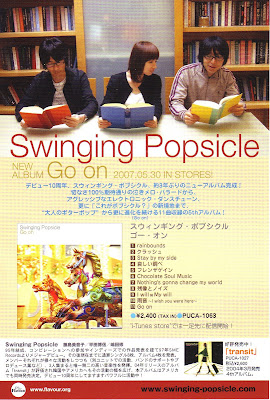
Also this month, on May 30, pop trio Swinging Popsicle is releasing their long-awaited 5th album Go on--I'll be buying as soon as it hits the store shelves.

Saturday, May 12, 2007

Backstage Pass

Musicians and fans mix freely at most Japanese rock events, but you can always tell who the performers are because they are the ones that have backstage pass stickers stuck to their jeans or wherever else on their wardrobe they decided to park them.

The stickers are usually made of a shiny fabric and say the name of the club, and the musicians write on it what unit they belong to. Clubs issue them to make sure customers don't get in for free passing themselves off as entertainers at events, where it's not unusual for there to be a couple of dozen musicians.

Many musicians treat old stickers as a memento of past performances, and you often see guys cover their metal brief cases (containing effect pedals) with used backstage passes.

Maybe when band members get the backstage pass for a bigger club like the Que or Loft or Quattro, they feel like they are going places.

They must really feel they've gotten somewhere when a big club doesn't ask them to put on a backstage pass because they're now so famous that all the staff recognize them. But, of course, hardly any musicians get that far.


***

I was bitching about the lousy state of Tokyo live houses in a previous post, but then last night I went to a club that was pretty ideal. It was called the Mosaic in Shimokitazawa. Several things I liked about the place: first, it's divided into two floors, with the basement the live space and the ground floor a bar with a TV that broadcasts the show going on downstairs. So, if the band playing doesn't interest you, you can go up for a drink in the bar, but then if the band looks good after all on the TV, you can descend the stairs again. Mosaic isn't the only club with this sort of set-up (the O-Nest in Shibuya has two floors too), but most aren't like this—it's a great thing if the club has the space.

Mosaic also looks nice with an all-white-colored live space, has good sound, and the staff is friendly.

***

The bands I saw at the Mosaic were Yuyake Lamp, a one-girl three-guy pop group named the 606, and vocalist Roco. The 606 was good, but I felt they could improve their stage presentation: the female vocalist/keyboardist sat at the very right while the three ordinary-looking guy musicians took up the rest of the stage, resulting in an out-of-balance look. Maybe if the bass on the very left of the stage were really unusual-looking, say, more than 2 meters tall and muscle-packed, with rainbow-colored dreads and donning schoolboy shorts, the left-right visual balance would have been better.

Roco was Only-In-Japan: a kogyaru(-like) lounge jazz vocalist. She'd sing nice pop-jazz, then between songs she'd talk in that abbreviated, hyper, alien Japanese of the very young, about subjects such as her favorite sort of cake. Or, maybe she's quite normal and the problem is aging me...

Yuyake Lamp I've written about many times, they are one of my favorite bands, but at this show during some moment I felt vocalist Yunn's voice sweep over me like waves, like her emotions caused the laws of the physics of sound to become manifest. Someone who possesses neither an especially powerful voice nor remarkable formal singing skills, Yunn is nevertheless a great vocalist.

P.S. These illustrations don't have anything to do with the text. Just some random fliers I was handed at the Mosaic show...


Friday, May 04, 2007

Tokyo Music On Melt-Banana Etc. Show

I was debating with myself about whether to write about the May 1st show featuring Melt-Banana, nhhmbase, Clisms, Yolz in the Sky and Shift at the Akihabara Goodman, but then I found that blogger template-mate* Tokyo Music had already done a very fine job reporting on it. Check it out. I especially liked this part about Melt-Banana:

According to Wikipedia, Melt-Banana singer Yasuko Onuki's vocal style has been described as "a rabid poodle on speed". After their set (this was the first time I'd actually heard any of their music - am I allowed to write a blog on Japanese music after such a confession?) I was trying to figure out what to say about them when my girlfriend trumped both my half-arsed notes and the anonymous critic cited on Wikipedia - "The music was OK but she sounds like Alvin and The Chipmunks going through teenage angst." 'Nuff said.


For my part, slight differences of opinion with Tokyo Music (but let a hundred flowers bloom, etc.):

1. The Goodman show was the third time or so I've seen nhhmbase, but I still don't get them. I can see they do sophisticated, occasionally beautiful music, but are they that special?

2. Tokyo Music didn't like Yolz in the Sky from Osaka because of the vocalist, but they were my favorite act of the night. They were like Suicide meets the Stalin, except on a record mistakenly played at 78 rpm--I have a major weakness for that sort of sound (maybe to make sure their influences were obvious, Yolz's guitarist actually wore a Suicide T-shirt).

3. I'd seen better gigs by both Clisms and Melt-Banana. Clear & Refreshing's Ian, who was in the audience, said Clisms (pronounced Chlistmas...) is best when the audience is completely drunk and radiating good vibes toward the stage, and that seemed true enough. As for Melt-Banana, for the full experience I think you need to catch them at an even smaller live house like the Shelter, and stand at the front so that at climactic moments you can see the female vocalist's irises swing like a pendulum inside her eyeballs like a Balinese dancer's.

Tokyo Music also highly recommended Shift, but I left before their show started. I seem to often miss out on their shows...

***

I said at the top I debated whether to write about this event--that's because, tell the truth, this event was another one of those unpleasant shows I touched upon in my previous post, and I wasn't sure whether writing about it was worth it: just too many people packed into a small, smoky space, and the Japanese live house dynamic was at work where, during the show, people in the audience had invisible but inviolable territories marked out for themselves, so that if you wanted to walk over to buy a beer or go to the bathroom it was a bit of a struggle because people didn't want to cede you their space to let you pass; the weird but typical result of which was that everyone went to buy drinks between sets, resulting in massive lines; of course, you could ignore the routine and shove your way to the bar, but that would be uncouth and out of line with the Japanese sensibilities I've developed from being in Tokyo too long (reading this outside of Japan you might not get what I'm talking about, but I think people who've been to their share of Japanese shows would understand).

Is it that hard to design a live house where it's easy to buy a drink even when the show is crowded?

Maybe because of Golden Week, there was a fair number of English-speaking foreigners in the audience, and I overheard one Japanese guy tell another: "I think the gaijin-san are here to see Melt-Banana". 'Gaijin-san'! Thanks for the politeness even in a private conversation not meant to be eavesdropped!

***

* RE my blogger template: a recent, positive review of Japan Live started out saying something like, 'its generic blogger template may lead you to think that it doesn't contain any valuable info, but nothing can be further from the truth'... Hmmm, I've sometimes wondered whether I should customize the template, but I never have, because 1. I'm lazy, and 2. I actually like this generic template with its dark colors, and think it's appropriate for the subject. Any thoughts?

Wednesday, May 02, 2007

The Disappointing 'Neo Underground'

About half a year ago someone told me about a must-check-out mixi community called Neo Underground. Put together by a few Tokyo-based musicians, it posed the questions that a lot of us were thinking but didn't ask out loud, at least not to a wide audience: why is the Tokyo music scene so unsatisfying in many ways, in spite of all the talent and variety? What are its problems? And what can we do to fix them?

In the section for introducing the community, where another mixi group might write, say, 'this is a community for people who love spicy food', was a long manifesto, written by the founder. It looked like something that took the person a whole night to write, in a feverish state. That original declaration has since been taken down, but here's what I remember of the Main Questions it asked: Why are Tokyo shows so expensive (both for the audience, and for bands to play)? Why is there always a one or two drink minimum, and why are those drinks always overpriced? Why do most bands have to pay to play gigs? Why are the shows always at the same few tired live houses? How can we get more shows going by like-minded, good bands? How can we get more people to come to more shows that are more fun, cheaper, and at more interesting venues and events?

Forums were set up to discuss those issues: for example, one forum was devoted to discussing alternatives to playing at live houses. How about playing at college campuses? Or, abandoned buildings? Parks with outdoor stages? Ideas flowed in, and it looked like, if these ideas were realized, in the near future we'd be seeing a lot more live shows that were different, enjoyable to go to aside from the music itself, and that didn't cost an arm and a leg to get in.

Maybe here it would be best to explain what is wrong with the Tokyo music scene, to give you a sense of why the solutions proposed by Neo Underground excited a lot of people. The most basic problem is that there are too many bands that want to play in front of paying audiences, and too many live houses (clubs) to accommodate those groups, but too few people who want to see shows. As a result, live houses have come up with a business model that would prevent them from losing money even if not many people show up for shows: they ask bands to guarantee a number of tickets, say, twenty tickets, and if twenty people don't show up the groups have to pay for the unsold tickets themselves. What this means is that most beginning bands have to pay to play, because they can't sell the minimum number of tickets.

As far as I can tell, live house managers rely mostly on the revenue from these guaranteed tickets sold to make ends meet, so, for example, it doesn't make a huge difference to them whether or not a lot of drinks are sold. Sure, if the fans buy a lot of drinks, so much the better, but if they don't, it's not a big problem because they are raising revenue from elsewhere: the bands themselves. And, indeed, one of the most striking things about Tokyo shows is that even though all live houses have bars, and they don't really check IDs, most fans don't drink that much. At most shows I've been to, I'd say that the majority of the people only imbibe their minimum 1-D.

Because selling drinks isn't a big consideration for the live houses, they don't make much of an effort to, so that, at a typical club there's one overworked employee selling expensive beers and badly-made cocktails; there are also no chairs or tables—you drink standing up, in a basement, facing the front like everyone else.

Neo Underground's goal was to change all this. How about doing a gig at an unused school building? The door charge would be half the usual price. And there wouldn't be a one drink minimum—but the drink charges would be close to their original cost, so people would be able to have more. Bands wouldn't have to pay anything to do gigs. And, organizers would only invite groups they thought were good, so there won't be shows where a batch of bands that had no connections with each other shared the stage.

It was exciting stuff, and the number of community members soared. There was to be a big meeting where the founding members and anyone interested could show up and talk about how to make all these ideas reality.

And the big meeting was held...but then, nothing happened.

For a couple of months, there wasn't even a report on the meeting itself. After a while, with apologies about the delay, a meeting report was published. The ideas mentioned above were apparently brought up, but, as would be expected, one meeting didn't change the world.

However...from about the time of the meeting, the air seemed to have gone out of the tires of the Neo Underground juggernaut. The energy level declined. There were far fewer ideas being thrown out in the forums, and no projects being planned. I got the sense that the key players of the community decided to make compromises. They got bored of trying to bring about changes. Or, they still thoughts changes would be good, but could come about more gradually, little by little.

In short, Neo Underground turned out to be a disappointment. The ideas were all great, but the mixi community wasn't able to realize them.

***

Moving forward a few months, last week there was an event organized by bands related to Neo Underground in Shinjuku, called closer Vol. 1. I wanted to see it to find out if the musicians were able to create anything new. It didn't live up to my expectations.

The event was held at two Shinjuku live houses at once, the Motion and Marz, and you walked from one club to the other depending on which act you wanted to see. That was a good thing—you could also hang out outside or buy cheap drinks or food at a convenience store, before heading back to see a show. But that wasn't a Neo Underground innovation—it's something others have tried before too.

Other than that, it was the usual, weariness-inducing Tokyo gig: too many people crammed into a tight space where there was nothing to do but stand around with drink in hand, listening to music.

I was there to see Yucca, but I ended up seeing only one other group besides them (out of the ten playing at the two clubs). It's this sense I think I've developed after seeing hundreds of shows these past few years in Tokyo, that after a few minutes I could tell whether I'd be bored with an event, and that was the case this evening. (Though, who knows, maybe if I stayed around I might have discovered some unbelievable band.)

The feeling I got was that these groups would be too much brains, and too little heart. They listen to a lot of prog and post-rock and currently trendy alternative music and create beautiful music, but they don't connect to the audience. Their shows are like a classical recital. And I think that's the style of a lot of the musicians who initially were behind Neo Underground. The funny thing is, if the venue was better, and more in line with some of Neo Underground's proposals, these shows might have been more tolerable, or even satifying. Just imagining here, but say, if the show had been at some abandoned building with lots of space, and you could watch a show or you could ignore it and have drinks with a friend, I think it would have been much more fun.

So, in spite of my disappointment over Neo Underground, I think their ideas and goals are worthy, and I wish people would follow through on them. That would be a good thing for the Tokyo music scene.

Monday, April 30, 2007

A Few Favorite Bands' Videos Found On Youtube

Surfing YouTube, I found videos by a few favorite artists...


This is from Spangle call Lilli line's Koto civic auditorium show a few years' back. If you are a Spangle fan and don't own 68scll, you should try to track down a copy, because it puts them in a different light, the live strings adding even more colors to their gorgeous palette of sound.


Here is enigmatic, sweet-voiced pop unit Cecil's new single, "Namida No Tsubomi ["The Teardrop's Bud"...hmmm, not quite as poetic as the Japanese...]. This year they are supposed to release a new CD, which I'm very much looking forward to. 


Capsule sometimes gets a bad rap as Pizzicato Five clones and so on, but I think they're one of the better Japanese units around now. One of their recent shows apparently got shut down by the Tokyo fire department because too many people showed up. Beautiful imagery in this video too.


Time-travel back to 1992, when Grunge was big, Supersnazz was the next big girl band from Japan (after Shonen Knife), and they went on a long Europe tour... I think that's where this video is from. They rocked back then, and they still do.

Sunday, April 22, 2007

Yuyake Lamp's Kokoro No Ki

There are very few musical works I've waited for as eagerly as piano pop band Yuyake Lamp's debut single. Yuyake Lamp is, after all, the successor band to Orange Plankton, one of my favorite Japanese groups, and I know from seeing them live that they're unlike any other band; they create their own world on stage. Now, the single, Kokoro No Ki, is out, and it lives up to my expectations.

I think this three-song single is intended to be Yuyake Lamp's make-it-big work; in the past, their album production and marketing were very much do-it-yourself indie band style, but for this CD they got serious people to help them so that, for example, the single has been mentioned in Weekly Pia magazine and they are doing an in-store show at HMV music store. The title track itself sounds more hit chart-friendly than anything Orange Plankton did; very upbeat and filled with sound. But my favorite song is the second one, “Ao No Yukue”, which is just vocalist Yumi accompanied by a piano, highlighting her voice.

And what a voice it is... It's one of the most distinct Japanese high female voices I know, gentle but filled with emotion and personality. Yumi's voice is a big part of what has made me follow Orange Plankton/Yuyake Lamp all these years.

The third and final track, “Fuwari Fuwari”, is like Yuyake Lamp's “I Want You To Want Me”. Just as Cheap Trick didn't come up with a definitive version of the song from the start (and instead, found success with the Budokan live version), I don't think Yuyake Lamp has created the ultimate version of this tune, one of the best, most memorable and catchiest numbers they've written so far. The version on this single is very good, but it doesn't quite measure up to the renditions I've listened to at their shows. The band says “Fuwari Fuwari” is an important song for them—I think it's one worth revisiting in recorded form, maybe as a live recording.

***

Writing about the band Yuyake Lamp puts me in a tight spot of sorts. They are, after all, friends who I've known for years (back from their Orange Plankton days), and haven't you ever had a friends' band in your life that you thought was the greatest? In other words, maybe I'm not very objective about them.

But I like to think that isn't the case. I discovered their music before I met them in person—my being blown away by their music preceded my making their acquaintance. And I haven't necessarily fallen for bands of other friends. Also, I'd like to think I can separate friendship and my musical tastes.

What I know is that when I put my iPod on shuffle and swim through a long stretch of unfamiliar songs, the gentle piano pop of a Orange Plankton/Yuyake Lamp tune often feels like seeing land in the horizon.

The other day shuffle brought me to an Orange Plankton song I hadn't heard in a while: “Wakaranai no Uta [Song of I Don't Know]”, from their album Wishing For Rain Tonight, released in 2002. It still sounded fresh. 2002...already half a decade ago, and much has changed in the meantime (Orange Plankton no longer exists in that form, for one thing), but listening to the song brought me back to those early days, when I made my way to clubs all over the west side of Tokyo to see them, in my memory always the sweaty summer months, and I'm walking under a railroad bridge somewhere to my destination of beer and music.


***

Yuyake Lamp is on the road again on a national tour to promote their single, and I went to see the first show of the tour, at the Plug in Shibuya. It was an exhilarating evening as usual. At one point they had a children's hand bell ensemble from their neighborhood play one of their melodies, and they stole the show, as performing kids tend to do.

***

“Kokoro No Ki” can be translated to something like “The Tree of the Heart”, but that's not quite adequate, because “kokoro” is one of those Japanese words that's hard to render into a single English word. Roughly, it means a person's internal emotional core, but is used much more casually and in everyday conversation than that definition would suggest.

Wednesday, April 18, 2007

Ken M, A Magnificent Seven (In Italy)

I was asked again by the Italian music website rockit.it to listen to Italian pop music and tell them what I really think as a foreigner. The last time I and the other foreign reviewers were collectively called the Foreign Legion, but this time we've been upgraded to the Magnificent Seven. Also, last time, I was assigned to review a CD by a crazed, screaming electric music dominatrix, but this time I was given an album called Non Voglio Che Clara that was totally my cup of tea, beautiful pop with strings and acoustic guitar and a guy who can really sing, and which I'd probably buy if I sampled it at some cool Tokyo import CD shop like Apple Crumble Record. Here's my capsule review.

Friday, April 06, 2007

Why I Walked Out On YMCK

I walked out on my first YMCK show last week even though I’m a big fan of their 8-bit techno jazz-pop music, for a simple reason: they prohibited photography.

The MC of the event told the audience before the show started that taking pictures and video-taping would be forbidden. And they seemed to have staffers standing around making sure no one did whip out their cameras. That put me off. I don't know the YMCK people or what was behind this prohibition, but it seemed needlessly uptight, especially for an indie band.

Plus, I listened to a couple of their songs and would have stuck around anyway if they were great performers, but, as far as I could tell, they were simply recreating their recorded sound on stage. They weren't adding that special thing that can only be created in a live show. It didn’t seem worth my time to stay until the end.

If people like to take pictures of bands, I don't see why they shouldn't.

Musicians may object that photo-taking by audience members disrupts the show. I could maybe see this if fans were taking pictures with a flash, but I never do.

Or, they might say they don't want their pictures appearing in blogs or other random places without their knowing about it. But to this, I ask: what’s the big deal? It isn’t as if the paparazzi are stalking them in their private lives—they’re on stage! Don’t they want the free publicity?

I don’t even see why major label artists are averse to getting their pictures taken. What would it matter if every other person in some arena show was taking photos? But there’s probably no hope of that ever happening.

What I wish for is more freedom. Music should be a free thing, and people should be free to enjoy it the way they like. Too often at Japanese shows, you are expected to enjoy the illusion of being free and eager music lovers when, in reality, authority figures are regulating everything you do, from the moment you line up to when you leave the hall. I dislike this this, and I avoid shows at the big venues if I can help it.

Smaller, independent shows shouldn’t be like this, but there will always be bands that want to take away the audience’s freedom. That’s their choice, but it’s my choice not to go to their shows or write about them (unless I want to—like today).