Saturday, November 25, 2006

Why Aren't Waffles Selling Like Hot Cakes?

Here is the story of my life as a music fan: I become ecstatic about a band after seeing their show; time passes, and I begin to wonder whether they were quite as good as I remembered; I see the band again and feel redeemed—they exceed my estimations of them in my shifty memory; repeat this cycle endlessly, without learning.

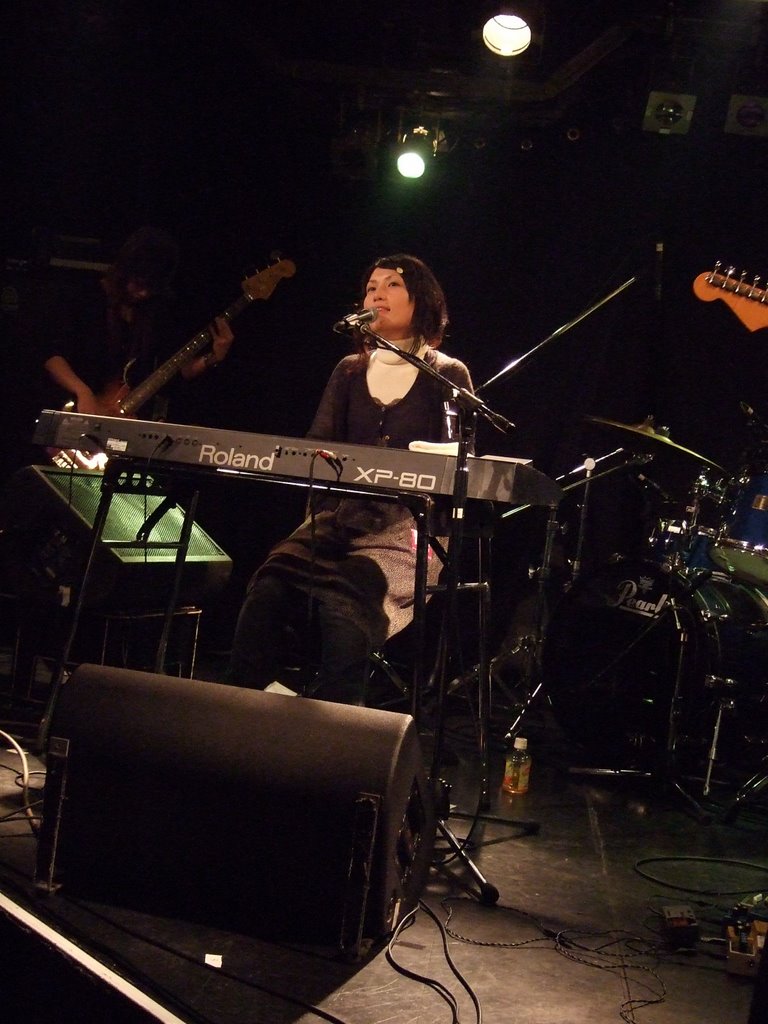
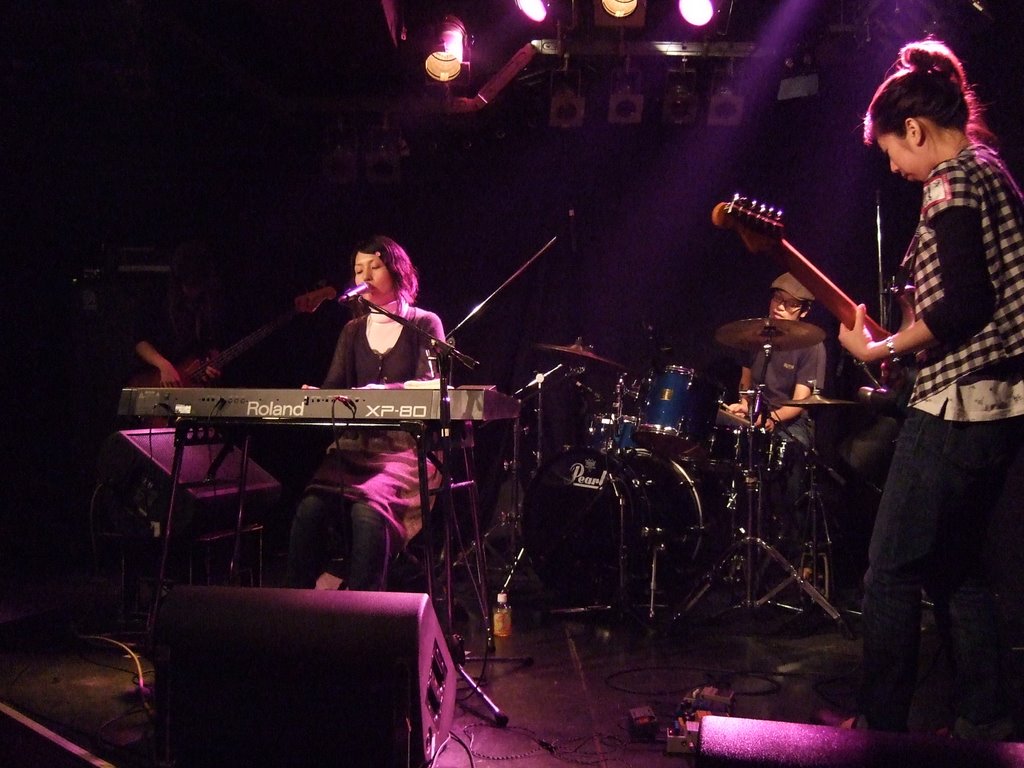
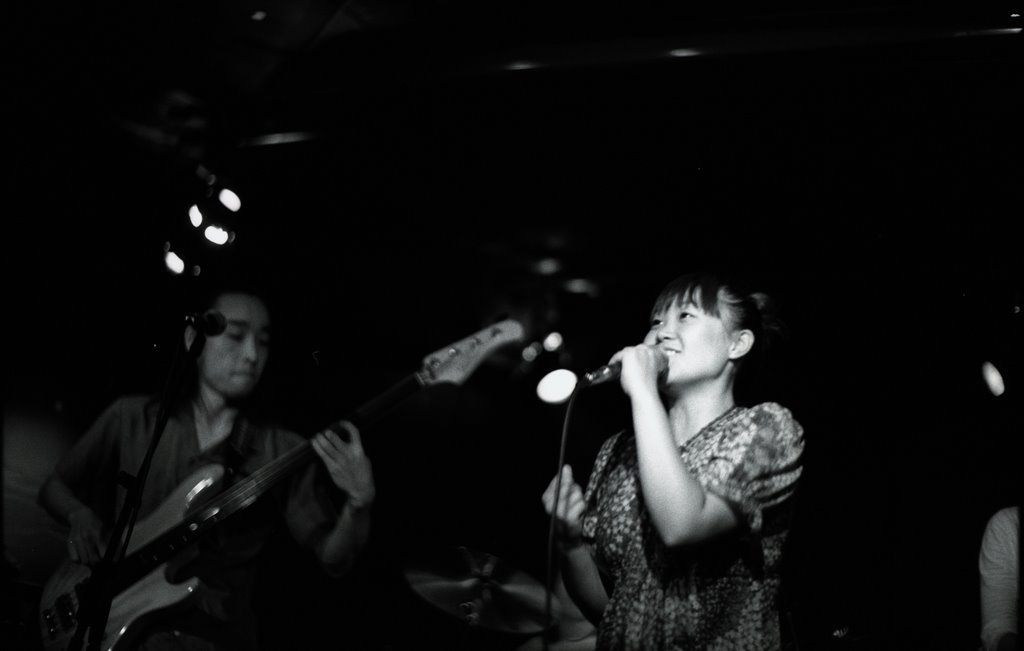
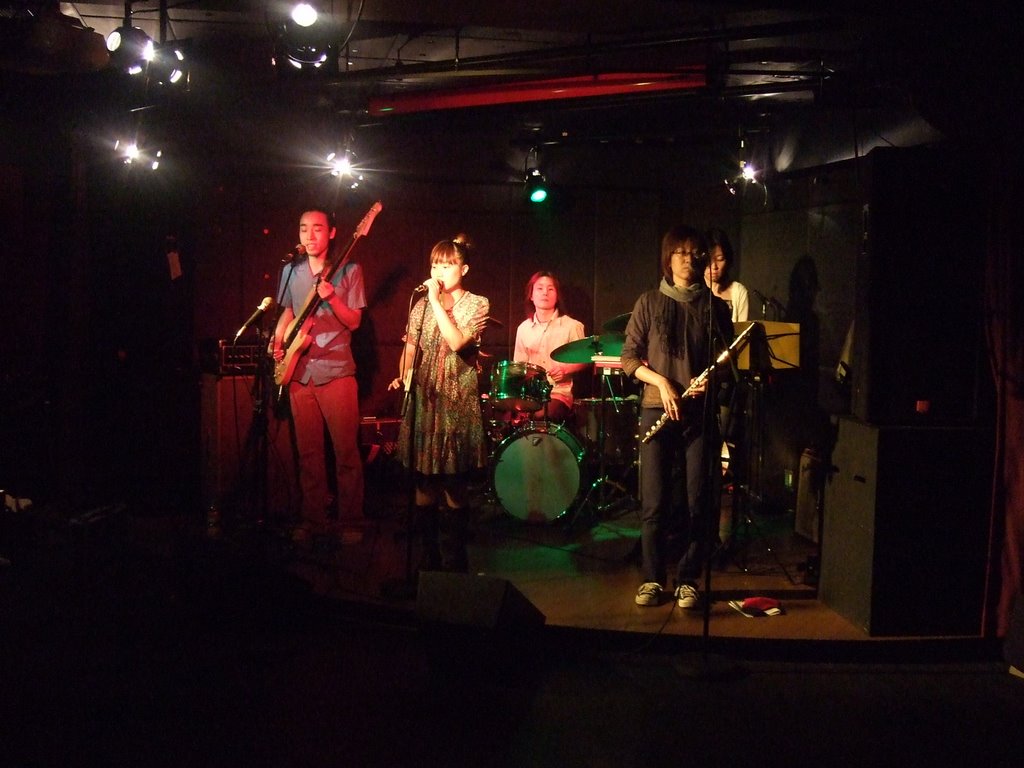
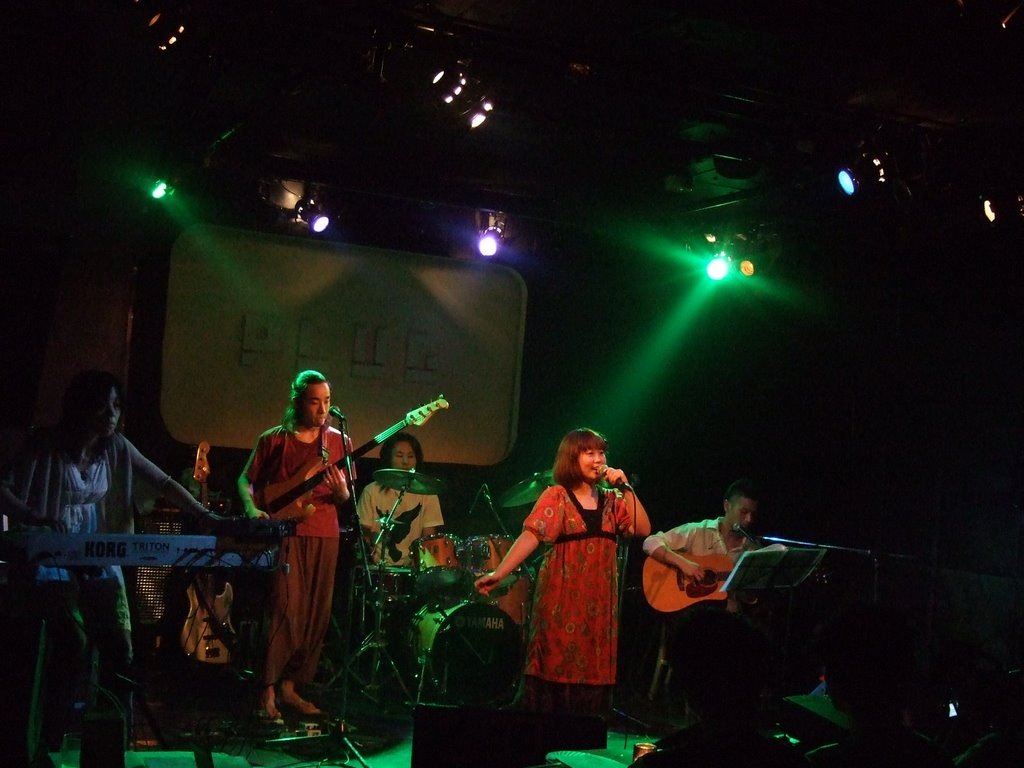
This was the case when I went to see waffles at the O-West in Shibuya a couple of weeks back: though a fan of theirs, I hadn’t been to their shows in a while, and had forgotten how wonderful they can be live. But seeing them, I was reminded: there aren’t many bands that play as joyfully as this pop quartet, the members all wearing genuine-looking smiles when playing the first few songs, and their singer Kyoko Ono is a talent, an owner of a beautiful voice who uses it to pour out emotion.

I wondered why they’ve never made it really big. Japanese hit charts are littered with songs that are less original and gorgeous than theirs. Are they too conventionally good, without scandalous elements, new fashions, or something exceptional (like, say, a lead guitar genius)? Who knows. One thing I did notice though was that the band played a couple of great old songs, “Tsugi no Hikari” and “Tokyo” (because this was the first stop of a multi-city tour), and going back and listening to those songs later they seemed just as good as the material from their latest album, Kimi no Mahou (‘Your Magic’), as if time has stood still. Does this show they are intent on keeping a certain sound, or are they being too averse to exploring new musical territories? I’m not sure, and in any case I do like Kimi no Mahou.

***

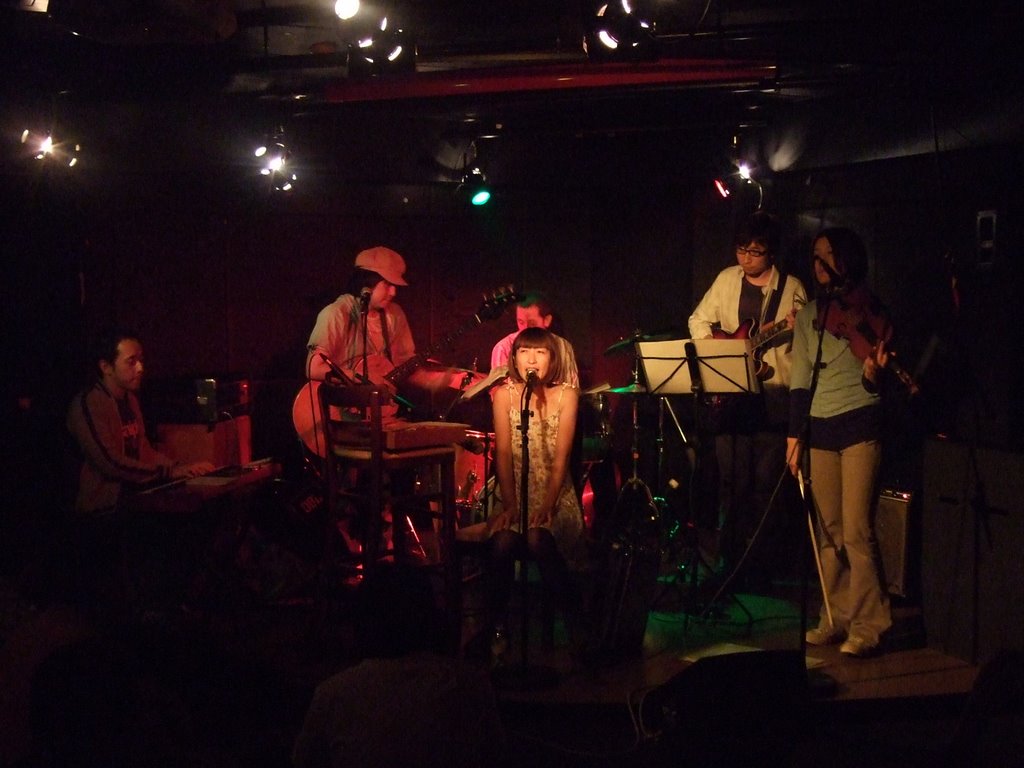
The event was called Lady, and featured two other female vocalist units, Quinka, with a Yawn and Furukawa Momoko, with whom waffles are touring, and also guest-starred advantage Lucy (who played a couple of new, good tunes). All were great, it was a satisfying evening, but I was particularly interested in the eccentrically named Quinka, with a Yawn, a one-woman unit of a keyboardist/vocalist who creates trippy, imagistic music by recording bells and other sounds on stage, looping them, and adding more sounds until they become a multi-layered backing track for her keyboard and voice (there must be a word for this that I don’t know…).

***

If you read Japanese, there's a report of this event here.

Wednesday, November 08, 2006

Rightround Column: Pico Pico Pop


My latest monthly column on rightround.com is paean to pico pico pop, a mini-mini-essay on the music of bands I've recently become enamored of, like Macdonald Duck Eclair and YMCK.

Saturday, November 04, 2006

Supersnazz, Solo Live At The Shelter


Sixteen years.

That's a long time, and that's the number of years Supersnazz has been playing.

At their solo show at the Shimokitazawa Shelter, vocalist Spike said some of you must have been little babies when Supersnazz started (after which she joked she too was only two years old at the beginning).

And, looking at the chain-smoking, biker-jacket-and-side-striped-T-shirt- wearing crowd that packed the Shelter, it didn't seem likely that many of these fans were there at the start a decade and a half ago.

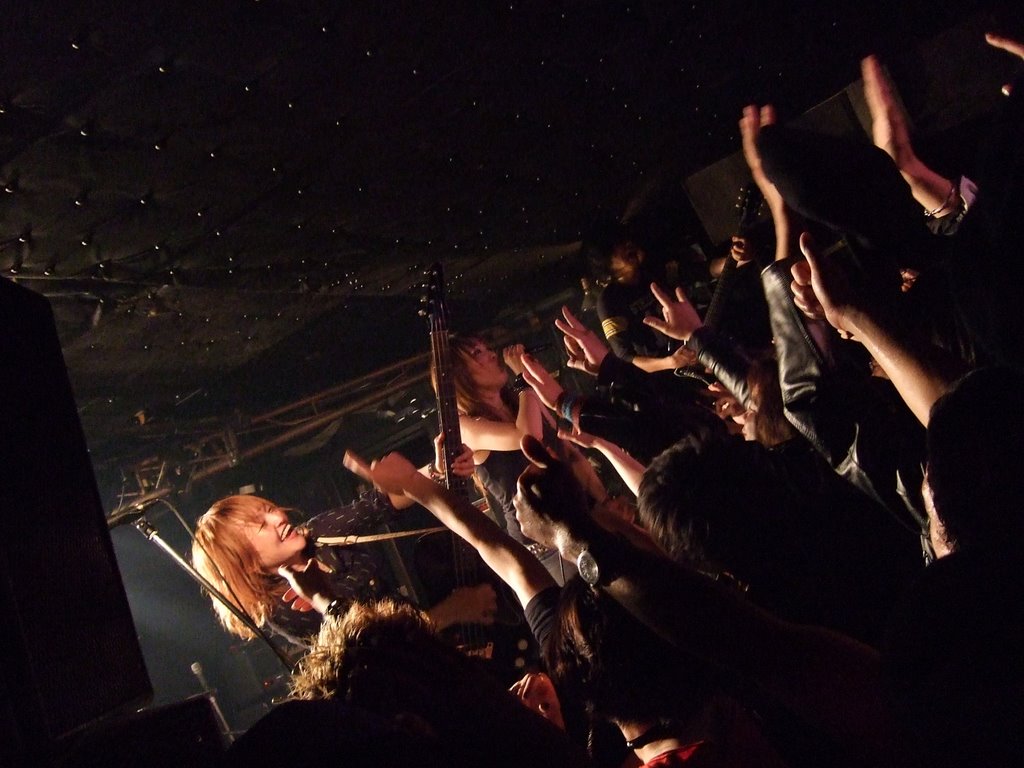
Over the years as old fans departed new ones must have boarded the Supersnazz train: I too only found out about this great quartet this year. But the crowd seemed to know all the old songs, punching their fists in the air at the intros (like in the photo above) and toasting with their cups of beer.

I don't know how many years more they can keep it up, but, I hope, it's many.

Sunday, October 29, 2006

Fliers, Yucca, Lodge


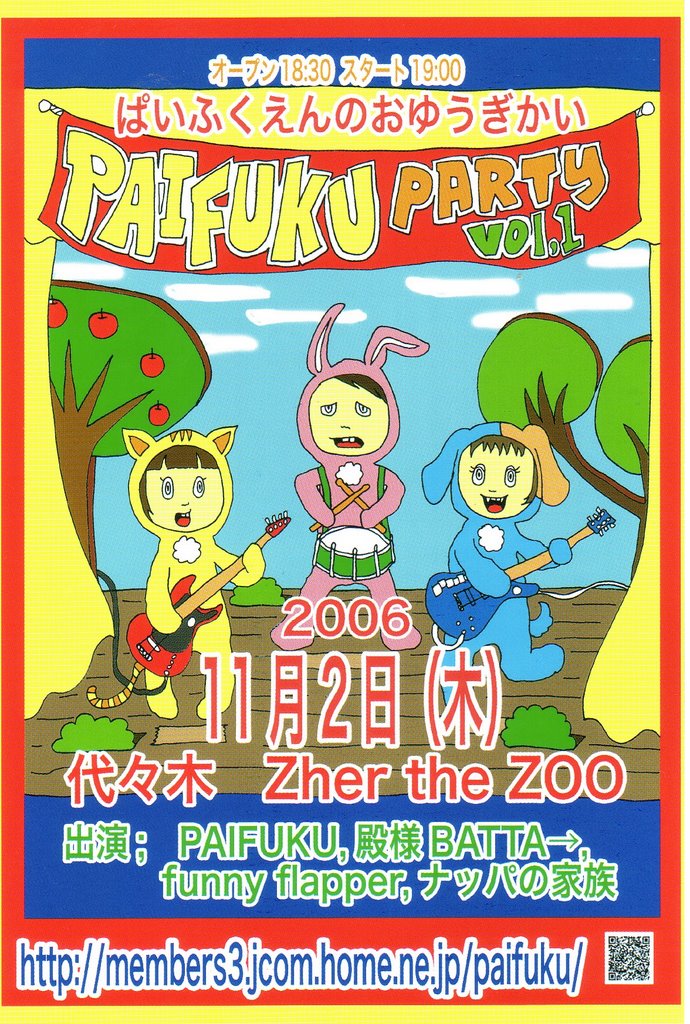
Back by popular (?) demand, here are cool fliers from a recent show featuring Yucca and Lodge. The event was organized by a fanzine called Supernova!, whose latest issue's cover features a bikini lady carrying a red lightning bestriding a yellow Lamborghini Countach...


If I knew this event is anything like the illustration, I'd definitely go see it.


Kicking it among the ginkgo leaves....


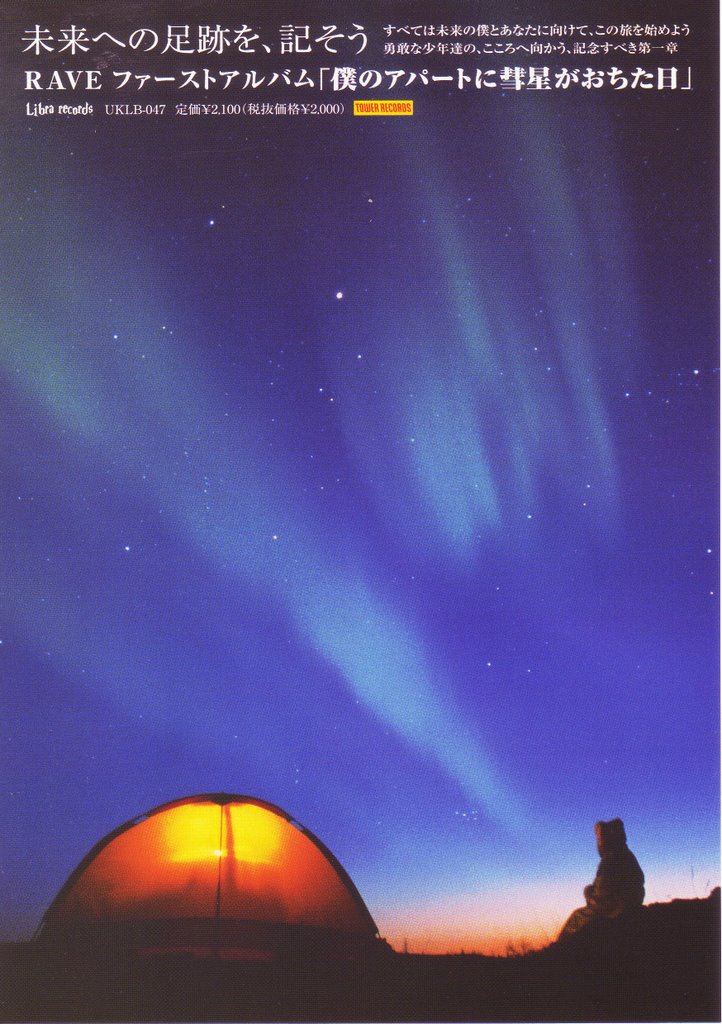
Kicking it under the aurora...

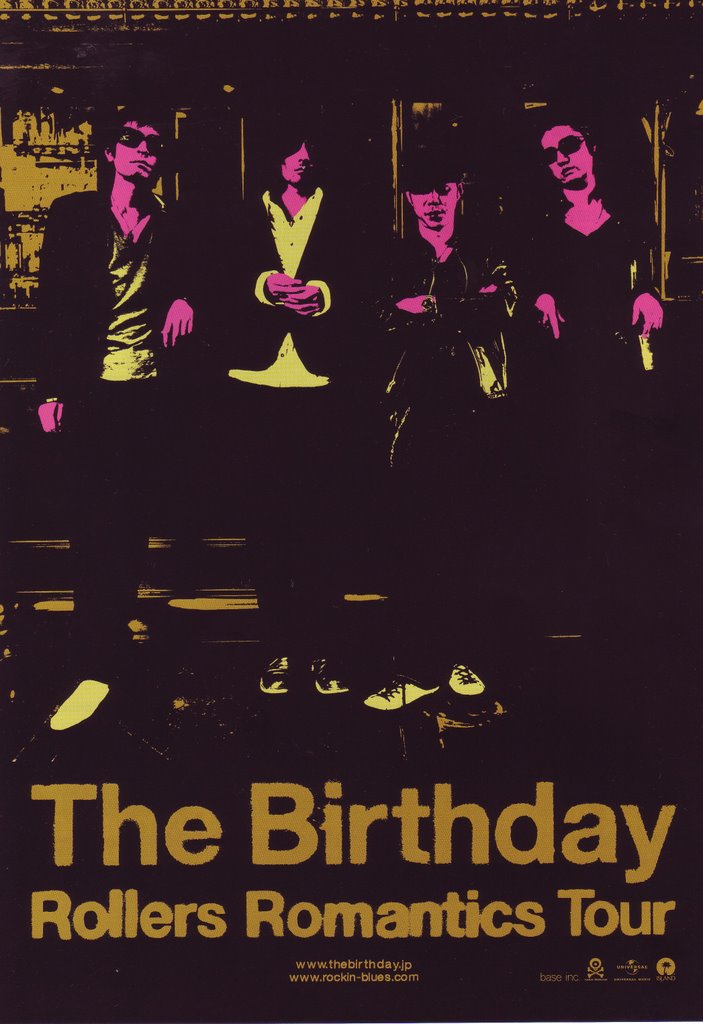
Pink-skinned Bad Boys...


Nice, colorful illustration.

This is a good, simple design.


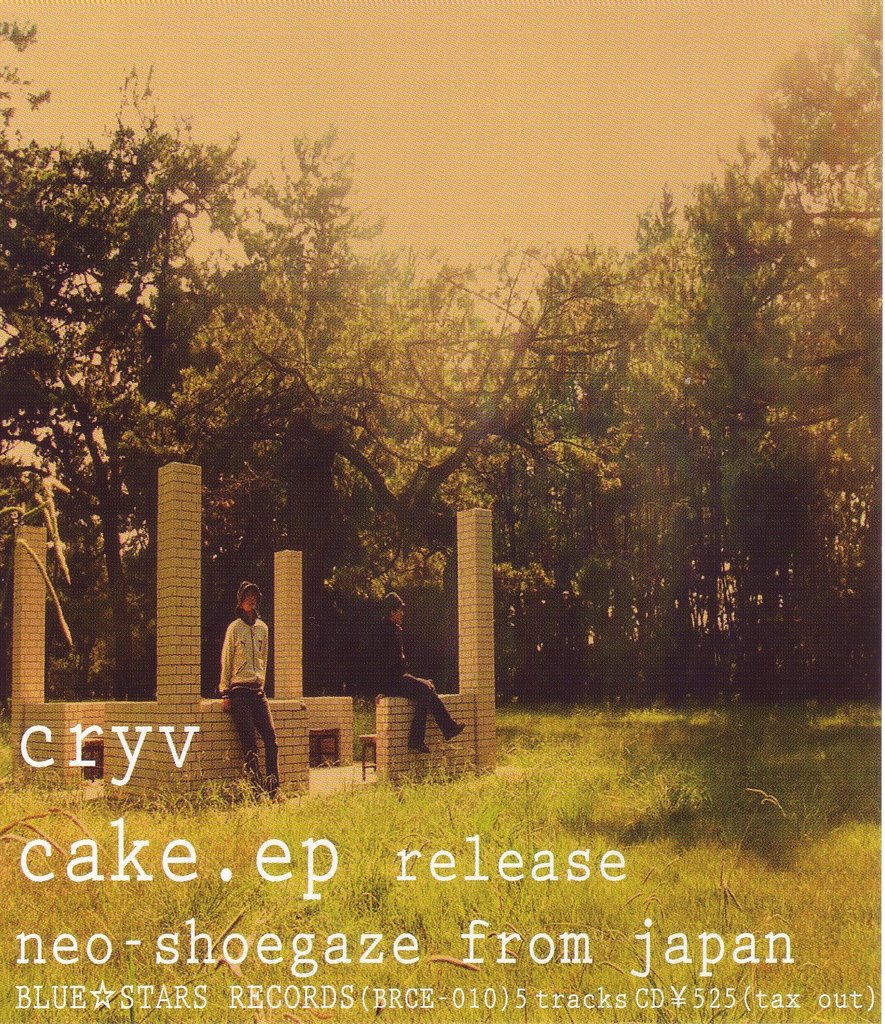
Nice, yellow-tinted photo. Wonder what that structure is though?


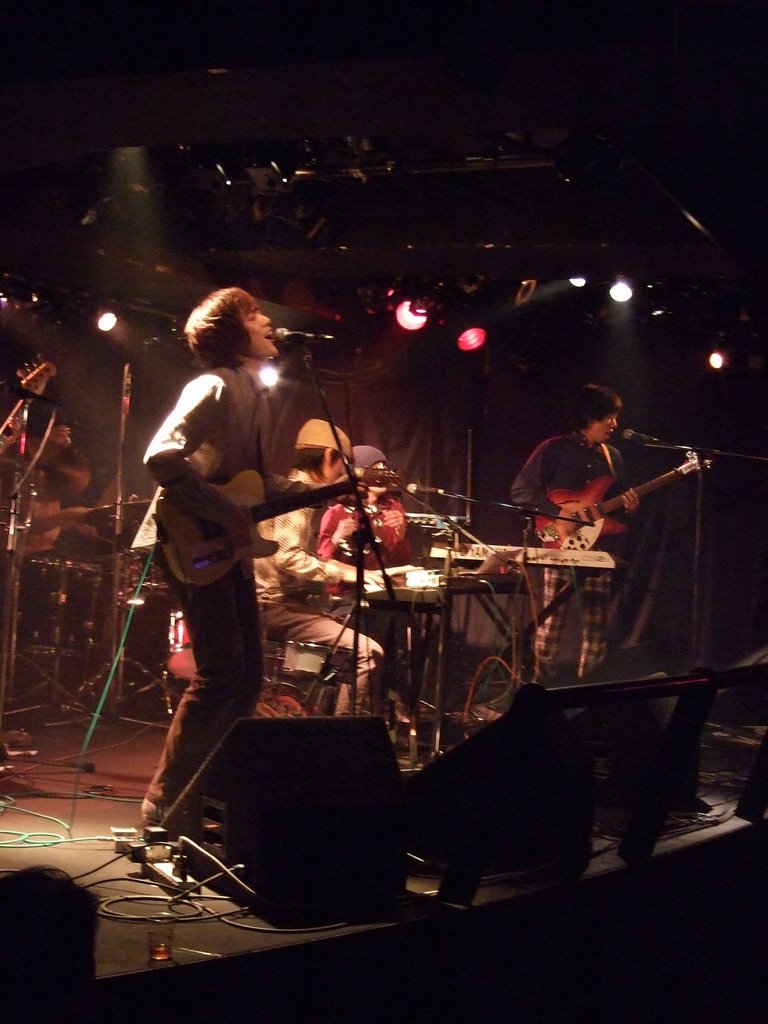
Good, stylized green live shot.


And a stylized purple-red live shot (I think?).


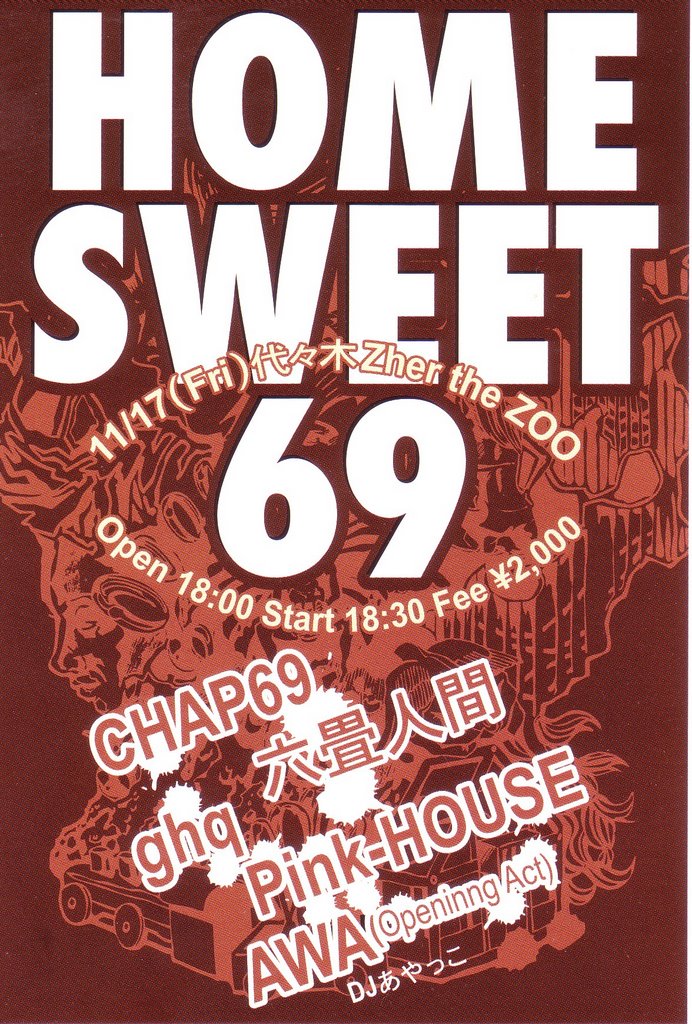
I liked the design of this 'Home Sweet' 69 flier.

***

tight --adj 1 closely held, drawn, fastened, fitting, etc. ...

The dictionary gives several definitions for the word 'tight', but it doesn't have one for when people say this or that group is TIGHT. Yet it's not too rare a thing; a tight band is something that people know when they see it, a combination of experience, skills, confidence, and certain unexplainable factors. A tight band is thrilling to discover, and makes all the trips to rock clubs and all the times putting up with mediocre bands seem worth it.

Lodge was a tight band. I don't really even remember much about their show, except that it played funky alternative rock, and one of the members banged on a tiny, kid's drum set. But next time I see their name on a flier or a club schedule I'd be disposed to check out that show, because I know they are TIGHT.


Lodge

Yucca, who I saw for the third time or so, is also tight, though in a different way from Lodge, playing their artful pop with a light touch, especially the female drummer, who often only taps on the drums. I caught their members outside the Zher The Zoo after their show, buying beer from a convenience store next door and celebrating under a sprinkling sky. They were nice guys.

Wednesday, October 25, 2006

A Macdonald Duck Eclair Convert

As recently as February I was so indifferent to the music of a band called Macdonald Duck Eclair that I walked out of their show after listening to only a few songs. Now I find this incredible; it’s hard to understand why I didn’t understand their stuff back then. You don’t always know what you're seeing in front of you is Revolution.

Macdonald Duck Eclair is a dialectical band, creating by juxtaposing contrasts: the female singer’s voice floats over the repetitive, mechanical and sometimes harsh techno, a voice that is soft as a feather brushing a foxtail. Sometimes they wade in pop music shallows, but they are best when diving into this sea of hard techno-gentle vocal contrasts. In their first album short short those include the tunes “mac teenage riot”, “texas”, “butterfly in the stomach” and “perpetuel”. Their second album The Genesis Songbook is even better because it has almost nothing but those songs of contrast, as if they’ve realized that’s their sound.

The Genesis Songbook is a wonderfully weird album—Genesis, the first book of the Bible, appears to have given them the inspiration for some of the songs, but clearly not in a religious way. Rather, it seems they used bible-sounding song titles (like “Paradise Song”, “Shepard” and “Le Diable”) as free-association springboards to explore ideas (some of which are pretty far from religion—“Shepard”, at one point, describes an SM master-slave relationship, in that gentle voice of the singer).

One day I’m going to have to accost this trio, demanding that they reveal their source of inspiration and ideas. And, alas, they play live only rarely, so next time they do a show, I’m going to stay put and focus my eyes and ears perfectly, as if I’m reporting on the Apocalypse.

***

You can listen to some of Macdonald Duck Eclair's songs at their MySpace page. I also play their tunes all the time on Japan Live Radio.

Tuesday, October 17, 2006

Good Bye, Kitchen Gorilla Drummer

I'd missed the last couple of Kitchen Gorilla shows but when I read on their website their drummer U-co was leaving the band and playing one last show, I felt I had to be there. It wasn't so much a devoted fan thing but more of a desire to see a spectacle, the teary-eyed farewells, the final bow, etc. Unexpectedly though, the departing drummer U-co made it through the evening with her eyes dry, and instead the singer Kayo was the one who came prepared with big goggle-like glasses to hide any tears, tossing them aside during the set, but then losing it during the encore, moving her face away from the mike, unable to sing for a few bars.

No one ever seems to take my word for this, and even I forget sometimes, but The Kitchen Gorilla is a great band, one that play beautiful rock melodies with an intensity I've hardly ever seen anywhere else, and listening them that night I became glad they will continue performing.

***

The biggest gorilla in the kitchen thing these days in Tokyo is that our neighboring tyrant could rain down nuclear armageddon on us one day, a year from now or a decade later, who can tell, so that the city feels like someone who isn't quite sure if he has cancer. Looking at Tokyo's elegant, contented people (who mostly appear to be apathetic or in denial), and the great metropolis they've built up, I feel a sadness thinking all this might be lost one day, though that's also a rehash of the dread my generation grew up with.

Wednesday, October 11, 2006

Contrary Parade Of Osaka

A series of coincidences led me to a Shimokitazawa club called Basement Bar, to see a band from Osaka: first, by chance, I picked up a compilation album and liked a song by the group, Contrary Parade; then, a friend of a friend just happened to know this band and said he will e-mail them to see if they could send me a copy of their demo CD; and by luck, Contrary Parade turned out to be the sort of group that was happy to send their CD-R to people who were interested in their music; and finally, months later, when they decided to make their first trip as a band to Tokyo, my e-mail address happened to be stored somewhere in their archives so that they could let me know about the show, which I was keen to go to.

Contrary Parade was three jittery girls on guitar, bass and keyboard, and a guy on drums. They were nervous because this was their first Tokyo show, in front of a sparse audience at the Basement Bar, and they mostly stood still as they went through their long, bright, guitar pop tunes. But there was something charming about them: the vocalist/keyboardist sang softly but with emotion in a high voice that trailed away at the end of phrases, while the rest of the quartet played with obvious enthusiasm and joy. After their show I met the four friendly, shy members of the band and had the usual clumsy conversation of people meeting for the first time, but I told them I won’t miss them the next time they are in Tokyo or if they were playing when I went to Osaka, and I meant that.

Friday, October 06, 2006

Japan Live Presents Photos By Komei Nakatani

Here are some beautiful photos of my event Japan Live Presents by my friend Komei Nakatani. I particularly like this photo above of Yunn & Yuyake Lamp's Yumi and Tsuji, because the grainy, slightly out of focus image makes it look like something out of a early-20th century Paris jazz club or Berlin cabaret.


4 Bonjour's Parties


Three Berry Icecream


Wednesday, October 04, 2006

Rightround Column: Making Of Japan Live Presents

You've (hopefully) read my account of the first-ever Japan Live Presents event. Now, in my monthly rightround column, you can read about the Making of Japan Live Presents, as it were: the long and winding road that led up to the event, as I tried for a couple of months to convince bands to play, and then waited for their answer. And waited. And waited...

Tuesday, October 03, 2006

The Shimokitazawa Road Controversy

The New York Times has a good story on what might be called the Shimokitazawa Road Controversy: Tokyo's plan to build a big thoroughfare that will split the neighborhood in two. Shimokitazawa, in case you've never been, is a densely-packed maze of alleys filled with tiny bars, used clothing stores, music clubs etc., like a super-concentrated Berkeley or Greenwich Village. Aging Japanese hippies and counterculture-types have launched a campaign called "Save the Shimokitazawa" to stop the road-building and keep the feel of the town unchanged. The NYT story does a fine job of also telling the other side of the story:


But the project also has many supporters, among them the Shimokitazawa shop owners’ unions, which were founded right after World War II. They hope a broad boulevard will provide an escape route in an earthquake, and make it easier for buses and taxis to run through the neighborhood.

Kuniyoshi Yoshida, a 71-year-old landowner who leads one of the unions, said that as the neighborhood, like the rest of Japan, grows older, residents place a higher priority on safety and convenience. He also said the newcomers had no right to complain, since most have refused to join his union and participate in neighborhood cleanups.

That is not to mention the host of troubles that they have brought, he says: the crowds, graffiti, loud music, drunken revelers urinating on homes.

“They say this road will destroy the neighborhood,” he said. “But we original residents see it as progress.”


Personally, though, I'd see it as destruction--I love wandering the streets of Shimokitazawa and checking out all the little shops and bars, running into friends and seeing musicians I know in this neighborhood that's unlike any other in Tokyo--it won't be the same after the Road is built.

Friday, September 29, 2006

Japan Live Presents, Volume 1

I organized a music event in Tokyo and, without intending to, seemed to have transported the spirit of an American gig into a Japanese club. It wasn’t like a normal Japanese show, where even punk audiences have been known to be as quiet and well behaved as those at a classical concert. My guys were there to party. A gang of gaijin inebriates took over the rear area next to the bar and held shouted conversations about every subject under the sun, except about the music that was playing in front of them. The Japanese closest to them were annoyed about the ruckus but also looked resigned to the fact that that’s just the way foreigners are. And several of the foreigners, for their part, told me later that they loved the music, and I took their word for it.

I wanted to make the event on Saturday night, the first installment of Japan Live Presents (produced together with Philipp Potz), freer and more relaxed than a typical Japanese show, and I think I succeeded. Guests could move in and out of the show at a bar called The Baron, so they could step out to the streets of Nishi-Azabu and Roppongi if they wanted during the gig and come back later. In Japanese events, you usually can’t get back in once you leave. Parents brought their children and sat together in front of the stage—something you don’t see that often at Tokyo gigs. And if people wanted to talk rather than listen raptly to the music, that was fine too.

But music was the key ingredient of the event, and while maybe I shouldn’t sing the praise of the bands too much considering I invited them all myself, still I have to say all their performances were dazzling. If I was there as a regular member of the audience I would have loved the evening too. After all, the three groups, Three Berry Icecream, Yunn & Yuyake Lamp and 4 Bonjour’s Parties, are among my favorite bands. And I’m also a big fan of DJ Kamaage, who spun records between sets.

Three Berry Icecream, the musical unit of former Bridge member Mayumi Ikemizu, played first. At gigs Ikemizu invites friends to perform, and these pals are also great, veteran musicians—at Japan Live Presents the six-person band included the leader of Little Lounge Little Twinkle, the keyboardist for Orangenoise Shortcut and the violist who once played in Rocky Chack’s Mori-No-Orchestra. Three Berry Icecream, as the name suggests, plays sweet, happy pop songs, but their orchestration is solid and imaginative—I especially liked the duets between the accordion and viola, which sounded like something out of a Paris street scene.


Yunn & Yuyake Lamp

Next up was Yunn & Yuyake Lamp, which is composed of three of the four members of the defunct Orange Plankton, a favorite band of mine that I’ve written about more than almost any group in these pages. Tonight the band had invited along a flutist and a pianist, allowing the vocalist Yunn to focus on singing rather than also playing the piano. This was as I desired—Yunn is a good pianist, but she really shines when she stands facing the crowd as a singer, crouching, jumping and dancing to create with her body the visuals to the words she’s singing.

At first after Yunn & Yuyake Lamp was formed they played all new songs, as if to emphasize they are a different entity from Orange Plankton, but recently they’ve become more comfortable looking back at their old days, and have been playing Orange Plankton tunes at shows. They did two at Saturday’s show, including “Mebuki”, the elemental, stirring finale to the album Wakusei Note. I was also surprised and delighted to see in the audience Yuki, the former pianist of Orange Plankton.


The last band, 4 Bonjour’s Parties, was the most popular with the foreigners in the audience, based on comments I got from several people during the show. And I could see how their long, mellow, chamber music-like post-rock compositions would probably be most in tune with the preferences of certain segments of mature, hip music fans. 4 Bonjour’s is a remarkable group—they have seven members, each of whom play several instruments—even the drummer sometimes switches instruments and plays the sax! The small stage wouldn’t fit them all so that some instruments, like the xylophone (!), had to be placed outside of the stage. The band is working on their first album and it would seem worth it for these guys to tour abroad when that’s done, though carrying all those instruments with them would no doubt be a logistical nightmare.

***

All through the first two acts or so I had a stomachache, brought on in part from downing two ice-cold pints of beer on an empty stomach, but also probably a result of nervousness as the organizer. Still, it was a lovely feeling to be able to introduce a few of my favorite Japanese bands to people that had never heard of them, and I want to do it again.

Monday, September 18, 2006

My Little Airport's Naughty Album Covers

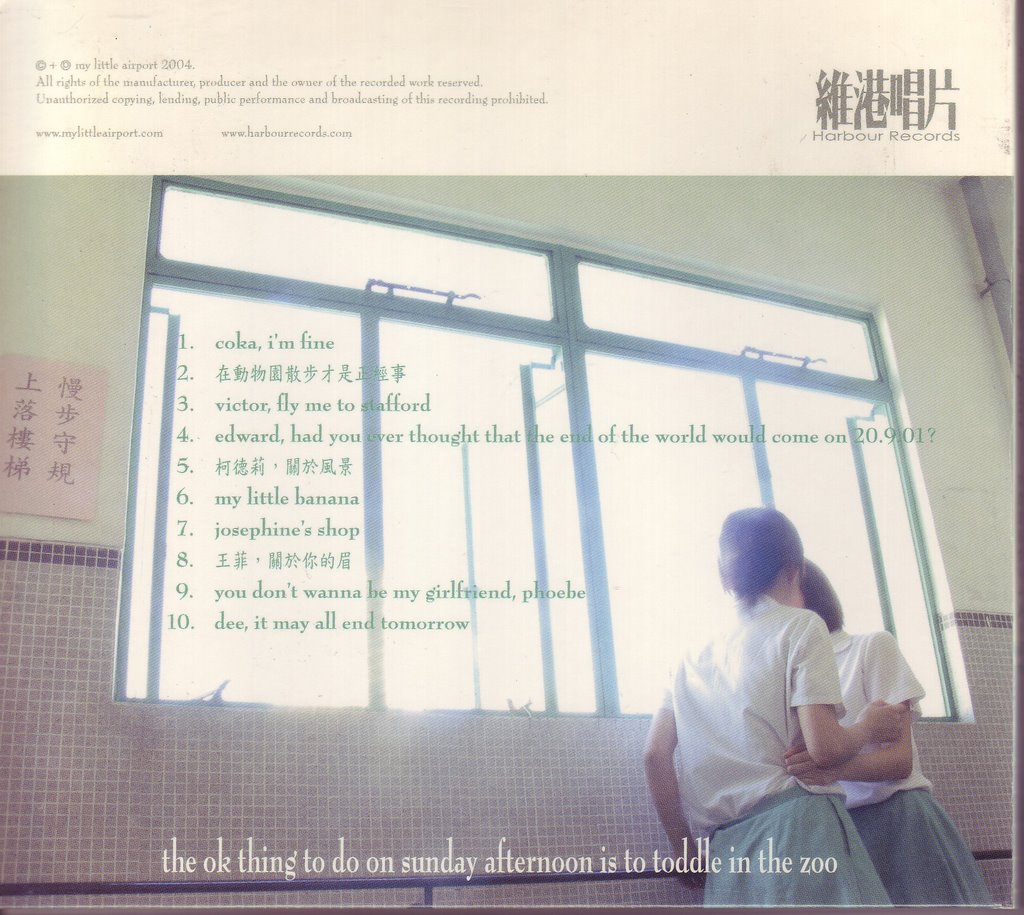
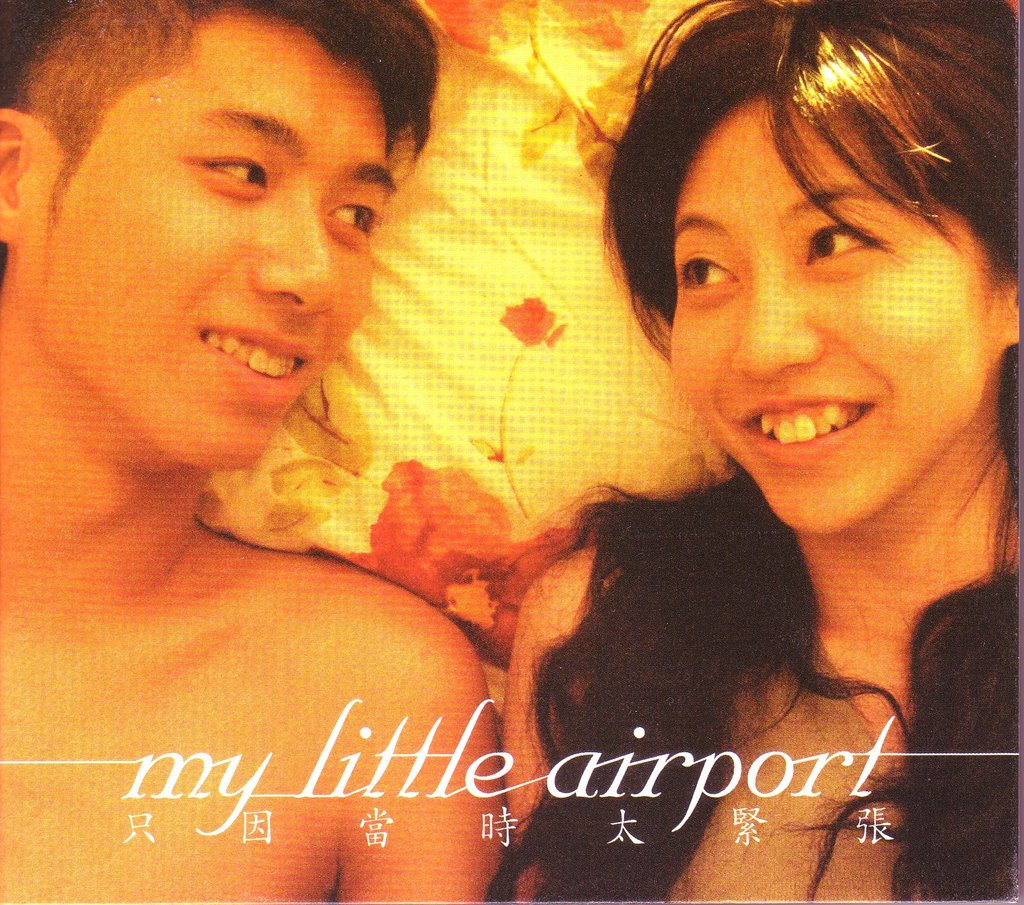
My Little Airport is a great Hong Kong indie band I've discovered recently. But rather than talk about their music (which is minimalistic and 80's New Wave-sounding), I'd like to bring your attention to the covers of their two albums. They are pretty naughty.

The cover of their first album, the ok thing to do on sunday afternoon is to toddle in the zoo, features two girls in school uniforms of pure white blouses and aqua skirts. The girl on the right is rubbing her cheek against her friend's with eyes closed dreamily. Her friend's expression is somewhere between blissful and about-to-burst-out-laughing.


The back-cover shows the two in a near-embrace, with faces close enough to be in a kiss.

This is a sort of scene I seldom saw in my school-days, and if it's a common thing in Hong Kong, well, I wish I grew up there rather than where I did...

Meanwhile, on the cover of My Little Airport's second album because i was too nervous at that time are a couple lying on a bed, looking smilingly into each other's eyes. The girl is lightly-dressed, which isn't surprising considering Hong Kong's heat and humidity. The guy, however, isn't wearing a shirt. What are these two kids up to??


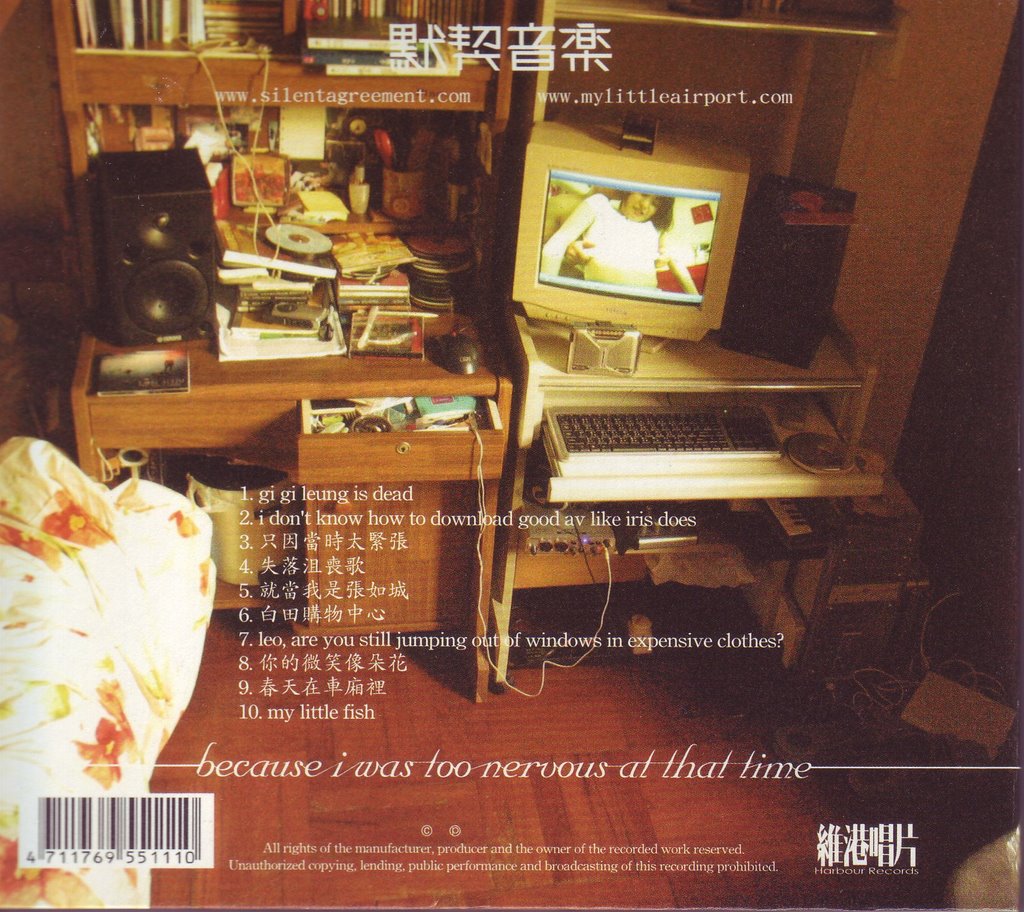
When you flip the CD over to the backside, you see the room where the bed is, with a desk and on top of it a computer, whose monitor shows a picture of...


What IS that a picture of?! A guy looks to be helping a girl remove a piece of her clothing...

The funny thing is My Little Airport's songs themselves aren't scandalous or naughty, though there is one song on the second album called "i don't know how to download good av like iris does" (AV standing for adult video).

I like these album covers but I have to confess I don't know how to read them. Are they a joke? Or are they meant to provoke? Or does the band see something romatic or aesthetically pleasing in these photos, enough that they wanted to make them their covers?

My confusion is compounded by my perception that the Chinese are relatively conservative when it comes to public discussion of sexual matters. But maybe my perception is out-dated, and/or it doesn't apply to independent artists working in a big, modern city like Hong Kong. (Though I'm guessing the 'good adult videos' that Iris downloads in the song mentioned above are Japanese rather than Greater Chinese in origin...)

Saturday, September 09, 2006

Yunn & Yuyake Lamp + Comedian + Actors

Most Tokyo live music shows feature only music acts, but some are more multi-disciplinary. Yunn & Yuyake Lamp’s event on August 30 was a good example of the latter.

In addition to several pop groups, Yunn invited a standup comedian, put on a spoken word act by two actors, and had friends sell their artwork on the side.

The comedian, who goes by the stage name Collagen Haigo Man, was living proof that it’s never easy to make it in show business: his main subject was how unsuccessful he’s been and how he’s watched his comedic contemporaries earn fame and become fixtures on TV. But, in fact, he was very good, with the smooth spoken delivery of a rakugo-ka, traditional comedians who are some of the best speakers of the Japanese language. The day after this event he left for a Japanese tour, with the first stop being…a show in someone’s living room in Yamanashi Prefecture.

The spoken word act featured an actor and actress talking about a boy and a girl growing up together, falling in love but then the young love being cut short by the death of the girl, while a video screen behind them flashed various images of childhood and summer. The act was a bit on the sentimental side, but the actress was a true tall Japanese feminine specimen of beauty (I just found out googling that she plays the role of a ‘different-dimension physicist’ in Ultraman Mebius—cool!).

I think Yunn & Yuyake Lamp’s basic stance is to welcome all sorts of musicians, artists and creative types into their fold, rather than carve out clique-like boundaries on the types of music and arts they will tolerate, and this night was a reflection of that. Their own show, as usual, was also deeply satisfying. Just to remind you that Yunn & Yuyake Lamp will be one of the three groups playing on September 23 at the Japan Live Presents show, which is sure to be a blast, so you should try to make it!

Thursday, September 07, 2006

Mark Your Calendars: Sep. 23 Japan Live Presents!

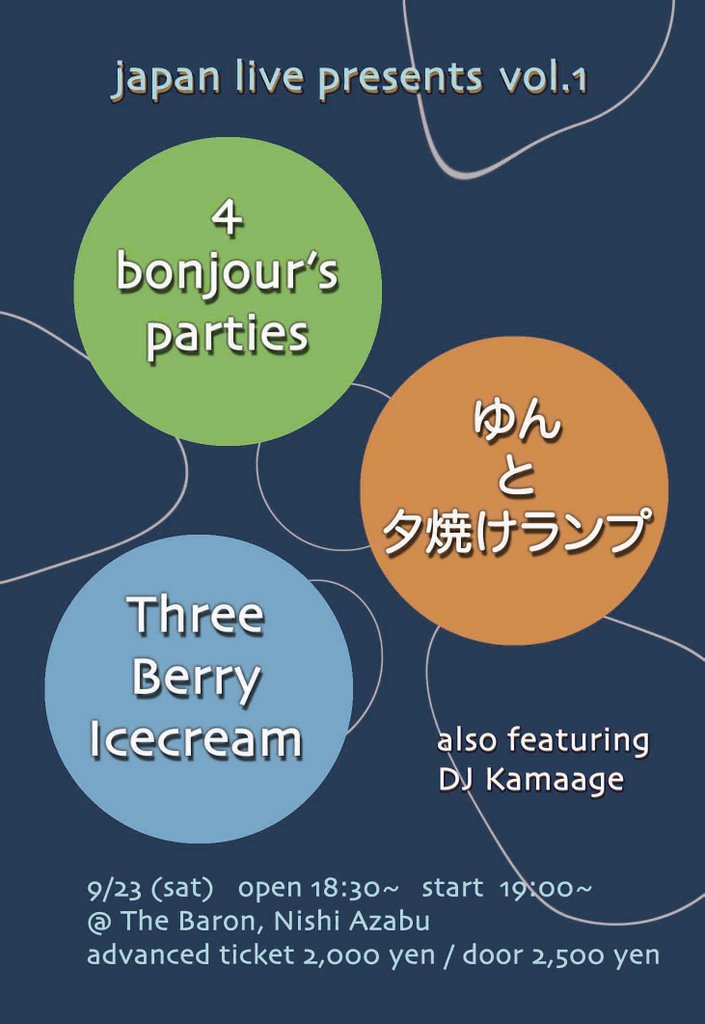
Tokyo residents: Mark your calendars for a music event produced by Japan Live, on Saturday, September 23--Japan Live Presents Volume 1!

Featured will be three fantastic Tokyo pop groups:

4 bonjour's parties, a seven-person ensemble that plays chamber-music-like indie pop influenced by Glasgow indie music, post-rock and electronica;

Yunn and Yuyake Lamp, the mellow piano pop group led by the Chara-esque vocalist Yunn, formerly of the quartet Orange Plankton (which sadly split up earlier this year);

And last but not least, Three Berry Icecream, the sunny neo-acoustic musical unit of Mayumi Ikemizu, who has played in influential guitar pop bands like Bridge, Daffodil-19 and the Bachelors.

This will be an evening for true music lovers: these groups create gorgeous tunes using everything from accordion to clarinet, flute, trombone, viola and glockenspiel, in addition to the usual guitars, bass and drums.

The event will be at the Nishiazabu Baron, a bar-restaurant that serves home-brewed beer and delightful tapas. Show starts at 7PM, doors open at 6:30 PM, and cover charge is 2,500 yen, or 2,000 yen if you reserve tickets with me--please send an e-mail to gonglinjian at yahoo dot com with your name, number of tickets desired, and, if possible, which band you most want to see.

Visitors to Japan: If, by coincidence, you are visiting Tokyo on September 23, and want to see some live music, come by to The Baron, which is about a ten minute walk from Roppongi station. In fact we will let you in at a discount price if you can provide evidence you are a genuine visitor by showing us a recent Japan tourist visa stamp in your passport!

I hope to see you there to celebrate autumn equinox with some good music.

Tuesday, September 05, 2006

My Rightround.com "Inside Tokyo" Column


I've started writing a monthly column about Japan's pop music scene for the San Francisco-based indie music info website rightround.com, and the first installment, about a road trip to see an advantage Lucy show in Nagoya, is now up, here. It's an interesting new website, bringing together blogs about the music scenes of Montreal, Sydney, San Francisco, Austin, Tokyo (that's me) and a lot of other subjects. Take a look!

Thursday, August 31, 2006

Watusi Zombie, Ruins Alone, Panic Smile


What’s the difference between mainstream and avant-garde music?

That’s a question I’ve been thinking about recently, especially after I saw a show called “Chika-teki Ongaku (Underground Music)” at the Shinjuku Red Cloth.

‘Mainstream’ and ‘avant-garde’ are relative terms. Something that was out-there one day might become ordinary the next. For example, at a certain point in the 70’s, progressive rock, which was once avant-garde, became mainstream. But then, in reaction to the excessively technically demanding nature of prog, punk arose, and its simple, aggressive beat was the new avant-garde. Until it too became mainstream, and prog-like music once again seemed radical and new.

Whether a type of music is mainstream or avant-garde isn’t decided by how it sounds—technically complex music could be mainstream, while simple 50’s-type rock might become radical. In Japan, Spangle call Lilli line, which makes music that is beautiful and unlike anything you’ve ever heard on Top 40 radio, has just got one of its songs featured in a shampoo commercial.

There are some sorts of music, however, that will probably always be stuck in the avant-garde corner of the musical world. Cecil Taylor, for instance.

What was interesting about the Red Cloth event was it bought together four groups that could be labeled ‘avant-garde’ or ‘underground’—Panic Smile, Watusi Zombie, Ruins Alone, and Core of Bells—but some of them seemed permanently avant-garde while others appeared to at least have a shot at the mainstream (if they wished it in the first place).

An example of the latter was the trio Watusi Zombie. They are weirdoes in some ways—the singer covers the mike with a plastic Buddha mask, they have two guitars but no bass, and for the finale they always toss the drum set from the stage into the audience section, and finish the gig literally surrounded by fans. But they play straightforward, fast, hypnotically repetitive punk rock, to which the fans head-bang. Maybe their quirks will one day become the added ingredients that will make them palatable to a mainstream audience that has suddenly developed adventurous tastes. Who knows—they did play at the Fuji Rock Festival last year…

Ruins Alone, on the other hand, I can’t see becoming mainstream in a hundred years. It is the unit of Tatsuya Yoshida, drummer of the experimental duo Ruins, which has been around since 1985. I remember I owned one of their CDs in college and a friend went through all my disks and said, 'I like your CD collection, except that band called the Ruins—I hate them!' They are, indeed, a group people usually love or hate—chaotically-structured, fast-moving, bass and drum musical passages, and yelps and wails. I liked them but not enough to buy more than one of their albums.

When I found out recently though that Yoshida is still playing as Ruins Alone, I became interested in seeing him live. I’m glad I did.

Yoshida took a long while to set up for the solo act, placing the drums at the front-center of the stage and putting all the mikes in the house around him. He seemed one of those bearded, middle-aged Japanese men who keep their feelings to themselves. But he became a different person once he said, ‘Hi, I’m Ruins Alone,’ and pounded the drums to start the set. His drumming was violent, animalistic, hyperactive and relentless, like an endless videotape loop of a cheetah going after its prey.


Ruins Alone

Somewhere between Ruins Alone and Watusi Zombie in terms of the possibility of going mainstream was the quartet Panic Smile. Ian of Clear and Refreshing told me that Panic Smile is a seminal band in the Fukuoka underground scene, spawning a number of like-minded bands and imitators (I’m stitching this together based on hazy memories of a drunken evening, so the details of what Ian said may not be exactly accurate…), and I’d been wanting to see them. They were good. First off, there’s diversity in their band member composition: the drummer is a girl, the bassist is a really big guy and the guitarist is a foreigner. They’re all good musicians, especially the guitarist, who blow-torches through solos. But they’re a little too different so it’s hard to imagine a day when their post-punk sonic experimentations will be played on commercial radio. Though, one never knows.

Thursday, August 24, 2006

The Brilliant Dolly's Pillbox Of Taiwan

While I was in Taipei for the Formoz festival, I bought a bunch of CDs of local musicians. I mostly chose the disks by their covers, figuring that musicians with good taste in CD covers must also have good taste in music. Although I haven’t gone through all the CDs yet, that reasoning of mine turned out to be true for one of the disks I bought—how are you today? by a quartet called Dolly’s Pillbox.

Actually, Dolly’s Pillbox’s music betrayed my expectations: the cover is a bright, pastel-colored illustration of a big white rabbit shedding blue droplets of tears, making me think this is a group that plays cute, toyshop pop, maybe like Japan’s Hazel Nuts Chocolate. But in reality, the only possibly ‘cute’ part of this 5-song mini-album is vocalist Cathy’s girlish singing voice, and even that often has a subtly weary quality—the rest of their music is solid indie rock/shoegazer, with streams of super-catchy melodies, sudden waterfalls of surprise chord changes and gurgling rapids of guitar solos. They’re like Galaxie 500, the Taiwanese Girl Band edition. (Dolly’s Pillbox are three girls and one guy.) All five songs on the album are top-rate, and you can listen to most on their MySpace page.

By coincidence after buying their CD I met their singer Cathy, because she was part of the advantage Lucy entourage guiding the band around Taipei during the music festival. I hadn’t listened to the CD yet so I had no idea that this down-to-earth girl was a brilliant creator of music (she also writes all the lyrics and drew the rabbit illustrations for the album—she seems to be a rabbit fanatic). Now I wish I could have seen Cathy’s band at Formoz, and I also wish I could be at eight places at once so I could be at Dolly’s Pillbox’s next show in Taipei while carrying on with everything else in my life.

Saturday, August 19, 2006

Supersnazz & VooDoo Hawaiians At NHK-FM

I have mixed feeling about NHK, Japan’s public television station.

On the one hand, it does great documentaries, history programs, and the like. Only on NHK can one find former sumo great Konishiki dressed up as a red ogre, singing and playing the ukulele for kids.


And its fang-baring monster mascot, Domo-kun, is the definition of cool.


But there are also reasons to dislike NHK. For example, it dispatches a gang of semi-thugs to collect your NHK bills, which you are required by Japanese law to pay, though there’s no penalty for not doing so, other than having to put up with the NHK collectors (if you lie and tell them you won’t pay because you don’t own a TV, they’ll ask to see your living room). NHK then uses your money to build lavish recreation facilities for its staffers.

Last night, though, my scale of feelings about NHK tipped to one side, the ‘NHK is cool’ side, because of one thing: their FM station was going to feature a live performance of great garage rockers Supersnazz and VooDoo Hawaiians, and invited fans to watch the gigs for free. Of course I headed to Shibuya to watch the radio recording—Supersnazz is one of my current favorite bands, and I’d also heard about and have wanted to see the VooDoo Hawaiians.

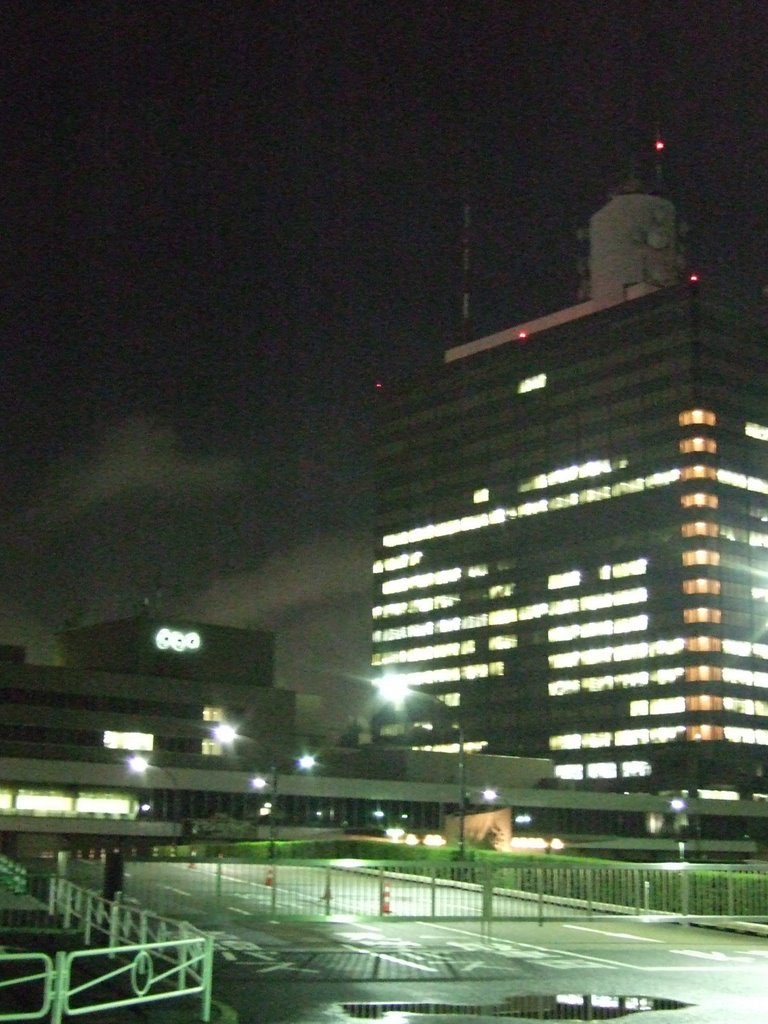
The NHK headquarters in Shibuya is a gray, government-ministry-like building complex, but the security was surprisingly lax—despite my being a sketchy gaijin, when I told the guard I was headed for ‘Studio 505’, he let me through with no questions asked and no IDs shown. The studio was a professional one with uneven, puzzle-like walls for acoustics, and was designed to hold many more than the several dozen people that showed up for Supersnazz and the VooDoo Hawaiians.

Before the first show, a staffer in a purple T-shirt got on the stage and said: “Can we practice applauding? There are a bit fewer audience members than usual tonight, so could each of you clap about two persons’ worth?” We proceeded to practice clapping for a minute or so.

When Supersnazz started, though, the clapping and cheering were entirely spontaneous. The band told jokes between songs.

“Since I’m going to be on NHK, I decided to wear a morning suit today,” the guitarist told a radio audience, who wouldn’t see he actually had on a shapeless gray long-sleeved shirt.

“Oh, well, we’re wearing yukata,” the two girls in the band said, and proceeded to compliment each other’s imaginary summer kimono (singer Spike was in reality wearing a navy blue summer dress with a plum blossom design, and bassist Tomoko had on a black X T-shirt).

They also did a new song about Ichiro, and when Tomoko was introducing the number by talking about the Seattle Mariners, she called someone involved with the team a ‘kichigai’, meaning a nutter, and definitely not a word that could be broadcast on public radio. So she started over with the introduction, but then one of the fans yelled out “Kichigai!”, and she ended up doing the intro for a third time.

***


VooDoo Hawaiians, in contrast to Supersnazz, hardly said anything between songs, and focused on their music, which was hard rock with long jams at the end of each song. The female vocalist looked like a classic Japanese doll, only with red-violet hair and wearing a bright red dress that said Pepsi-Cola. The other members, all guys, were hollow-cheeked, cigarette-stained rocker types, and the lead guitarist clearly had a Keith Richards thing going.

Mysteriously, the fans that showed up to see VooDoo Hawaiians were almost all un-flashy ladies in their twenties—I couldn’t work out why their music appealed to this demographic group in particular. The band rocked enough that I thought they should be embraced by a much wider audience.

***

All in all, it was a fun change of pace to see bands in a radio studio, but there wasn’t the booze and atmosphere of a live house, and I also sensed that going to see a band play at a radio event is more of a thing for hardcore fans to do (partly because you have to go through hoops to make it to the event, including sending a letter to NHK to get on the guest list), and though I’ve fallen hard for Supersnazz, maybe I’m not quite that hardcore yet, so I sorta stood out. Still, it was worth it—for one thing, because of the awesome acoustics, I was able to hear all of Supersnazz’s instruments crystal-clear and was able to appreciate more fully what great musicians they are. And I got to see VooDoo Hawaiians, who I’ll be checking out more in the future.

Tuesday, August 15, 2006

CDs Of Note: Spaghetti Vabune, The Caraway

Two great Japanese ‘guitar pop’* albums just came out:

One is Guitar Pop Grand Prix by Spaghetti Vabune. This strangely named sextet from Kobe has been growing in popularity, and I’ve been a fan of their ultra-catchy pop for a while. But their latest album took me by surprise: while their debut effort Summer Vacation, Sunset Vehicle was good, this second album of theirs marks a quantum leap in artistry. It’s my favorite Japanese album so far this year.

Opening with an anthemic declaration of their musical loyalties, ‘this is guitar pop!’ (‘this, is, guitar, pop, and you love I love guitar pop’, the song goes), the album runs through one after another bright and upbeat tunes that stick in the mind. Spaghetti Vabune songs are instantly recognizable because of their girl-guy twin vocals: neither is in any way an accomplished vocalist, but that’s part of the charm of this band. The female singer Chee’s style in particular is distinct, a warbling, nasal voice that seems to come out of the corners of her mouth—it’s probably an acquired taste, but one that you get hooked on once you do acquire it. Overall, the album is more bass-heavy than the lighter debut album, and the songs are lined up in a more focused way, to progressively jam up the listener’s voltage. The only shortcoming I can think of is that Spaghetti Vabune’s songs don’t have much variety: they’re all fast, energetic, sunny pop songs. But maybe that’s the Spaghetti Vabune sound, and moving away from it will make them a different band.

I also like Guitar Pop Grand Prix for its colorful art and design, all created by singer Chee, and for the fact that the lyric sheet includes chords, in case you want to play the songs yourself.


***

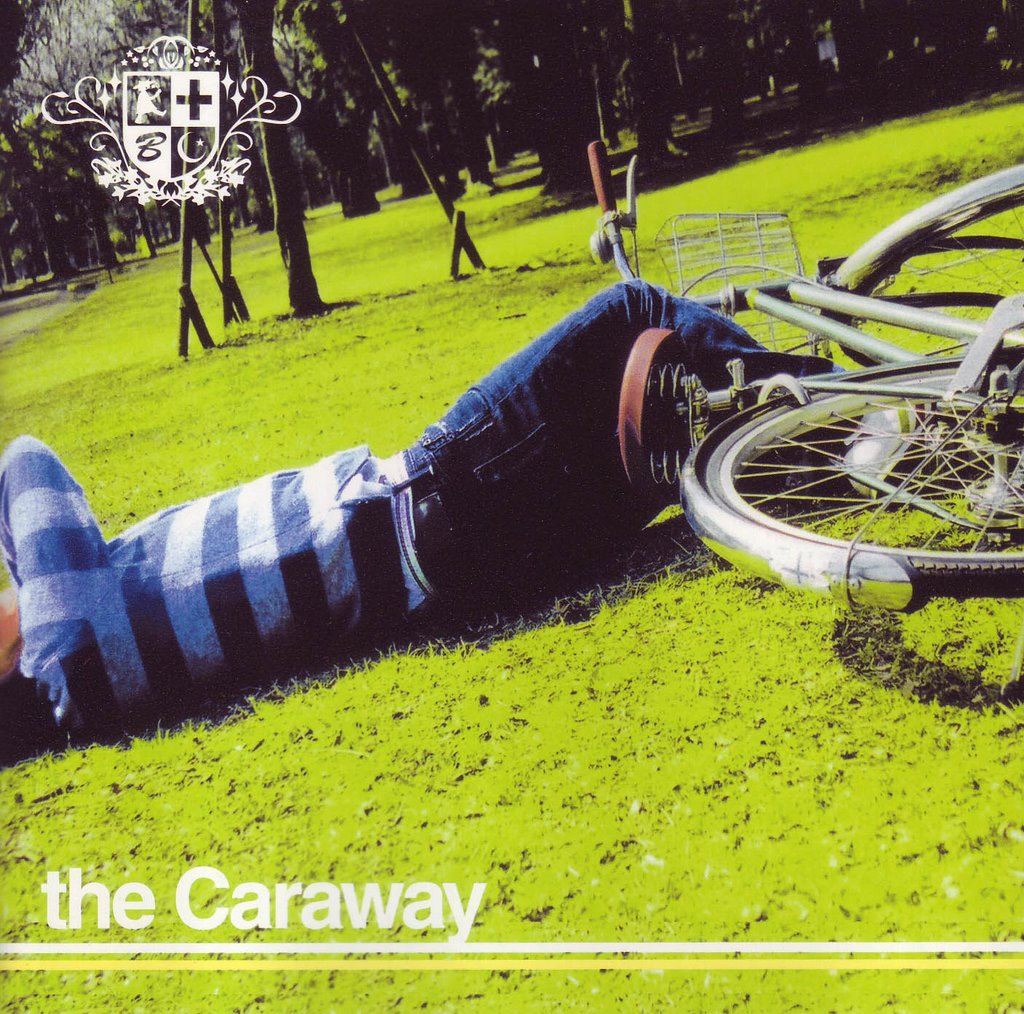
The other nice album is the self-titled debut CD of the Caraway, the trio led by Swinging Popsicle guitarist Osamu Shimada. Shimada is a connoisseur of American and European indie pop and rock, but his biggest love is the Beach Boys, which he says he listens to every day. And, indeed, this album from perennially overcast Tokyo is California sunny in sound, every tune joyful (Shimada plays for several bands, but he always seems to be having the most fun when performing for the Caraway). Shimada sings in all the songs but one, ‘Dislike You’, in which keyboardist Miyuki Yoshida does lead vocals, and it’s a good change of pace. Shimada says the band will be featuring her singing more in the future, something that will make their sound richer.

I’m listed in the ‘thanks’ list of this album, by the way, partly because, for reasons I won’t get into, I provided the band with a childhood photo of myself…

*Guitar Pop is a hard-to-define musical genre that I haven’t seen mentioned much outside of Japan. Think the Cardigans and Smiths.

Friday, August 11, 2006

Japan Live Radio Updated: Mellow

Japan Live Radio has been updated, this time featuring lots of mellow songs by artists such as Kuki Kodan, Nikaido Kazumi (thanks for the recommendation David!), Cibo Matto (thanks for the recommendation Justin!) and Frenesi (though I also managed to fit in the garage rock of Supersnazz, the Clicks and Teeny Frahoop...).

One thing to note: although I describe the station as 'the best of Japanese indies music', I also play music from Korea, Hong Kong and elsewhere from time to time, and feature major label music that I like. I note this because this time I included Aoi Teshima's 'Teruu No Uta', a big hit from the animation movie Gedo Senki's soundtrack. There's nothing remotely 'independent' about the producers of this song, but it fits the mellow theme well, and the 19-year-old Teshima's vocals are fragile and lovely, like a song heard from faraway in a grand open space like the Mongolian steppe.

By the way, for reasons I'm not aware of, the number of people listening to the radio has shot up in the past few weeks. I'm talking a three-fold rise... A lot of the listeners are from Japan and big groups of them seem to tune in at the same time. I'm wondering whether there's something wrong with Live 365's listener tracking system, but then again, maybe it's something more interesting, like a class full of schoolkids with computers all listening to the radio at once, for example...