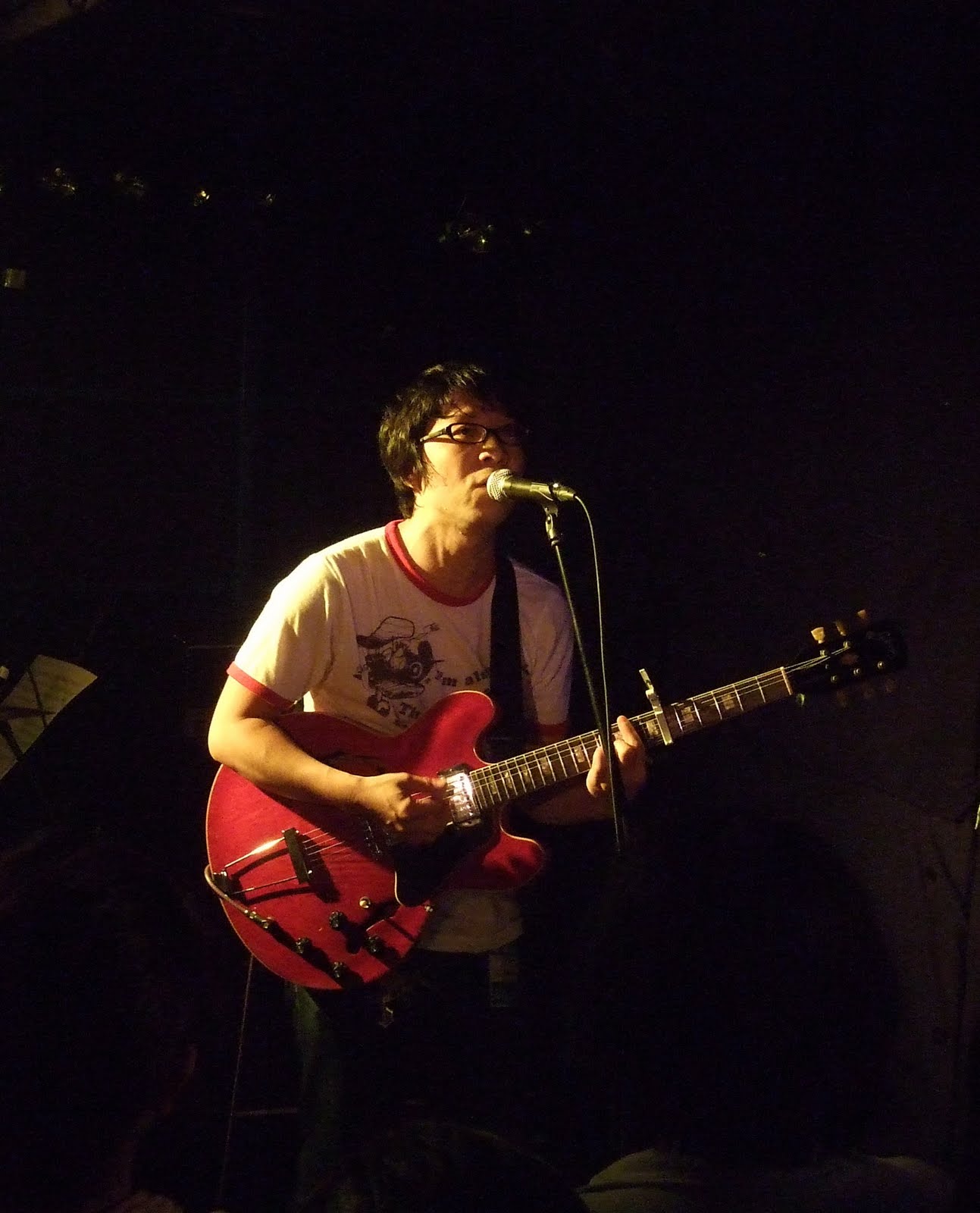
Before I started this blog, before the 21st century even began, I used to go to music shows in Tokyo in the late 90's, and one of the bands I liked was called Qypthone. A late-comer to the Shibuya-kei scene, they started out playing hyper tech music, then turned more mellow and jazzy, released a few good albums, then fizzled out. ...well, not completely.
Takeshi Nakatsuka
I was aware they still performed from time to time as solo acts. I found out they were playing at the Batica in Ebisu, so I decided to check it out. The show was led by Takeshi Nakatsuka, who was the leader of Qypthone. He did an energetic, fusion-music set. The next act was videobrother, a lively brass band. Izumi Ookawara, the statuesque songstress of Qypthone, was the last act.
They all still looked like they used to, but it's strange--somewhere along the way, two decades had passed. We hardly even stopped to think time was passing. The year 1998 seemed so recent, but that world is gone. Back then they were young, and they seemed to want to create something new, via a musical explosion. Maybe that's still there, but they've added something mature and understanding. I liked it. The air in the small performance space was perfumed with a pleasant scent. I didn't know whether it a woman's perfume, or they lit incense in the club.
Hi, it's been a while. I haven't been going to as many shows as before, but a friend tipped me off to a gig I couldn't miss--they're keeping the guest musicians secret because if it got out, the crowd may overwhelm the live house. That piqued my curiosity.
There were two surprises: first, Bridge, a neo-acoustic band popular in the early 90's, reunited and did a few songs for the first time in more than 20 years. The six-member group includes Hideki Kaji, now a popular solo act, and Mayuki Ikemizu, who performs as Three Berry Icecream.
Bridge
Second surprise: during the extended final set of a post-rock band called Penny Arcade (they themselves were back to doing shows after a 28-year hiatus, apparently), the vocalist said she would now like to invite a friend of hers to play guitar, a busy friend--and the guy who walked on stage was Keigo Oyamada, aka Cornelius, one of the superstars of Shibuya-kei. The audience ooh-ed and aah-ed, as they did at the start of Bridge's set, when the vocalist said, "Good evening, we're Bridge."
This was a reunion of the Trattoria label, which Oyamada once ran.
Cornelius on the left
These bands, and the other two groups, Philips and Debonair, were all active 20 or 30 years ago, when they were young, in their 20's. Now they were mothers and fathers, people with regular jobs. You could see that those three decades had marked them; many of the members, if you saw them on the street, you wouldn't imagine them to have once been rock stars.
But that made the show even more touching in a way. I've been watching bands in Tokyo for more than a dozen years now. I've seen the musicians come and go. Even the great ones have disappeared. And here we have Bridge, Penny Arcade and the others, who were active when Japan was in a bubble a few decades ago, and people worried it would take over the world, and they decided to play again.
Yoko Satori, the vocalist of Penny Arcade, said the idea of a reunion came up a few years ago over hot pot. There was sometimes rust in their performance, but overall they were great. These were serious musicians, who once became popular, and time passed and they still kept music close by in their lives.
I've been to a few dozen rock clubs in Tokyo, but there are still places I've never heard of, and Billy's Bar Gold Star in Shimoigusa was one of those. In fact, I'd never been to Shimoigusa, a commuter town on the Seibu Shinjuku line, one of those stops in between the rural quietness of western Tokyo and the manic sleepless energy of a place like Shinjuku. Gold Star was a small, rectangular place with a bar at the back and a ground level stage by the door so that if you enter while a show is going on, hello!, you're part of the show.
I was there to see Soul Train from Seoul (...no, not Seoul Train...), a band of friends of friends. They played energetic soul and R&B, and was one of those bands you find in a random, tiny bar whose musicians are so good you wonder what their story is--did the kids go to music school, were they child prodigies...? The solos including the trombone and sax were inspired.
Korea is so close to Japan that in spite of the historical issues there's a lot of interest in each other and back and forth, and I think it's getting much more common for Korean musicians to play in Japan and vice versa. It's a good thing--an easy way to get over stereotypes is to meet and talk to the object of those stereotypes. A friend from Seoul I met the night of the show has been to Tokyo many times and he hits the record shops during his visits, unearthing rare vinyl LPs to add to his collection back home.
Kounotori, which means 'stork' in Japanese (as in the baby-carrying bird...not very poetic in English), is an Osaka-based pop band, They just released their first album, Arawarerumono, Kieteyukumono(things that appear, things that disappear), and they played at Mona Records in Shimokitazawa to celebrate the release.
The members are friends of mine so I'm biased, but listening to them reminded me of the unique pleasure of discovering great new music by people who are writing songs for the love of it. That's what this blog has always been about.
Sweet-voiced vocalist Kazuhiro Takamatsu, who writes the songs, says he was influenced by Sunny Day Service and Kenji Ozawa and now listens to samba. The pianist Nao Orino and drummer Kiyoshi Tsurumaki are jazz musicians when not playing with Kounotori, and they give the music a nice swing. Bassist Minsung Kang, formerly of Seoul's Linus' Blanket, helps run indie label Lepus Records, which sells Kounotori's CDs. Mayumi Hozaki is usually on the flute, but she came down with the flu, so the show instead featured Mayumi Ikemizu of Three Berry Icecream on accordion and vocals, and Keiko Tanaka of Little Lounge Little Twinkle on viola.
Here they are at another show, playing a song I really like called "London Road".
But I haven't been going to as many shows. I'm less willing that in the past to spend hours at night trying out the music of new bands I've never listened to before.
There was no worry of disappointment at last night's show at the Shindaita Fever--the program was like a list of my favorite Japanese bands: advantage Lucy, Contrary Parade, Risette and Swinging Popsicle.
***
Lucy was playing their first Tokyo show in two years. Vocalist Aiko gave birth last year, and had been focused on bringing up the boy.
Now, they were back, and it didn't feel like all that time had elapsed. Advantage Lucy is still such a good band on stage, creating together that distinct sound, and standing at the center Aiko closes her eyes and weaves her body as she breathes in the music.
They did an old song called 'Memai' (above is a video of a past performance of the tune). Meaning something like 'dizziness', it's a sweet love song about a girl feeling dizzy when she hears the low, kind voice (hikuku yasashii koe) of her guy (but then the lyrics imply that they split up and are meeting again, though I'm not sure--maybe I'll ask one day... By the way, a lot of the words in the song are hard to translate, like 'memai' as dizziness, but I don't think it's meant to be the sort of dizzy that incapacitates you. Or, there's a line, 'futari no kisetsu ga modoreba to omotta watashi wa zurui' which I would translate to something like, 'is it wrong for me to wish that we would once again have a season together,' but that word 'zurui' is strange. It usually means sly, or cunning, or dishonest, but I think in this case a Japanese would hear it as meaning more, maybe something like, being selfish to the verge of being wrong, but it can' t be helped because of the emotions. End of digression...)
It was touching to hear this song now because, well, the singer and guitarist of this band are married now and have a child, but, making the assumption that the song's words at least partly reflect lyricist Aiko's feelings, does it mean that there's still that low, kind voice that can make her pleasantly dizzy?
***
There's also the matter that many of us in the audience grew up listening to Lucy songs like 'Memai', so they've now been weaved into our memories, things that happened, places where we spent time.
Mayu Tanaka, a keyboardist-vocalist who has a one-girl unit called Contrary Parade (it used to be a band with three members, I think, but it shrank), listened to 'Memai' in school too, and she said she once wrote a song imitating it. The music is passed on...
When DJ Kamaage and I got into the Que for the Vasallo Crab 75 event "So Many Colours" after a couple of beers at the nearby Shimo-Kitazawa stand-up sake joint Yocchan, the first band was already playing, and at first I didn't recognize who they were. The singer looked different in one of those mini-beards that are ubiquitous these days, but then, gradually, I realized it was Condor 44, the 90's alternative-inspired trio I've seen from time to time for the last decade.
The singer said they were excited about the event so went into a rehearsal studio in the morning to practice one last time, but, because they were getting older, now in the evening they were tired out during the actual performance. A standard gag. But at the same time, it's pretty Japanese to follow the script diligently in terms of age roles, I'm not entirely sure why, probably a lot of it is Confucianism, but maybe there are other cultural things going on too.
The second band was called Frisco, a fabulous rocksteady outfit with a horn section and a pedal steel guitar guy, among others. It's amazing that there's a great rocksteady group playing in Shimo-Kitazawa, Tokyo, Japan, on the other side of the world from Jamaica. They've been around a long time too. The singer said when they did their first show at the Garage, they were so bad the club's manager said please don't come back again. A long way from there...
And Vasallo Crab 75 closed their event. I think I've been to a few of their So Many Colours, but I didn't pay that much attention to event names in the past, because I didn't know how much thought and emotion went into them. This one was started by the late Takayuki Fukumura, and they've been doing it for about ten years, and VC75 vocalist Daisuke Kudo told me that he'd lost count of how many they'd put on--fifteen, sixteen? In the meantime, their music has evolved from bedroom-recorded indie pop to a jazzy, funky, show-off, rocking pop. I've run out of ways to praise them--scroll back and read my past ovations if you please, in this journal that's also almost ten years old now, wow... seeing them just feels now like going to a favorite restaurant that never seems to get bad, run by a chef that never seems to turn old.
Happy New Year. It's taken me this long to find the time to
write about a show on Nov. 25.
It was the ninth Munekyun Arpeggio, an annual event to remember the life of
Takayuki Fukumura, the former guitarist for advantage Lucy and Vasallo Crab 75.
I thought about birth at this show that came into being because of Fukumura's
death.
New sounds were being born. The first band was Bertoia, led
by a girl who calls herself Murmur. She'd been an advantage Lucy fan since high
school, when she went to see the band in Osaka with her mom. Now she has her
own shoegazer group, playing for a packed audience at the Que.
Up until I stepped into the club and heard Bertoia's first
note, I was feeling a mental chill--maybe going to this gig was like trying to
relive something that had already passed me by. But then the first chord
sounded, and the warmth returned.
I'd seen Murmur on stage before, but I saw that she and her
band had grown as performers. Once shy and appearing almost afraid, she now
looked at the audience, so that she could better tell her story of music. And
when I listened later to their album Modern Synthesis that I bought that night
at the club, I remembered what they created on stage--emotions melted and
shaped into music.
***
When advantage Lucy came on stage and vocalist Aiko
introduced the band, she said there was one other person there--she was almost
seven months pregnant. Tiring more easily because of the baby, she still sang
beautifully old songs like "When I Sleep" and "Nico" that
she once played together with Fukumura. Almost ten years since his departure, a
new life was being created--it was sweet to think about the old times those
songs evoked and the days that had passed.
The bands made a compilation album for the Munekyun Arpeggio
event, and advantage Lucy contributed a song called "Stars". Aiko
teared up, saying women in her state became emotional easily, while explaining
the song: it's about all those people who are gone, but may be looking over us
from the sky. And if the death of one person hurt so much, what must it have
been like, after the earthquake, when more than 10,000 lives disappeared? That
was the emotion that led to the song's conception.
***
Last up was Vasallo Crab 75, Fukumura's final band, which he
formed with school-buddy Daisuke Kudo.
If Bertoia and Lucy made me think of birth, VC75's music was
about growth: from a duo that home-recorded guitar pop tunes a decade ago, VC75
had evolved and mutated into a funky six-piece ensemble that mashed together
rock, soul, jazz and classical, always energizing the audience. But I felt that
the sensibility hadn't changed, and Fukumura would have enjoyed seeing what the
band had become.
Walking Kyoto's mundane Japanese city streets, a temple or an old house emerges that gives a glimpse of a thousand years of history. Sitting pondering a sea of stone at Daitoku-temple, listening to the wind and cicadas, I lose track of time. The people walk more slowly, savoring their conversations, stretching out the vowels at the end of sentences.
I was in Kyoto see Yuyake Lamp play at Kibune Shrine up in the hills north of the city. Kibune means something like 'holy boat'--the tale is that a goddess took a boat up a river and left it in the shrine grounds. It's a shrine of engagement, marriage and birth. Somewhere in the grounds are two trees whose branches have joined together, a symbol of marriage.
Yuyake Lamp played on a wooden Noh stage overlooking a creek. Wearing yukata, they performed for an hour with keyboard, flute and cajon. The river's rustle below and the ringing cicadas were a harmony to their songs.
It felt like a while since I was last in Shimokitazawa.
Walking down the stair of the south exit, for the how-many-hundredth-time?, I went down the main street, past the cafe smelling of overheated coffee. Coming up were girls, and some guys, in yukata, headed for the Sumida-gawa fireworks festival. Did this street always have this many chains? My memory is uncertain, but two decades ago when I first visited, it seemed this town was all mom & pop shops.
It was a long time too since I'd been to the 251. My friends' bands had grown up, so they mostly play now upstairs at 440, the mellow cafe.
I used to go to the 251 a lot around 1999, when shows were a salad bar of melodic punk and Shibuya-kei pop groups. There was a night when Qypthone (Shibuya-kei) and House Plan (punk) were on the same bill, and Chinese-Japanese model Hana, a friend of Qypthone, was in the audience (both bands are now M.I.A.). Wearing an orange windbreaker, immediately recognizable at the time, Hana stood shyly in the corner. I found out later on TV that her hobby was to look at Buddhist sculpture--her term was she was 'meeting' the statues--and she teared up when she saw them.
There were tables and chairs at the club tonight, and family from a white-haired grandma to a little girl in a red T-shirt sat to watch their bands. Something was missing for me with the opening bands, a lack of originality and/or Japanese-ness, but then when Vasallo Crab 75 came on, exploding rock, funk and pop, all the ice that was there despite the summer melted.
I've drifted from the music scene for a bit, for various reasons, going to only a few shows and not having any idea what events are coming up at the Que, the O-Nest and all the usual haunts. It's a situation I hope to change.
In the meantime, events like Guitar Pop Restaurant help me keep in touch with the good bands out there. Organized by a guy named Nakamura Kazumi, who as far as I can tell isn't a musician himself and is involved in this venture solely for the satisfaction of bringing together on stage bands he likes, the event has been held ten times now, which is an accomplishment. I remember seeing after one of the first shows a veteran musician scolding him about some problem with the event--he's come a long way.
Volume 10 was held at the small Shibuya Home, made more cramped by the chairs laid out at the front of the hall, and it was stuffy until the air-con kicked in. It was another eclectic Guitar Pop Restaurant pick of bands--advantage Lucy-inspired Humming Parlour; saccharine-sweet songstress Marino with her excellent backing jazz ensemble, the Teapot Orchestra; Ruby Chouette, a whispering pop singer getting her inspiration from Shibuya-kei; and a collaboration of Mayumi Ikemizu's Three Berry Icecream (photo above) and Hozaki Mayumi and Lepus from Osaka--friends of mine who make mellow, creative music with flute, viola, xylophone, piano, in addition to guitars and drums.
***
I changed the weblog layout. I liked the one before, but it was getting old, plus the comment service I used suddenly changed its system so that all my old comments appeared to be lost and the new ones were presented in an unsightly, expanded dialogue box, so I decided to ditch it and try a new layout. Maybe I'll change this one too, though I'm usually lackadaisical about that sort of thing...
Went to see Love and Hates, the indie breakbeat duo that includes Yuppa of Hazel Nuts Chocolate. The event started at 5 and went until around 10 at the Shinjuku Marz, though I only made it about half way into it, catching the Suzan, a New York-based girl rock band, beatboxer Afra, and Luvraw & BTB, a smooth funk/soul/city pop group from Yokohama featuring not one, but two vocoder players.
Luvraw & BTB
The two LAH girls ascended the stage wearing striped leotards and paper crowns, and danced, rapped and blew various whistles over DJ samples. They reminded me of whacky, hyper Japanese acts from the 80's and 90's, except that while the latter bands were seeking the Cool of their New Wave and punk influences, LAH's more going for Cute (the name of Hazel Nuts Chocolate's second album). Yuppa kept on talking about things being 'suteki'--meaning 'lovely' or 'wonderful'.
For fans of HNC's first two albums, Bewitched and Cute, those collections of darling, children's books in the form of songs (with titles like "Yuppa Goes to Space" and "Honey Lip Tarte Tatin"), the Yuppa unit's current direction might not necessarily satisfy. It's more Club than Cafe. You see a similar thing with Capsule, who once created lovely Shibuya-kei songs about things like spending the weekend in one's favorite room, but has turned itself into a unit heavily influenced by Daft Punk, composing electronic music ballads about life and death. Capsule's latest manifestation is growing on me--I'm crazy about songs like "Pleasure Ground"--but I wonder whether anyone's going to pick up where HNC and Capsule left off and make more songs about fashion and sweets and city living and innocent childlike fun etc.
A band called Plectrum turned fifteen and held their birthday gig. I used to feature them a lot, this power pop group that worships Teenage Fanclub, when I started writing Japan Live seven years ago (suddenly it's half their age!). But I haven't kept up the coverage, partly because Plectrum hasn't played as much, but also because I haven't been to all their shows. Sometimes you need reminders that there really was something there.
Plectrum reminded me. Of that feeling when musicians are able to pull you and the crowd into the songs, making you forget everything else.
Plectrum has a song called '30 Boy', written when singer Taisuke Takata was 30, and he said on stage he's about to become a '40 boy' but he wants to continue at it, heartened by predecessors like Mick Jagger sempai and Keith Richards sempai. The way he sang '30 Boy' that night... it had the weight of all those years and feelings.
There's a line in '30 Boy' that says 'I'm still not used to Tokyo/ but I don't mind how I'm left alone (mada Tokyo ni naretawakejanai/ demo hottokareruno wa iyajanai)', and it came alive when Takata sang it. He's a rocker born down south in Saga prefecture, and he's one of the many people from other places who gather in Tokyo, where things happen because so many people are together. For example, shows like Plectrum's, somewhere every night in this city, that open your eyes and make you feel you're living.
Advantage Lucy played at the Yoyogi Zher The Zoo after a six month absence from the live stage, and since they were opening for the Waffles, a band that vocalist Aiko said sings such sweet tunes, they also chose their sweetest numbers, including 'Sakuranbo', 'Kaze ni Azukete' and 'Memai' (and, fellow advantage Lucy fans, I'm sure you could appreciate what a delectable offering that was...).
The highlight for me was 'Hibikasete', that winter song, sung so beautifully it felt like the air around me shone. The last song on the mini-album Oolt Cloud,Aiko said its image was of winter in Hokkaido, icicles hanging. 'Hibiku' means to echo, reverberate, or just sound, so 'Hibikasete' could mean 'make (your voice) reverberate', in my imagination in a winter night in the north, the ground glowing white with snow, icicles on eaves.
The Waffles were celebrating a pre-10th year anniversary (it's next year), and they played a few nice songs from an album to be released in January called Tenpo, as well as oldies. What I liked was that from where I stood I could see a few fans in the front mouthing the lyrics to the old songs--these were a part of their lives. Toward the end they performed one of their best songs, 'Tsugi no Hikari', which means 'the next light'. I think it's about hopes of understanding another person (a lover) in spite of the obstacles of time and changes. The Waffles have been at it for nine years now, and many of their fans must have followed them all that time (I'm basically one of those). Wonder if they, we, have discovered the next light?
For the encore, the Waffles invited advantage Lucy back on stage, saying they are huge fans, and they did Lucy's 'Goodbye'--that classic--with the Waffles' Kyoko Ono singing the first part and Aiko taking over on the next. If you like both Lucy and the Waffles, you can imagine what a treat it was to listen to those two gorgeous voices singing together that brilliant tune. During the first verse, Aiko mouthed the words away from the mike. It was sweet to see.
Once in a while there's a show that reminds me why I became so crazy about guitar pop around 2003, almost a decade ago now, when I sometimes went to several events in a week. This time it was Caraway, themselves playing for the first time in three years as a band. They're led by Swinging Popsicle's Osamu Shimada, the Beach Boys-loving guitarist that reminds me a little bit of Buddy Holly because of his spectacles and wholesome looks. Off stage, he is down to earth and polite, with just a hint of a charming mischievousness. On stage he's different, giving it his all, connecting with the crowd with his sound and humor.
The event was Guitar Shop Restaurant at the Nishi-Ogikubo Waver, and the flier for it featured a girl in a white dress, floating in the clouds holding a bunny and a kitten. Over drinks one night before the show, my friend DJ Kamaage and I chatted about this picture, which maybe reflected how a younger generation thought of guitar pop, but didn't feel right to us. Guitar pop isn't just sweet and gentle music. Some of us fans think it's a successor to the original punk rock, trying new things, with a Do It Yourself attitude. Or, as twee.net says,"Pop Kids everywhere know that the true spirit of Punk Rock lives on not in the mass-marketed "alternative" scene, or the sub-metal caterwauling of testosterone-poisoned grunge-rockers, but in the simple and pure efforts of kids banging out sweet delicious songs on cheap guitars. "
A certain feeling of being on edge can be seen in the live shows of bands like Caraway. In a different way, another group on the set that night, Three Berry Icecream, shows the true guitar pop spirit, creating beautiful, short tunes with accordion, viola, xylophone, just because those are the instruments that band leader Mayumi Ikemizu wants to use to create sounds.
This was a 'sold out' event, at a tiny venue I'd never been to before. Fortunately, and unusually for a Tokyo show, the audience could exit and re-enter the venue freely, which was good, because the place was packed. There's a relationship between how much you love a show and how much discomfort you are willing to put up with, and these days in my case the love really has to be there to stay at an uncomfortable event, whereas Tokyo audiences seem to be able to put up better with the lack of space, or maybe they just love the music more. Or, I might just be turning into an old grouch. It was good, though, to be able to go outside and walk around in Nishi-Ogikubo at night, a dense neighborhood of eateries and bars, including a huge yakitori joint called Ebisu that occupied multiple storefronts in one block.
The Kurawood in Asakusa is such a nice live house, with a friendly vibe. I recommend it highly for any music-loving visitor to Tokyo, since you won't want to miss Asakusa in any case (and for that matter, anyone who lives in Tokyo should go too).
Kurawood's bar sells, in addition to the usual beer and cocktails, several types of shochu, sake, Denki Bran--'electric brandy'--that specialty of Kamiya Bar in Asakusa, a liquor that tastes like sugar and herbs dunked into brandy, and bar food, including oden for 300 yen, which is a good deal.
Hung from the ceiling of the stage area are paper lanterns that darken when shows start. They're inscribed with the characters for Sanjya festival, a big annual event in Asakusa.
I headed to Kurawood from Asakusa station, and the evening was autumnal, with a cool breeze swinging the branches of a willow tree next to an old restaurant with a black-tiled roof. The night's show was organized by Asakusa Jinta, so I knew it would be good.
The first group I saw was called OldFashion, an energetic, swinging outfit with three sax players, a wood bass, two guitars and a drummer. Nattily dressed in jackets and ties, OldFashion was one of those groups that was inspired by old jazz and pop. They reminded me a bit of Ego-Wrappin and Crazy Ken Band, and I liked them a lot.
Next up was a funny band led by the 'Mick Jagger of Adachi ward', and these guys really learned their stage show from Rolling Stones 101, complete with a lead guitar with Keith Richards mannerisms.
Then Asakusa Jinta came on, and the floor erupted into joyful dancing. An especially excited kid turned around and apologized when he bumped into me, and I felt bad because his hops and swinging dance and arm pumps were what I felt too, inside. Though by about the middle of the show, the music was so powerful, I jettisoned my inhibitions and joined him and the other fans in dancing.
One of the things that makes Asakusa Jinta great is that they've made music that sounds both retro and new, mixing western and Japanese styles. Others have tried this too, but I don't think as successfully. And they're master performers, fun and engaging to watch. It's a stupid miracle that you can still see these guys right up close at a little place like the Kurawood.